
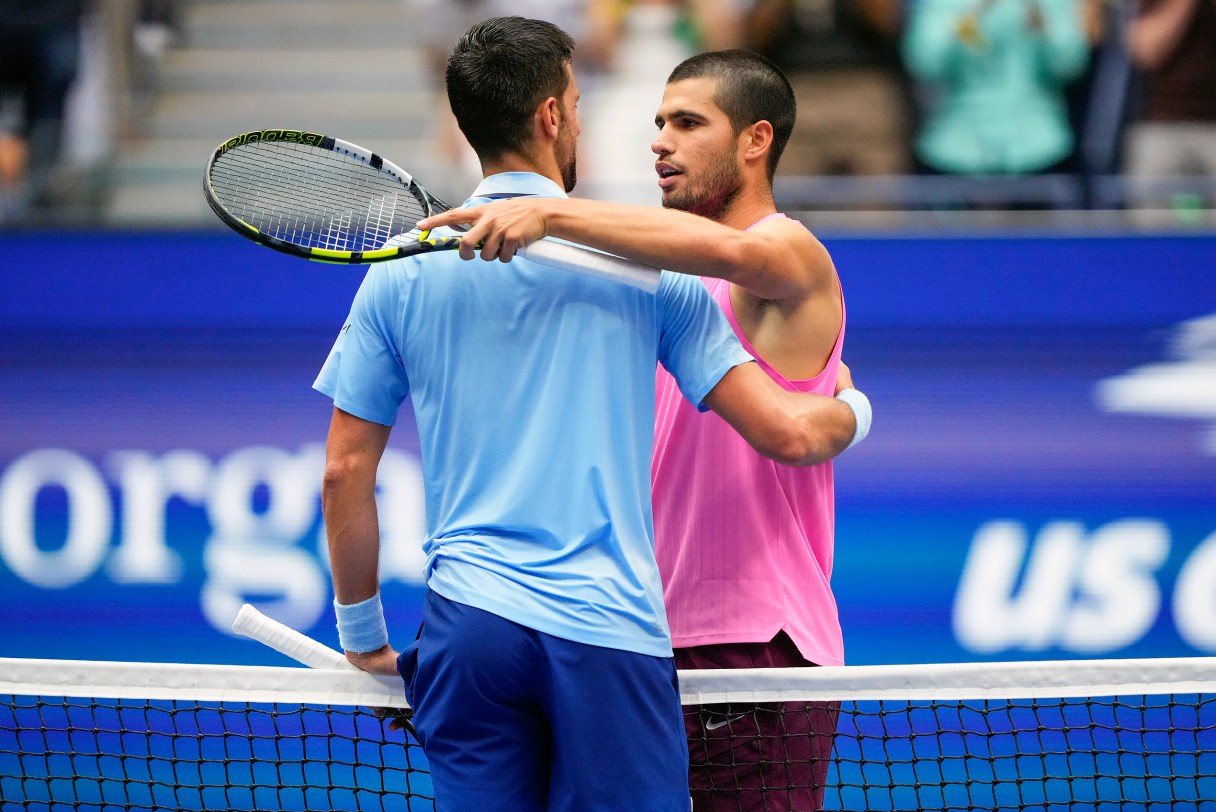
NEW YORK — Carlos Alcaraz was about to start a series of TV interviews to discuss the way he used his youth, athleticism and creativity to beat the much more accomplished (but also much older) Novak Djokovic 6-4, 7-6 (4), 6-2 in the U.S. Open men’s singles semifinals Friday.
First, though, Alcaraz asked everyone to hold on for a moment. He pulled his cellphone out of a pocket so he could check the score of Jannik Sinner’s semifinal against Felix Auger-Aliassime. It was still only the first set of that match, but you’ve got to keep tabs on your biggest rival, right?
A few hours later, Sinner would finish off his 6-1, 3-6, 6-3, 6-4 victory over Auger-Aliassime, establishing the Flushing Meadows final that somehow seemed inevitable, even if unprecedented: No. 1 Sinner and No. 2 Alcaraz will meet Sunday to decide the champion, marking the first time the same two men have played each other in three consecutive Grand Slam singles finals within one season.
Alcaraz defeated Sinner on clay at the French Open in June; Sinner defeated Alcaraz on grass at Wimbledon in July.
“These two players,” said Djokovic, a 24-time major champion, “are the best in the world right now.”
No doubt about that. They have established themselves as far and away the elite men in tennis.
No matter Sunday’s result, it will mark the eighth straight major in which one member of the young star duo has won a championship, and combined they have also taken 10 of the past 13. Their career totals: Alcaraz owns five major titles, while Sinner has four.
And the No. 1 ranking on the ATP Tour will be on the line Sunday, when U.S. President Donald Trump plans to attend.
“It’s great for the sport having rivalries, having hopefully great matches in front of us,” Sinner said. “I’m someone who loves these challenges, and I love to put myself in these positions and to see how it goes.”
Sinner is trying to become the first repeat men’s champion in New York since Roger Federer won the hard-court tournament five years in a row from 2004-08. The 24-year-old Italian also has made it to five straight Grand Slam finals, a stretch that started at the U.S. Open 12 months ago.
Alcaraz hasn’t dropped a set as the 22-year-old Spaniard pursues his sixth major title and second at Flushing Meadows.
Go back to April, and Alcaraz is 44-2, making it to the finals at each of his past eight tour-level events.
“It’s something that I’m working on, just the consistency on the matches, on the tournaments, on the year, in general. Just not having up-and-downs in (a) match,” Alcaraz said. “Probably, I’m just getting mature, just getting to know myself much better, what I need on, off the court.”
Since the start of 2024, Sinner is 1-6 against Alcaraz — and 109-4 against anyone else.
“We have played quite a lot this year,” Sinner said. “So we know each other very well.”
Alcaraz had lost his two most recent matches against Djokovic — the gold-medal final at the Paris Olympics last year and an Australian Open quarterfinal inJanuary — going into Friday’s showdown.
“It’s not easy playing against him, to be honest,” Alcaraz said. “I’m thinking about the legend, what he has achieved in his career. It’s difficult not to think about it.”
But by the end, the seventh-seeded Djokovic was “gassed out,” as he described it afterward, and seemed resigned to the result. The 38-year-old from Serbia reached the semifinals at all four Slams this season but exited in that round each time, three via losses to Alcaraz or Sinner.
“It’s frustrating on the court when you are not able to keep up with that level physically, but at the same time, it’s something also expected, I guess,” Djokovic said. “It comes with time and with age.”
His bid to become the first player in tennis history with 25 major titles in singles competition was blocked again, and he thinks part of the problem is trying to overcome much younger men in best-of-five matches.
“I still want to play … (a) full Grand Slam season next year,” Djokovic said. “Let’s see whether that’s going to happen or not, but … Slams are Slams. They are just different from any other tournament. They are the pillars of our sport, the most important tournaments we have. But I do fancy my chances a bit more in best-of-three.”
He led Alcaraz 3-0 in the second set but couldn’t sustain that level.
“Today, I’d say, it wasn’t the best level of the tournament for me,” said Alcaraz, whose 30 unforced errors were the same as Djokovic’s total, “but I just kept a cool level (from) the beginning until the last point.”
He was wearing a sleeveless pink shirt and sporting nearly a full head of hair less than two weeks after showing up with a buzz cut he said was necessary when his brother tried to play barber but messed up.
Asked whether he’ll stick with the new look if he wins Sunday, Alcaraz smiled and replied: “Even better. You will see. … Surprise, surprise.”
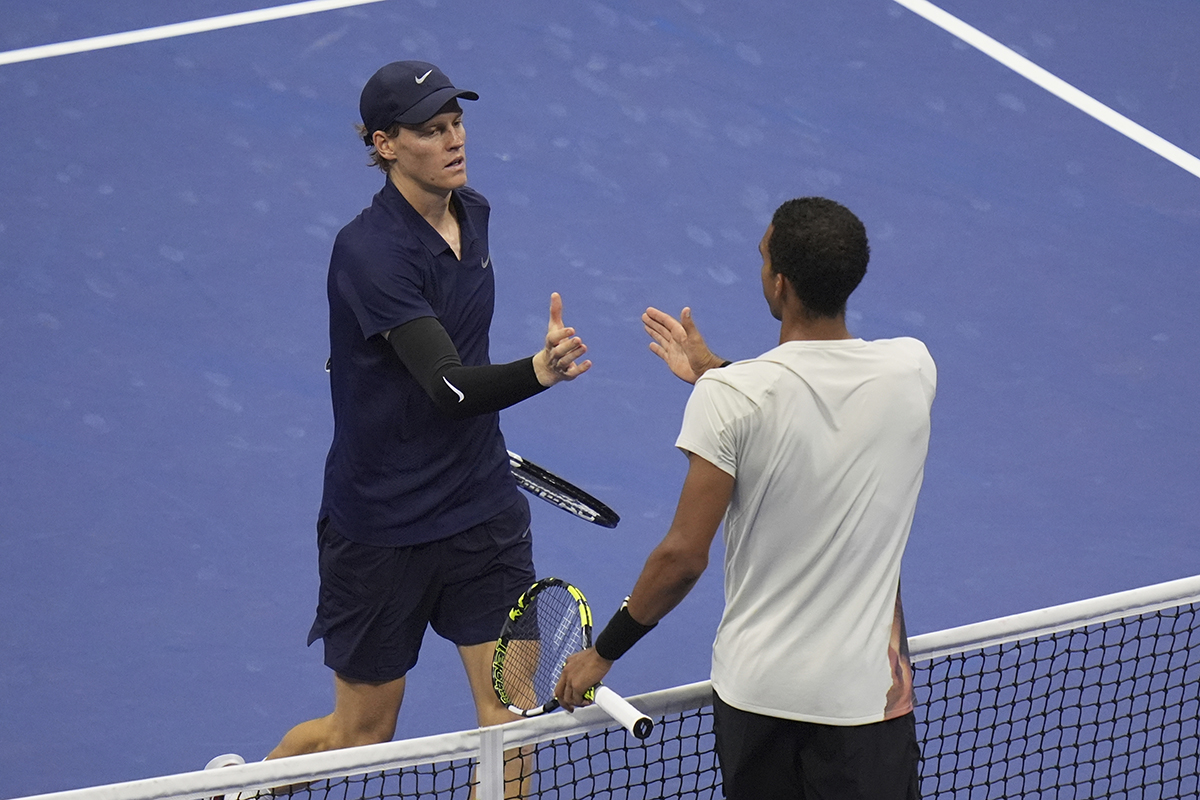
Sinner took a medical timeout because of a bothersome abdominal muscle during a mid-match lull before retaking control against the 25th-seeded Auger-Aliassime, a 25-year-old Canadian bidding for what would have been his first appearance in a Grand Slam final.
Sinner’s run of five consecutive major finals began when he beat Taylor Fritz in Flushing Meadows 12 months ago and Alexander Zverev at the Australian Open in January before the loss to Alcaraz in Paris and the win against him in London.
“Amazing season,” Sinner said.
In this semifinal, Sinner was terrific in the opening set, then merely so-so in the next, when the abdominal problem limited his ability to serve his best, according to one of his coaches, Simone Vagnozzi.
“Sometimes you’re tired and you can’t let your opponent see that. At a certain point in the second set, his level went down. And naturally, if your opponent sees that, he can take energy from that,” Vagnozzi said. “So you have to be good at masking your emotions and masking the physical issues Jannik had today.”
Sinner’s run of 38 service holds that dated to the third round ended when Auger-Aliassime went up 5-3 in the second by driving a 99 mph inside-out forehand winner for a break that he marked with a loud yell.
That forehand was key for Auger-Aliassime, who had eliminated No. 3 Alexander Zverev, No. 8 Alex de Minaur and No. 15 Andrey Rublev on his way to the semifinals.
When he closed that set with a 117 mph ace, Auger-Aliassime had grabbed 12 of 13 points and the match was all even.
“I was going toe to toe, at times,” he said.
After that set, Sinner left the court for medical attention that Vagnozzi said afterward had made a difference.
Indeed, Sinner looked just fine when he returned from the locker room. So did his play.
“After the treatment, was feeling much, much better,” Sinner said. “At some point I didn’t feel anything anymore. I was serving back to normal pace, so it was all good. Nothing to worry about.”
After managing only three winners, but six unforced errors, in the second set, Sinner was back to being Sinner in the third: 11 winners, four unforced errors. He broke thanks to a stumbling, awkward return of a 124 mph serve that somehow landed in, drawing a netted response from Auger-Aliassime.
More of that came in the fourth, when, after saving five break points early — he saved nine of 10 throughout the evening — Sinner broke to move ahead 3-2. Just 25 minutes later, it was over, and Sinner had earned his 33rd win in his past 34 Grand Slam matches, which includes an unbeaten run of 27 on hard courts.
“He’s been dominating on hard courts,” Auger-Aliassime said, “but, I mean, kind of everywhere.”