
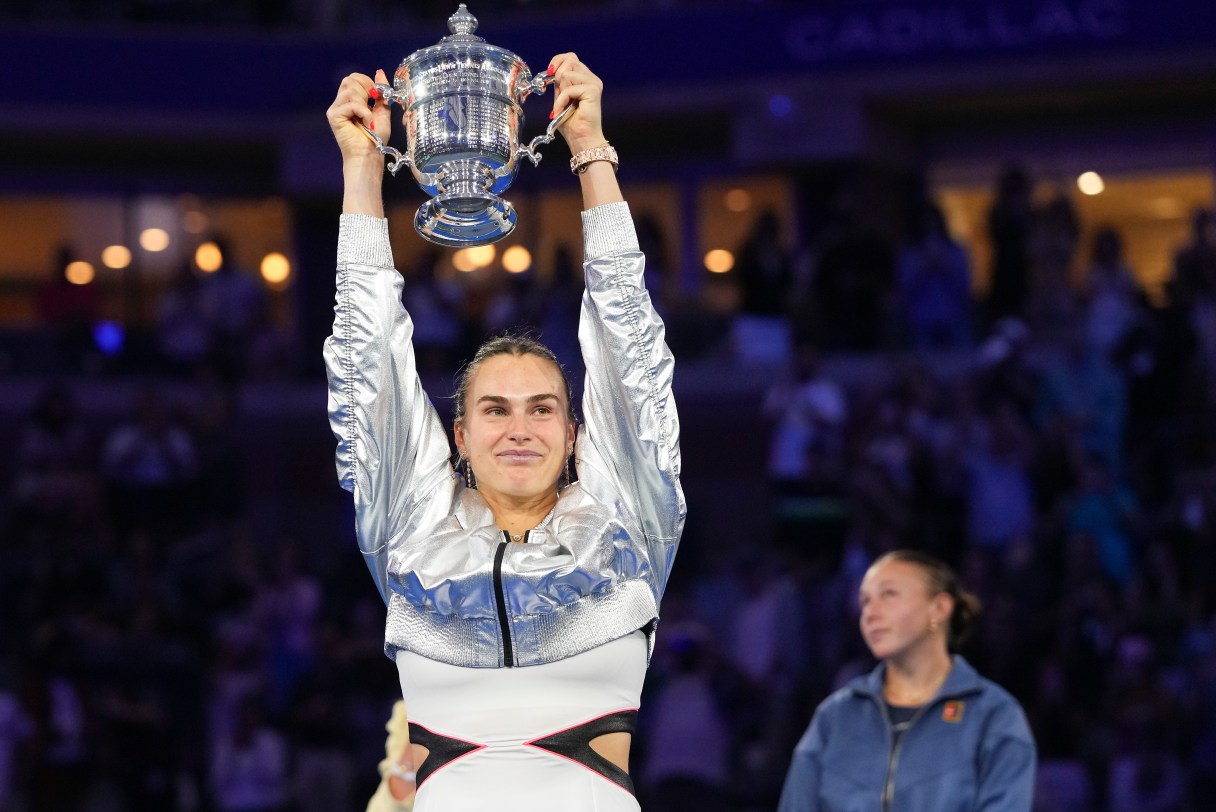
NEW YORK — Aryna Sabalenka was two points away from what eventually would be a second consecutive U.S. Open title when she had what should have been a routine — easy, even — overhead smash.
Instead, while backpedaling, she dumped the ball into the net, giving her opponent, Amanda Anisimova, a break chance.
After that excruciating miss Saturday, Sabalenka dropped her racket on the blue court and smiled a rueful smile. The 27-year-old from Belarus who is No. 1 on the the WTA Tour began to feel the sort of emotions that got the better of her during losses in the finals at the Australian Open in January and the French Open in June bubble up. And so she tried to compose herself.
“I just let the doubt get into my head,” Sabalenka explained later. “But then I turned around and I took a deep breath in, and I was like, ‘OK. It happens. It’s in the past. Let’s focus on the next one.'”
So everything was fine from there? Well, no.
“She broke me,” Sabalenka said with a loud laugh. “I was like, ‘OK. … Reset.”
It took another 15 minutes to complete the job, but the top-seeded Sabalenka did reset, unlike at those earlier Grand Slam title matches in 2025, and was able to kneel on Arthur Ashe Stadium’s court while covering her face with her hands after beating her 24-year-old American opponent 6-3, 7-6 (3). It made Sabalenka the first woman to earn the trophy at Flushing Meadows in consecutive years since Serena Williams won three in a row 2012-14.
“I truly really admire her,” Anisimova, a New Jersey native who heard raucous support from the 24,000 or so spectators, said of Sabelenka. “She puts in a lot of work, and that’s why she’s where she is.”
Sabalenka was the runner-up to American player Madison Keys at the hard-court Australian Open in January and the runner-up to American player Coco Gauff at the clay-court French Open in June. Those defeats helped her Saturday.
“After the Australian Open, I thought that the right way would be just to forget it and move on. But then the same thing happened at the French Open,” said Sabalenka, who showed up at her news conference after Saturday’s match with a bottle of Champagne and a pair of dark goggles atop her head. “So after the French Open, I figured that, OK, maybe it’s time for me to sit back and to look at those finals and to maybe learn something, because I didn’t want it to happen again and again and again.”
As the eighth-seededAnisimova kept making things close again, and the crowd kept getting loud, Sabalenka reminded herself to focus on herself. It worked.
When Anisimova trailed Sabalenka 2-0, 30-love as this match began, some fans might have wondered: There’s no way there’s going to be a repeat of the Wimbledon final, right? That’s because Anisimova’s first major final, on the grass of the All England Club in July, ended with a 6-0, 6-0 shutout loss to Iga Swiatek.
Anisimova grabbed the next four points to break back, though, capping the game with a backhand winner and a forehand winner. That got folks on their feet, shouting, and Anisimova — who beat No. 2 Swiatek in the U.S. Open quarterfinals — exhaled as she walked to the sideline. Soon, she led 3-2.
That was another moment that could have thrown Sabalenka, who was eliminated in the Wimbledon semifinals by Anisimova. Nope. She took the next four games and that set.
And a quarter-hour after that flubbed overhead in the second set, Sabalenka was kneeling on the court and covering her face with both hands, having come through on her third match point — which made perfect sense, because she simply doesn’t lose tiebreakers. She is 21-1 in those this year, having won her past 19.
“Losing in two finals in a row is great, but then it’s also super hard,” said Anisimova, who sat and buried her face in a towel after the match was over. “I think I didn’t fight hard enough for my dreams today.”
Sabalenka, who avoided becoming the first woman to lose three major finals in a single season since Justine Henin in 2006, told Anisimova: “I know how much it hurts losing in the finals, but trust me … you’re going to win (one). … Girl, you’re going to enjoy it even more after these tough losses in the finals.”
It began pouring before the match, so Ashe’s artificial lights were on, and its retractable roof was shut. That appeared to be a distraction at times to Anisimova, who motioned to her team in the stands that something was bothering her during ball tosses for serves.
“There was no way of adjusting, because I could not see the ball when I was serving, and that was a huge shock to my system,” Anisimova said. “Because I knew if I can’t hold my serve, it was going to be very tough to stay in the match.”
The setup also created windless conditions, ideal for two ball-strikers who really can bring the power with good contact. And that’s what they both did from the start, striking speedy serves and deep ground strokes with so much pace that responding was never simple.
Some exchanges were breathtaking — to them, certainly, and to spectators who gasped at the power during longer points. Both are aggressive during back-and-forth exchanges and rarely are risk-averse players. The rewards can be huge, as can the mistakes, and Anisimova was seeking the lines with full cuts off both sides.
Of Sabalenka’s first 13 points, which helped her take the initial two games, just one came via her own winner. The other dozen arrived thanks to Anisimova’s six unforced errors and six forced errors.
By the end, Anisimova had nearly twice as many winners as Sabalenka, 22-13, and nearly twice as many unforced errors, too, 29-15.
“There was two moments where I was really close to lose control,” Sabalenka said later, “but … I told myself, ‘No, it’s not going to happen. It’s absolutely OK.'”
More than OK, as it turned out.