
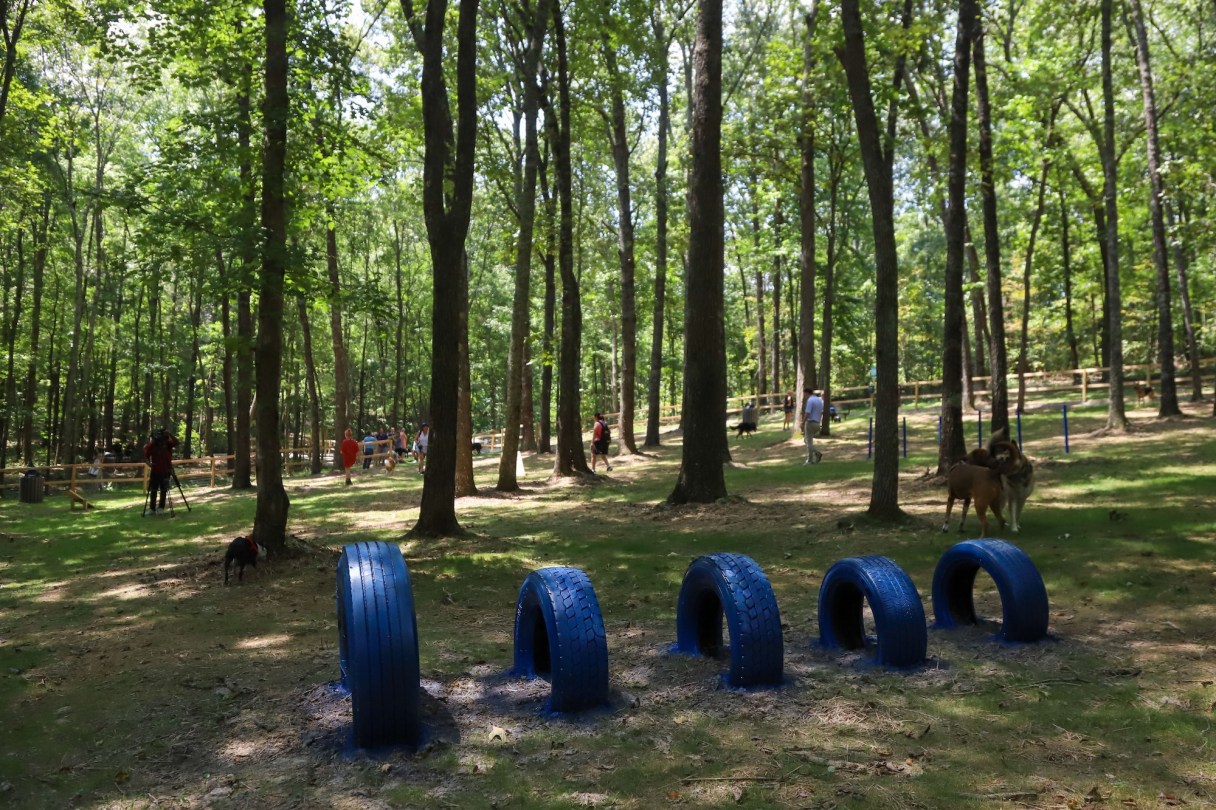
Last week, the Chattanooga Free Times Press first reported the story about a proposed “land swap” supported by Hamilton County Mayor Weston Wamp, Chattanooga City Mayor Tim Kelly and other local, state and federal elected officials that would see Enterprise South Nature Park lose more than 500 acres of protected land to industrial development.
It is being presented as a means of conserving McDonald Farm, which had originally been purchased by the county for industrial development. While the county has decided not to pursue the development for the time being at McDonald Farm, it is important to remember that the properties are completely separate and nearly 30 miles apart. They are being linked by our elected officials to make taking a significant part of Hamilton County’s largest public park — at 2,800 acres — away from its citizens more palatable. We should not be OK with this.
My family and I go to the Enterprise South Nature Park several times a week, and have done so since we moved to Chattanooga over five years ago. Aside from the recreation that the trails and paved roads provide to humans, the wildlife habitat and connection with nature that it provides are priceless. As a conservation professional and land steward with the Oconee River Land Trust, I’ve walked thousands of miles on protected land, and I know valuable habitat when I see it. While the land use is not limited to conservation and is geared more toward recreation, this park still checks all the boxes thanks to thoughtful and responsible management.
My partner and I have circulated an online petition and founded Save Enterprise South Nature Park, a grassroots effort to protect this incredible green space. We recognize that a petition (with 4,200 signatures gathered so far) can only take things so far, and we are actively exploring various avenues of resistance. Our stance is that both Enterprise South Nature Park and McDonald Farm should be protected.
When the city and county accepted ownership of the park (then the third largest in Tennessee) in 2005 as part of the PILOT program (payment in lieu of taxes) that brought Volkswagen to Chattanooga, it came with a restricted deed from the National Park Service and the General Services Administration that limited its use to passive parkland for recreation in perpetuity. The park’s establishment also required no funding from the city or the county. Now the city and county are now more interested in the financial windfall they would get from potentially destroying it. It’s telling that for this “swap” to even work, it would have to be approved by the Department of the Interior.