
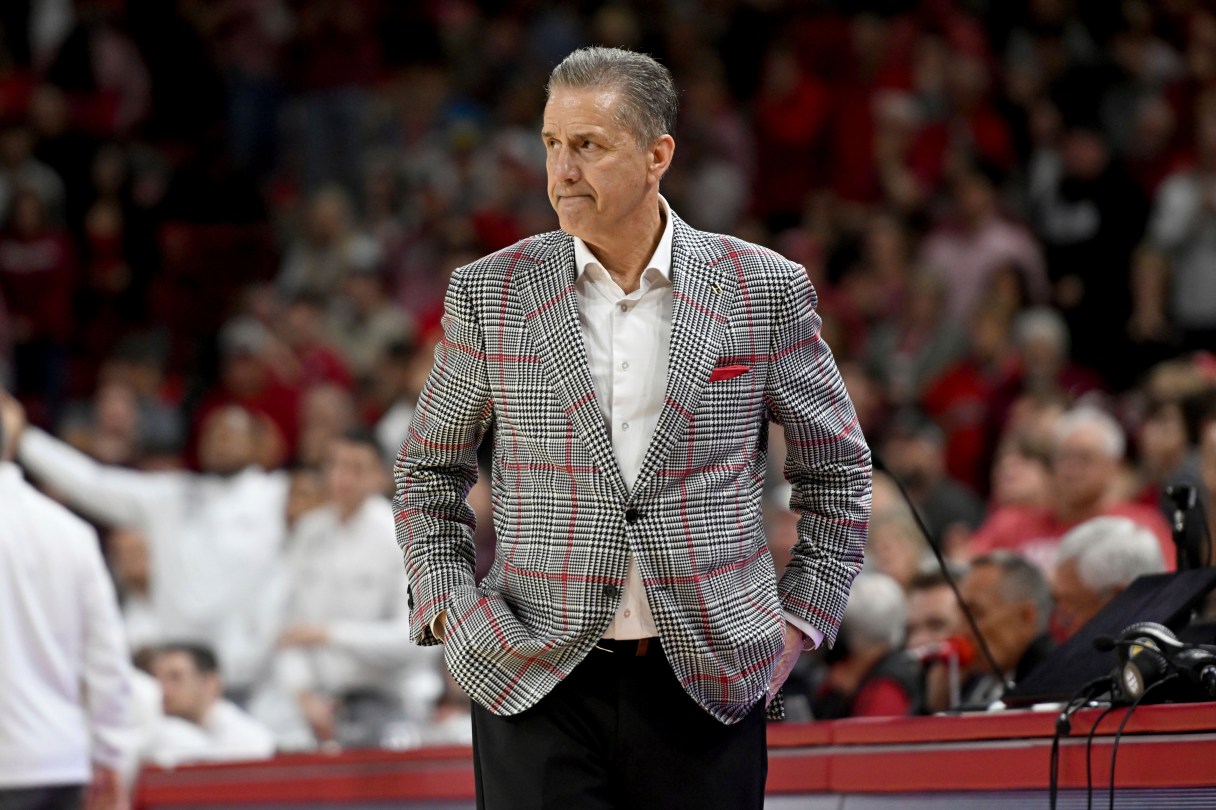
BIRMINGHAM, Ala. — Arkansas men’s basketball coach John Calipari, whose one-and-done era at Kentucky included NBA talent coming and going nearly every season in Lexington, criticized what he is seeing in the current climate of college athletics, saying he will not become a “transactional” coach and that he “won’t do this anymore” if it comes down to that.
The 66-year-old Calipari said he welcomes some changes in sports more than others after three-plus decades of head coaching.
“I want to help 25 to 30 more families,” Calipari said Tuesday at the Southeastern Conference’s basketball media days event. “The only way you do that is to be transformational as a coach. If you’re not, you’re transactional. If I become transactional — ‘I’m going to pay you this to do this and that’ — then I won’t do this anymore. I don’t need to.”
A transactional approach has become exceedingly more common — and sometimes mandatory — for programs looking to stay competitive.
The NCAA transfer portal’s debut in October 2018 made it easier for athletes looking for a new athletic home and coaches looking for new talent to connect. NCAA transfer rules were softened in 2021, no longer penalizing athletes with the requirement to sit out for a year — eventually, even if if wasn’t their first time changing programs. Name, image and likeness compensation for NCAA athletes was also allowed in 2021, permitting them to profit from their celebrity without losing eligibility. The $2.8 billion House v. NCAA antitrust lawsuit settlement took effect July 1, allowing schools to directly pay athletes for the first time in history.
Calipari was hired by Arkansas in April 2024, a day after stepping down from the Kentucky program he led to the 2012 NCAA championship. Among active NCAA Division I men’s basketball coaches, his 835 wins trail only Rick Barnes at Tennessee and Bill Self at Kansas, each with 836.
An elite recruiter, Calipari has seen top players come and go. And now the modernization of college athletics has become impossible to avoid.
Coach after coach, from Miami’s Jim Larrañaga to Virginia’s Tony Bennett to Villanova’s Jay Wright and others have all walked away from the game in recent years, saying it no longer holds the appeal it once did. Some blamed the transfer-heavy climate for the added stress — Michigan State coach Tom Izzo has called the portal a “urinal” — and the pressure to compete for players with money, a topic that stretches beyond basketball.
“If someone puts their name in the portal, I say, ‘You’re not coming back,’ because it’s not going to be transactional,” Calipari said. “That last place you’ll be at, they’ll be loyal to you? No, you’re a mercenary.”
Calipari said he doesn’t oppose transfers but “you just can’t transfer four times because it’s not good for you. Four schools in four years, you’ll never have a college degree.”
He backed the NCAA’s stance that athletes get five years for four seasons of eligibility, a guideline currently being challenged in multiple lawsuits.
“Why would kids want to stay in school five extra years? For money,” Calipari said. “Well, we’ve got to say you’ve got five years to play four, and that’s it. That’s all. If we get those two things in order, we’re on the path to being better.”
Calipari said he wants to positively impact the next generation of players and coaches, including his son Brad, an assistant on his staff.
“Part of the reason I’m still doing this, my son is coaching,” he said. “(Houston coach) Kelvin Sampson and I just talked. I said, ‘We have to fix some of this stuff before we’re out for our own children.'”