
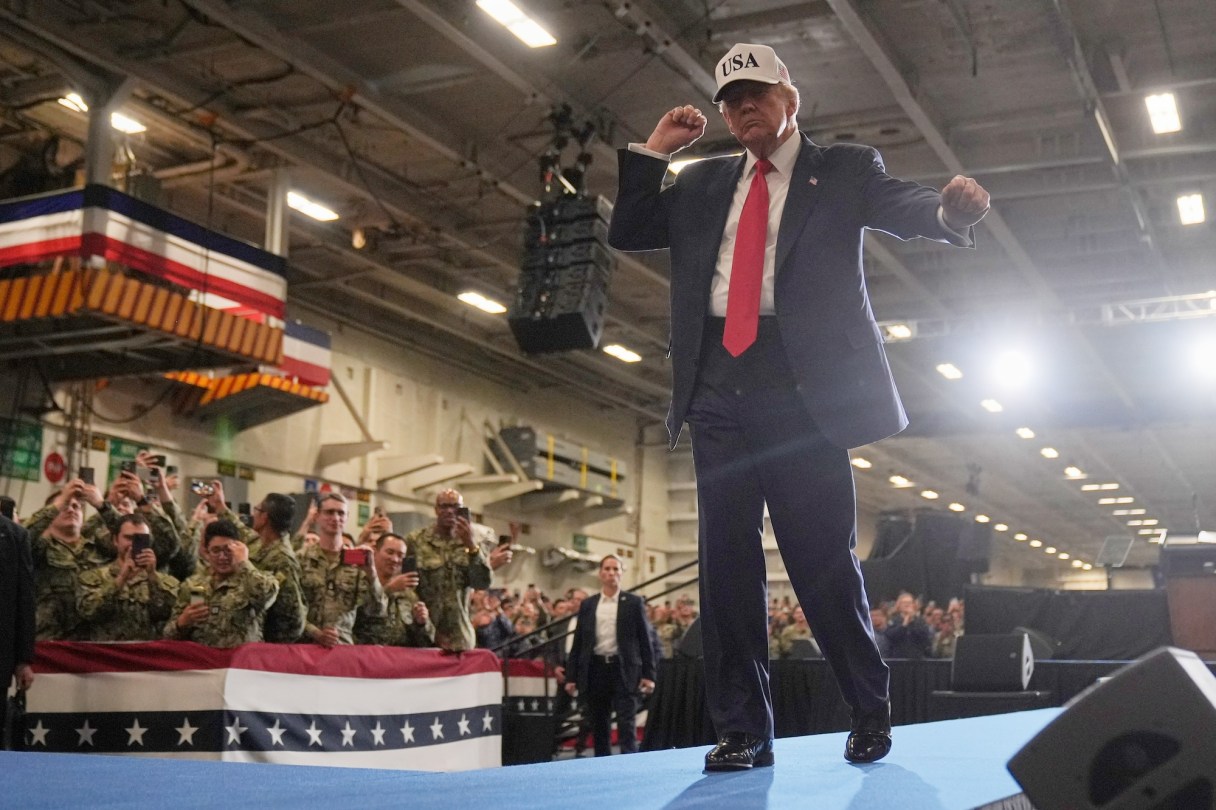
When President Donald Trump claimed members of Congress deserved the death penalty last week, he showed yet again that he doesn’t respect the rule of law.
The president turned to social media to accuse six Democratic members of Congress of “SEDITIOUS BEHAVIOR, punishable by DEATH,” in reaction to a video these elected officials, all former members of the military or the intelligence community, had posted the day before. They remind military service members: “You can refuse illegal orders” and “no one has to carry out orders that violate the law or our Constitution.”
The video states the obvious: Every member of the military takes an oath to obey the Uniform Code of Military Justice — which states they must not obey an order if it “is contrary to the Constitution” or “the laws of the United States” even if given by a superior officer or the commander in chief.
Trump was so rattled by the video that he unleashed a stream of 19 posts or shares including: “SEDITIOUS BEHAVIOR FROM TRAITORS!!! LOCK THEM UP???” A predictable surge of threats against the lawmakers followed, prompting the House Sergeant at Arms and the U.S. Capitol Police to provide them with additional security.
When White House Press Secretary Karoline Leavitt weighed in, saying the president would never authorize an illegal order, she inaccurately claimed the Democrats were “encouraging” members of the military “to defy the President’s lawful orders.”
The situation is entirely of Trump’s own making. For weeks, military personnel have been seeking outside legal counsel about orders, especially the U.S. strikes against alleged drug boats and the military deployments to American cities. The legality of the attacks on boats is disputed, and federal judges have halted National Guard deployment to U.S. cities while lawsuits proceed.
This has led to a spike in inquiries to The Orders Project, a nonpartisan program run by the National Institute of Military Justice, created at the end of the first Trump administration to help military personnel understand their options when faced with orders they believe may not be legal.
Lieutenant Colonel Frank Rosenblatt, a former U.S. Army lawyer who runs the program, said callers have indicated that “they’re feeling pressure from their higher-ups” to concur with the Pentagon’s decision to carry out the strikes, he said.
All these legal arguments can be challenging for the rank-and-file military, said General Randy Manner, a retired two-star Army Major General. It’s a mistake to assume that individual junior members of the military can analyze every order, he told me.
Recent decisions by what is now called the Department of War may compromise the ability of new enlistees to assess the legality of their orders. Under Trump, the department has removed instructions on the Geneva Conventions from basic training.
“Without that training, our soldiers and sailors and our Marines are not going to know what right looks like,” Manner said.
Senator Mark Kelly, a 25-year combat pilot in the U.S. Navy and a Democrat from Arizona, told CNN on Thursday that the group made their video because Trump continues to talk about sending troops into more U.S. cities, invoking the Insurrection Act, and in 2020 asked his then-Secretary of Defense Mark Esper about whether he could shoot Black Lives Matter protesters in the legs.
“That is an example of an illegal order — if it was given,” Kelly continued. “He didn’t give the order, but it’s obviously rattling around in his head.”
If Trump is disturbed by the reaction to his decisions, he should be. But the best response is not to seemingly call for the execution of members of Congress, but to reconsider how he ought to use the world’s most powerful military.