
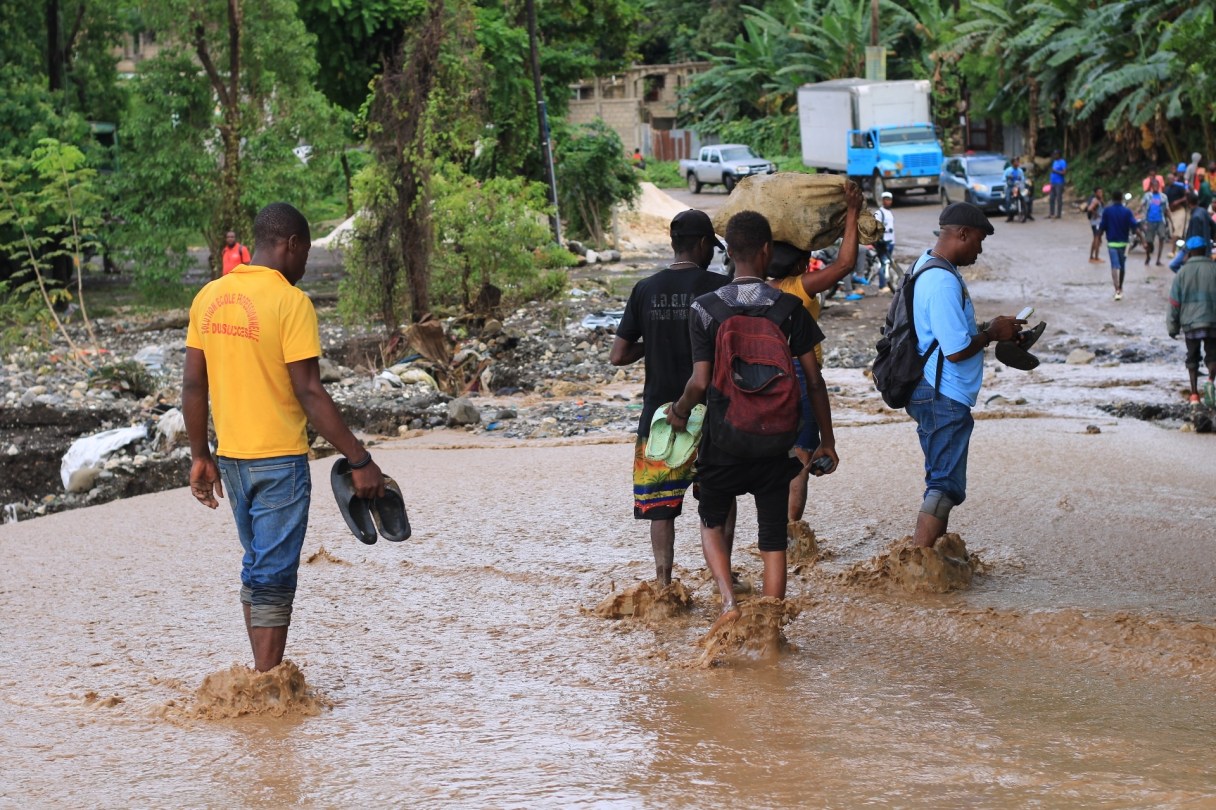
Last week, while Hurricane Melissa battered the Caribbean, Haiti was poised to suffer the worst of the impact given its already poor conditions. The U.S. National Hurricane Center warned of “catastrophic” flooding and landslides, and today, that forecast is reality: communities are destroyed, families isolated, and the country is suffering yet another humanitarian disaster.
For 28 years, the Children’s Nutrition Program of Haiti (CNP) has walked alongside families in the southern communes of Léogâne and Petit-Goâve — spanning nearly 300 miles of farmland and mountain villages. Even before the hurricane, daily life was marked by struggle — years of political violence, economic collapse, and hunger had pushed Haiti to its highest levels of displacement and food insecurity in modern history.
Here at home, many families are also struggling to put food on the table. With grocery prices soaring and SNAP benefits in a precarious place, parents across the U.S. are making impossible choices among housing, medicine and meals.
The fear of not being able to feed your child or care for her when she is sick is a shared fear — one we cannot turn away from in our neighborhoods or abroad. Compassion is not confined by borders. No child, anywhere, should go hungry. Whether in a grocery line in Tennessee or a flooded village in Léogâne, mothers are asking the same question: How do I feed my child today?
In Petit-Goâve, the Digue River overflowed last week, taking the lives of several children. Three of our own staff lost everything. Yet CNP’s 38 Haitian health workers continue walking by foot to reach mothers and children who have no one else coming. Over the weekend, our teams held community meetings to share life-saving messages on treating water and recognizing signs of illness. We distributed hygiene kits and supplies for malnutrition treatment and continue home visits and mobile clinics wherever access is still possible.
Before the storm, 6 million people in Haiti were already acutely food insecure, and more than 1 million children were on the brink of life-threatening hunger. Now, with floodwaters contaminating wells and families crowding into makeshift shelters, the next wave of threats — diarrhea, cholera, pneumonia, and other infectious diseases — could be even deadlier.
This is when local responders make the greatest difference. CNP doesn’t need to deploy; we are already there.
Our emergency priorities:
› Provide hygiene kits and chlorination points to prevent disease.
› Educate families on safe water, sanitation and nutrition.
› Screen and treat malnourished children through mobile clinics.
› Deploy trained health workers to identify danger signs early.
We urgently need $75,000 to reach 3,500 women and children within four weeks.
› $75 provides clean water and hygiene supplies for a family.
› $250 equips a clinic to treat 15 malnourished children for a week.
› $1,000 supports our community health workers serving remote villages.
We are a shared humanity. Let us support our neighbors struggling to feed their families here at home — and, if we are able, the children and families on the brink of life and death in Haiti. To help, go to https://www.cnphaiti.org/.
Kathryn Bolles is the chief executive officer of the Children’s Nutrition Program of Haiti.