
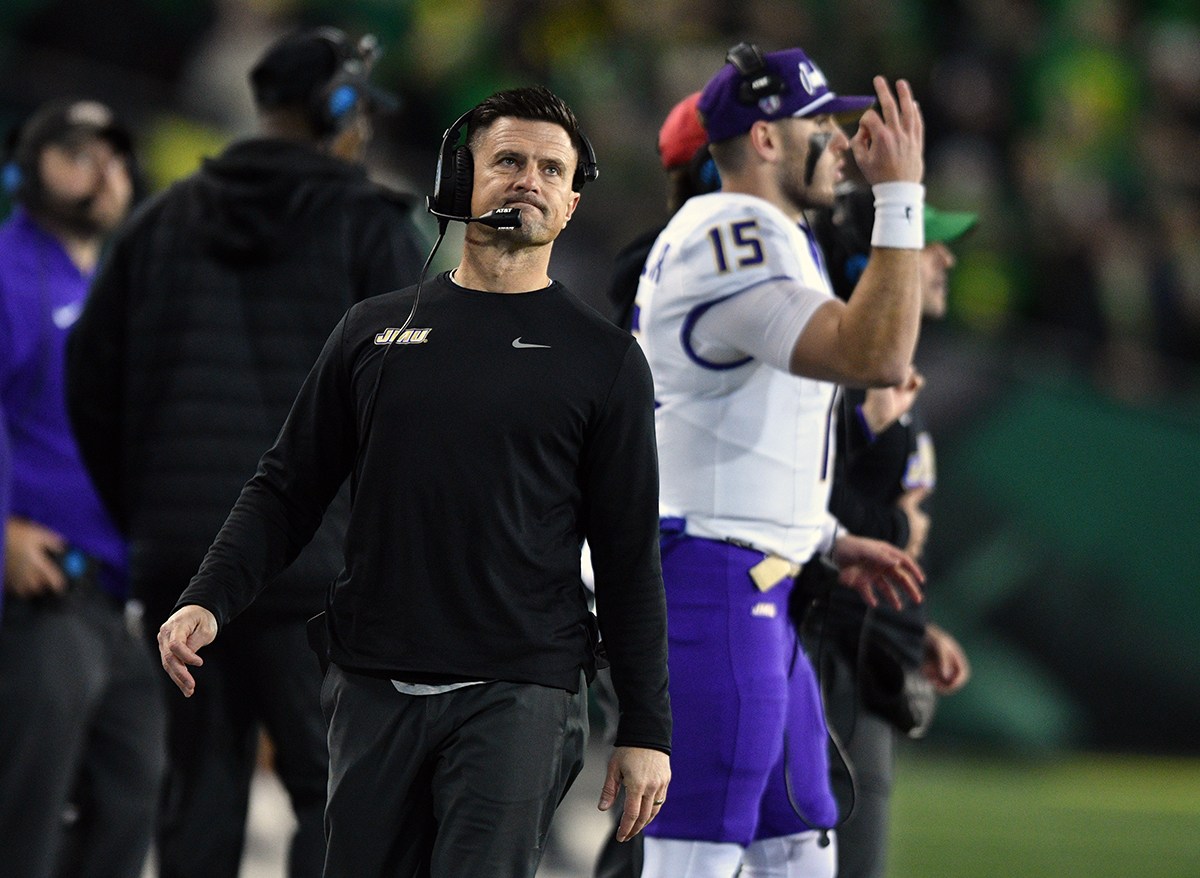
EUGENE, Ore. — Perhaps it was James Madison University going for it twice on fourth down on its first drive of the game.
Or maybe it was coach Bob Chesney calling for a double pass on the team’s second series of the evening. Even the Dukes successfully pulling off a fake punt could have adequately explained what the scoreboard failed to convey.
It was clear that the No. 5 Oregon Ducks were in a different class than their visitors in a 51-34 win in a College Football Playoff first round matchup Saturday at Autzen Stadium. Oregon led 48-13 midway through the third quarter before the 19th-ranked, 12th-seeded Dukes added three late touchdowns to make the final score appear closer than the game really was.
“I think the scoreboard itself, every time we got down there we kind of shot ourselves in the foot,” Chesney said. “If we did not do that, if we did not end with 13 penalties, is this a little bit of a different game? Maybe. But at the same point in time, that’s a tough offense to stop, and I think it’s tough for a lot of teams in the entire country to stop.”
With the Sun Belt Conference champions defeated by the Ducks of the Big Ten — one of the current Power Four conferences — teams from the Group of Five leagues (those outside the power ranks) fell to 0-4 all-time in CFP games.
American Conference champion Tulane, ranked 17th and seeded 11th, lost 41-10 at No. 6 Ole Miss of the Southeastern Conference earlier Saturday, while in last season’s playoff, the first 12-team edition of the event that had a four-team bracket for its first decade, Mountain West champ Boise State lost 31-14 to Big Ten member Penn State in the Fiesta Bowl during the quarterfinal round. In the 2021 season, American champ Cincinnati became the first Group of Five team to make the playoff and lost 27-6 to SEC champ Alabama in the Cotton Bowl semifinal.
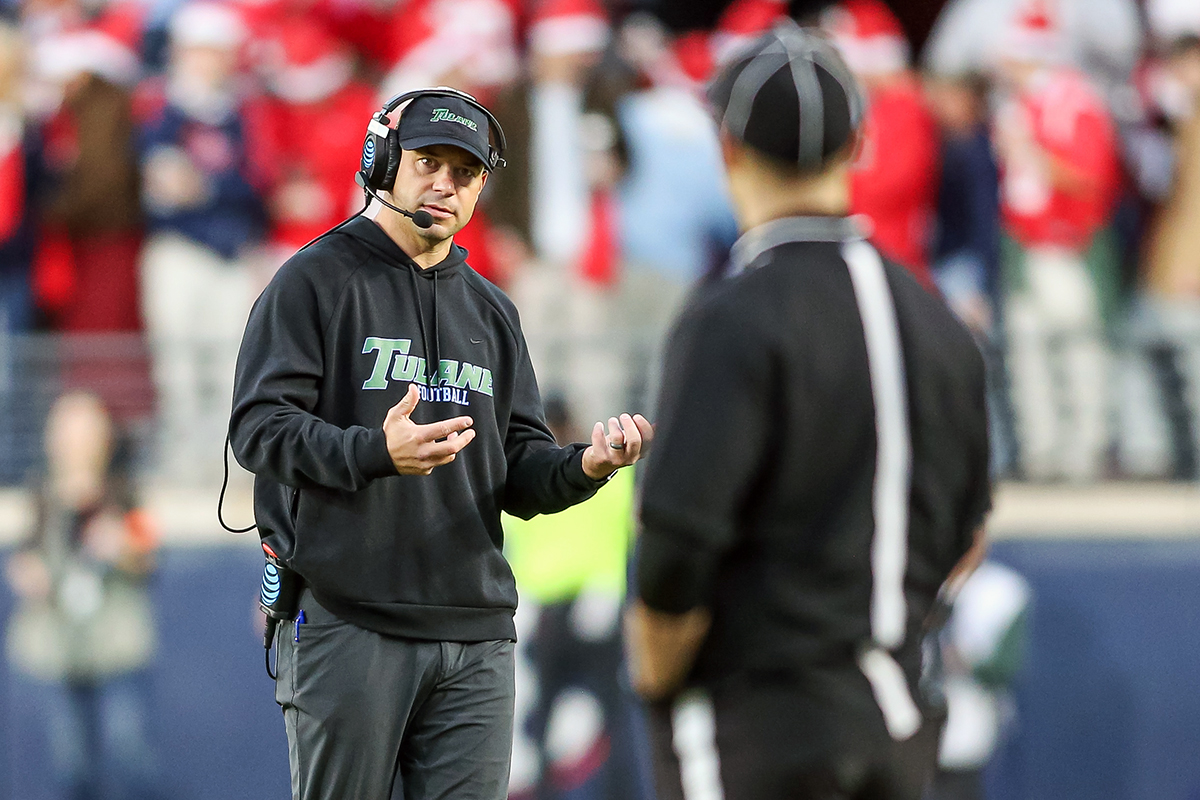
After the loss to Ole Miss, Tulane coach Jon Sumrall brushed aside any notion of the Green Wave not belonging among the last 12 standing.
“We’re our conference champion, and the rules are what they were, and I think there should be access for at least one G5 team moving forward,” Sumrall said. “I do. I think you should have given the American champion an opportunity before the ACC champion this year because we beat the ACC champion. So Duke won the ACC championship; we beat them.”
To Sumrall’s point, Tulane beat a pair of Power Four teams in Northwestern of the Big Ten and Duke, but those schools combined to go 14-11 in 2025.
JMU, meanwhile, lost to its only Power Four opponent during the regular season, with Atlantic Coast Conference member Louisville winning 28-14 in a game in which the Dukes mustered just 263 yards of offense. Most of the season, JMU ran the ball with ease against its opponents, rushing for 300-plus yards in a game five times and for 200-plus nine times.
Saturday at Oregon, the Dukes mostly abandoned the run after quickly falling behind, and instead often turned to Sun Belt player of the year Alonza Barnett III as the JMU quarterback attempted a career-high 48 passes. Even so, Barnett was confident his team belonged in the CFP over other Power Four schools.
“I believe people saw that we were meant to be on this level. When you look at the Power Four teams and whatever, the destiny is really the ball is in your court. You control your own destiny,” Barnett said. “Most of those teams that didn’t make it, they controlled their own destiny, and we handled what we could handle, and we didn’t give into outside noise.”
Among the Group of Five schools who have made the playoff, JMU did fare the best of any of them on offense. The other three programs scored a combined 30 points in their respective playoff games, a total the Dukes eclipsed against the nation’s eighth-ranked scoring defense.
Where the Dukes fell flat was slowing down the Ducks’ ninth-ranked scoring offense. Oregon ran the ball with ease, averaging more than 7.7 yards per attempt against a run defense that entered the contest allowing the second-fewest yards per game in the country.
As has often been the case in matchups between Power Four and Group of Five teams, the greatest discrepancies existed in the trenches. To a man, the Dukes could not adequately match up with Oregon, just as Tulane couldn’t with Ole Miss and many other G5 programs before them both failed to do.
“I think there were moments today where I feel like we could play with them,” Chesney said. ” And I think that today, the complementary football and us playing in the way we needed to just did not exist.”
Whether G5 teams are deserving of competing alongside P4 programs in the Football Bowl Subdivision’s national championship chase will continue to be debated, but what’s clear is the highest level of the college game will continue to be the target destination for ambitious players and coaches.
To that point, both of this year’s Group of Five representatives were led in their playoff games by coaches who are now moving on elsewhere. James Madison’s Chesney is now in charge at Big Ten member UCLA, which helped lead the mass exodus from the Pac-12 ahead of the 2024 season that made what was the Power Five the Power Four, while Tulane’s Sumrall takes over at Florida, with the Gators eager to return to contending for SEC titles and national championships.