
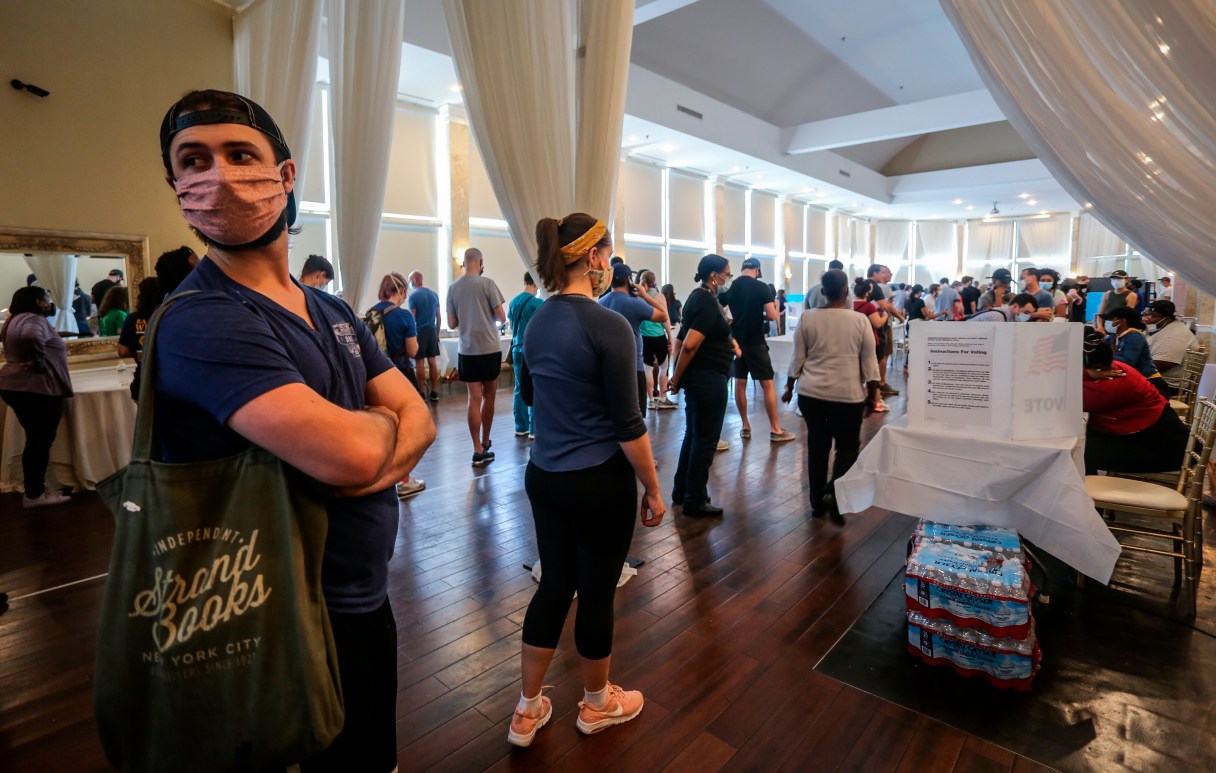
ATLANTA (AP) – First-time poll worker Kirubel Behailu thought he’d become more familiar with Georgia’s new voting machines at a quiet election site during Tuesday’s primary. Instead, he found himself scrambling to sanitize equipment, clear jams in a ballot scanner and run back voter cards during a 15-hour marathon at an Atlanta church inundated with frustrated citizens.
“I broke a sweat throughout the day. I logged at least 10,000 steps. It was kind of overwhelming,” said Behailu, one of several poll workers who shared their experiences with The Associated Press.
Voting problems were reported across much of Georgia, forcing 20 of a 159 counties to extend voting in at least one precinct. But it was particularly messy in metro Atlanta.
Election officials in Fulton County – the state’s most populous – faced a backlog of thousands of absentee ballot applications after staff became sick with the coronavirus and a deluge of requests froze email accounts and jammed printers.
Many voters who didn’t get their absentee ballots had to crowd into polling sites that had been consolidated because of the virus. Lines then grew because social distancing requirements limited the number of machines that could be used in confined spaces. Voters at Behailu’s site reported waiting up to two hours; some voters elsewhere said they had to wait up to five hours; others simply gave up.