
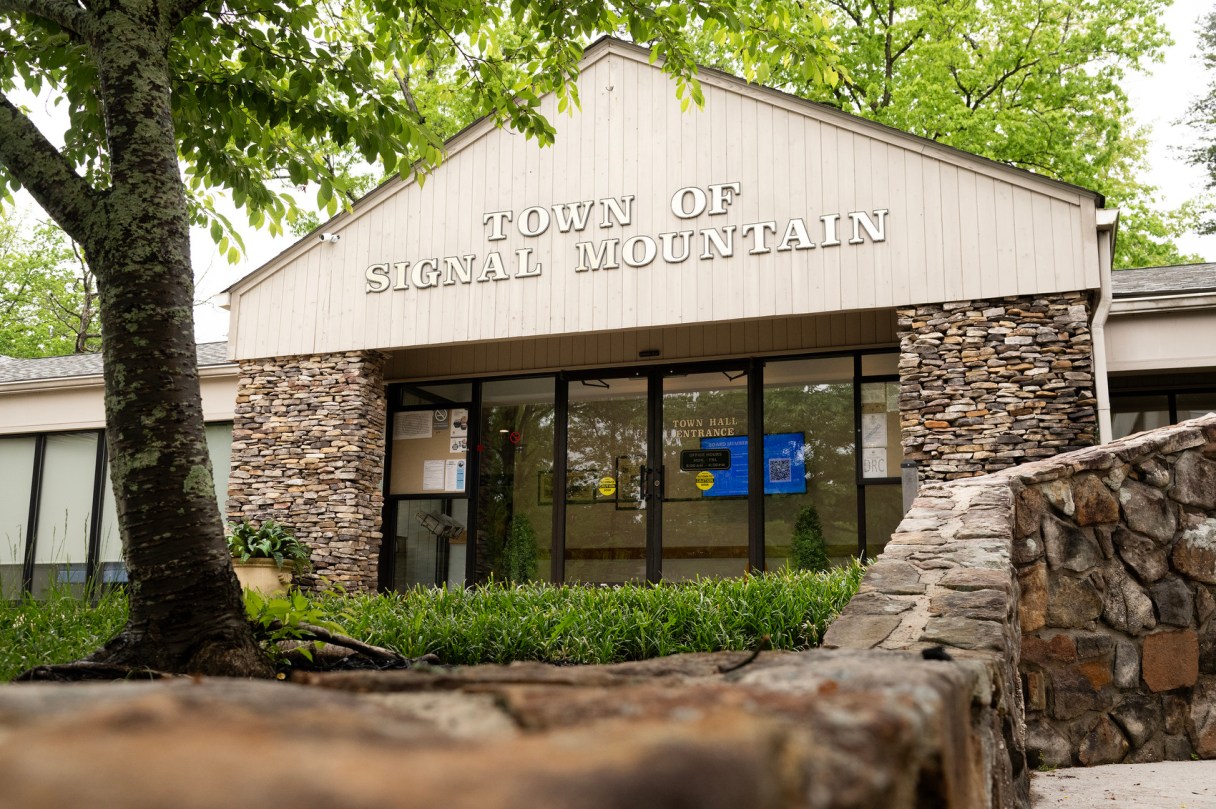
Signal Mountain Town Manager Matt Justice says artificial intelligence is a tool he uses to save time and improve productivity in his work.
“It’s here, and it’s being used,” Justice said by phone. “The newness is worn off of it. I think that folks expect you to use it, especially for the basic tasks.”
Like many others in local government, Justice uses AI for purposes including writing memos, drafting ordinances and resolutions and creating job descriptions for new municipal roles. The Chattanooga Times Free Press obtained over 500 pages of Justice’s exchanges with the AI service ChatGPT through an open records request as part of Sunshine Week, a nationwide effort to raise awareness of open government matters.
As the technology began to proliferate, Justice first used AI in his personal life, he said. As it improved, Justice realized the technology could be used professionally. And, within the past year, Justice has used the technology more often, he said.
“I see it as something that’s learning and getting better every day,” Justice said. “The current version is the worst version we’re going to have for now. Tomorrow, it will be better.”
Signal Mountain Mayor Elizabeth Baker said she is fine with the town manager using the technology for first drafts or initial ideas.
“We read the resolutions and the ordinances that he has created, whether he has created them sitting at his computer using Microsoft Word or using AI,” Baker said by phone. “He’s got to start somewhere.”
AI provides a head start, but Justice does not trust it to provide a finished product, he said.
“It gives good bones or good foundation, but it’s not complete,” Justice said. “It doesn’t give complete products. It’s only as good as the prompt you write and the information that you put in it.”
POLICIES
When the town assumed operation of the Mountain Arts Community Center at the start of the year, Justice asked AI to create resolutions to terminate a lease and a memorandum of understanding with the nonprofit Signal Mountain Elementary Preservation Fund, which had been running the center.
“Below are two separate, companion resolutions, written in a clean, professional municipal style that emphasizes transparency, gratitude and orderly transition — without reopening or litigating past arrangements,” ChatGPT responded. “These are termination authorizations, not critiques. They protect the town and respect SMEPF’s legacy.”
The bulk of the wording between the final resolutions and the ChatGPT drafts appears identical, although some edits had been made. For example, ChatGPT used numbered lists toward the end of its versions, which did not make it into the final copy. Some of the text had been moved from the lists into the body of the resolutions.
The Town Council passed the resolutions to authorize the early termination of the lease agreement with the nonprofit.
There is a trust-but-verify relationship with AI, Justice said.
“I think it’s inherently written to try to be right and try to please whoever’s prompting it,” Justice said.
For example, if Justice asks AI to draft a meeting agenda, he said he has to put in the information the chatbot needs to build the agenda. Justice then needs to proofread it to ensure the product is what Justice wants, not what the AI wants.
AI in government
The Chattanooga Times Free Press made dozens of document requests for artificial intelligence policies and chat logs from state agencies and local governments in the region to mark Sunshine Week in March. This national, nonpartisan collaboration of journalists, civic educators, government officials and businesses highlights the need for open government and freedom of information. This story is one of several examining policies, AI use and compliance with public records laws at governments in the region.
(READ MORE: Red Bank city employees use AI for social posts, employee counseling)
In one instance, ChatGPT mistakenly called the community center the “Municipal Activities and Community Center,” which Justice called out in a follow-up prompt.
“It is the Mountain Arts Community Center,” Justice said. “You should know this.”
“You’re right to call that out — I used the wrong expansion,” ChatGPT responded. “In Signal Mountain, MACC is the Mountain Arts Community Center. That was my mistake.”
Because the town manager juggles many responsibilities, Baker said she supports the town manager finding something to assist him or to help him use his time more effectively.
“Whether it takes him 12 hours or 14 hours or 18 hours a day, he’s going to do it,” Baker said of Justice. “And, if he can save himself some time, I’m all for it.”
Justice also had ChatGPT draft an ordinance to allow the town to charge fees for the use of the community center. As with the resolutions, much of the ordinance’s text appears identical to the AI draft, though additional sections included by ChatGPT were cut in the final version.
Unlike ChatGPT’s version, the final ordinance places the ability to amend fees, rates, deposits and related terms under the town manager instead of the Town Council.
The Town Council passed the ordinance earlier this year. When the council first discussed the ordinance at its meeting in January, Justice did not disclose he had used ChatGPT to draft the ordinance.
Justice does not hide his use of AI, he said, but he does not go out of his way to disclose when he has used it.
In conversation, Justice has disclosed when he has used AI for something, Baker said.
Through a separate open records request, the Times Free Press sought policies regarding AI usage for Signal Mountain employees.
“The town does not currently have any written policies, guidelines, directives, memoranda, standard operating procedures, internal guidance, training materials or other records governing or addressing employee use of artificial intelligence, including generative AI, machine learning systems or automated decision-making tools,” the town said in its response to the request.
Baker would entertain bringing an AI policy before the Town Council should a council member or town employee insist upon it, she said. But she is not sure if she would be the one to bring it up, citing her own lack of familiarity with the technology.
Policies and training on AI are going to be needed, Justice said.
“There’s no replacement for human conversation,” Justice said. “It’s one thing to punch it in there, but again, it’s really just the template. It’s just the bones.”
Signal Mountain town manager uses AI for crafting policy, hiring, more



HIRING
In addition to using ChatGPT to draft policies, Justice also made use of the technology during the hiring process when the town sought a community development director and a manager for the community center.
In the case of the community development director position, Justice prompted ChatGPT to “act as an expert hiring recruiter with 20+ years of experience in municipal government employment” to create a job description for the role. The chatbot fulfilled Justice’s request.
“Here’s a professional job description for the community development director position that balances municipal HR standards with the unique needs of Signal Mountain,” ChatGPT responded.
Justice further prompted ChatGPT to generate an email to send to job candidates for them to schedule an interview, to generate a plan for conducting interviews and to generate interview questions to ask the candidates.
Out of a pool of over a dozen applicants, the town hired Chelsea Ryden for the community development director role.
As part of the job, Ryden has “broad responsibility for planning, directing and coordinating a comprehensive portfolio of community-focused initiatives and programs, including — but not limited to — communications, community engagement, economic development, town branding and the oversight of community programs and facilities,” according to a January press release from the town.
Before taking on the municipal position, Ryden served as brand and event manager for the United Way of Greater Chattanooga.
Ryden has no issue with Justice’s use of AI during the hiring process, she said by phone. Knowing the interview process and how Justice operates, Ryden is confident she was a good fit for the role, she said.
“He probably could have worked at coming up with an interview timeline for two days straight,” Ryden said of Justice. “I don’t know anybody that uses AI like it’s end-all, be-all.”
As part of his use of AI during the hiring process, Justice put the job description, the town’s strategic action plan and applicants’ resumes into ChatGPT and prompted the chatbot to assess the candidates, looking at how their skills and experience fit the role and noting their strengths and weaknesses.
After doing so, ChatGPT asked Justice if he wanted it to create a weighted scoring matrix to directly compare all the applicants. Justice responded in the affirmative. Along with its weighted scoring matrix, ChatGPT also created a ranked summary of the job candidates.
Out of 16 applicants, the chatbot ranked Ryden seventh. Out of 15 applicants, the chatbot ranked Ryden sixth. Out of seven applicants, the chatbot ranked Ryden third.
That was the first time Justice had ever used AI during a hiring process, he said. He would not use AI for any critical decision-making, he said, and ChatGPT’s candidate assessment did not influence the hiring team’s decisions during the process, Justice said.
“I put that info in there, and the way we used it was we didn’t really reference it at all until we got done through the steps and looked at the candidates,” Justice said. “We all came together, figured out our own scoring and all that. And then we went back and said, ‘OK, let’s see how this compared. What did ChatGPT tell us?’ And, it was very, very close to a lot of it.”
Research and guidance are good uses for AI, Ryden said. Because her role is more relational, Ryden said she does not use the technology in her work.
Contact Sam Still at sstill@timesfreepress.com or 423-757-6579.