
Friday, November 6, 2026Nov 6

This story is free to read.

Czechs present lost music composed by Mozart and Salieri

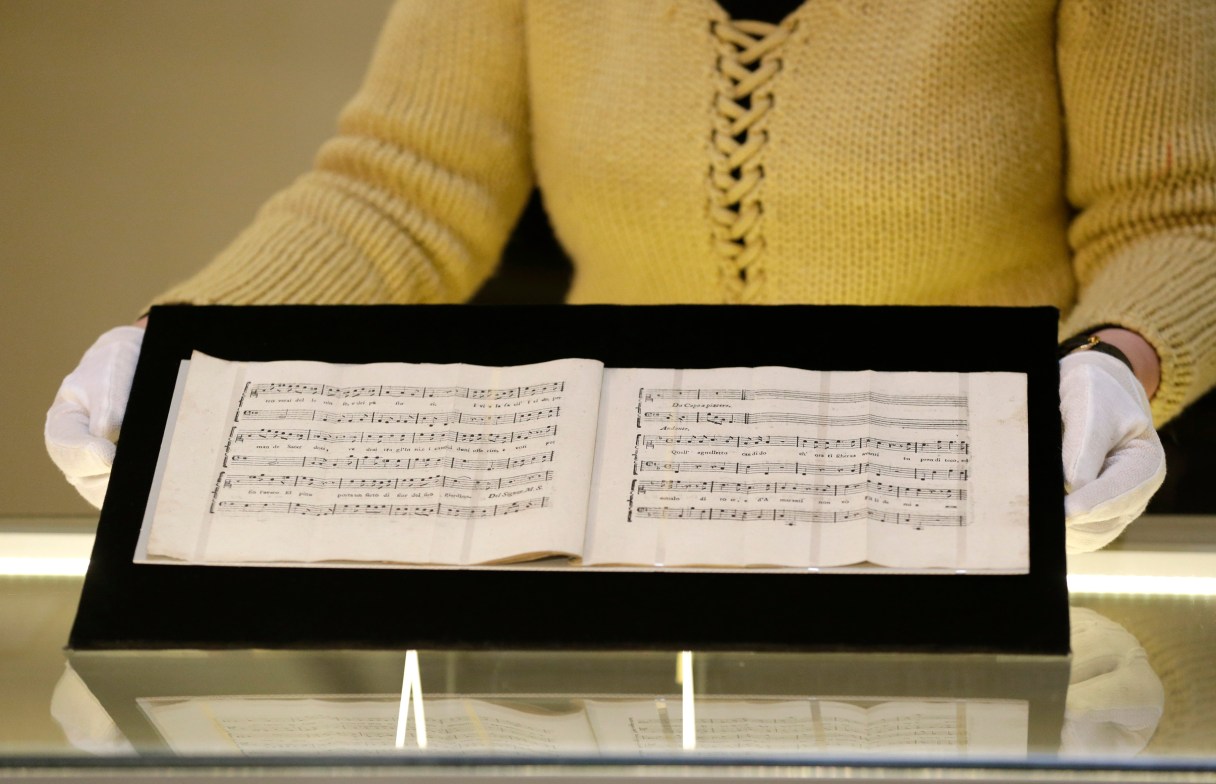
A recently discovered piece of music composed jointly by Wolfgang Amadeus Mozart and Antonio Salieri, and an unknown composer Cornetti that was considered lost for more than 200 years is presented at the Czech Museum of Music in Prague, Czech Republic, Tuesday, Feb. 16, 2016. Cantata “Per la Ricuperata Salute di Offelia” was composed in 1785 on the libretto by Vienna court poet Lorenzo Da Ponte. (AP Photo/Petr David Josek)
A recently discovered piece of music composed jointly by Wolfgang Amadeus Mozart and Antonio Salieri, and an unknown composer Cornetti that was considered lost for more than 200 years is presented at the Czech Museum of Music in Prague, Czech Republic, Tuesday, Feb. 16, 2016. Cantata “Per la Ricuperata Salute di Offelia” was composed in 1785 on the libretto by Vienna court poet Lorenzo Da Ponte. (AP Photo/Petr David Josek) A recently discovered piece of music composed jointly by Wolfgang Amadeus Mozart and Antonio Salieri, and an unknown composer Cornetti that was considered lost for more than 200 years is presented at the Czech Museum of Music in Prague, Czech Republic, Tuesday, Feb. 16, 2016. Cantata “Per la Ricuperata Salute di Offelia” was composed in 1785 on the libretto by Vienna court poet Lorenzo Da Ponte. (AP Photo/Petr David Josek)

PRAGUE (AP) – The Czech Museum of Music has presented a recently discovered piece of music composed jointly by Wolfgang Amadeus Mozart, Antonio Salieri and an unknown composer, Cornetti, that was considered lost for more than 200 years.

The cantata “Per la Ricuperata Salute di Offelia” was composed in 1785 on a libretto by Vienna court poet Lorenzo Da Ponte for Vienna-based English soprano Nancy Storace, who returned to stage after losing her voice.

The original sheet with the libretto was acquired by the museum in 1949-50 in a collection of material.

German musicologist and composer Timo Jouko Herrmann first recognized the cantata’s name when he was browsing the museum’s online catalogues in November 2015.

Ulrich Leisinger from the Mozart Institute in Salzburg, Austria, says there’s no doubt about the authorship.