
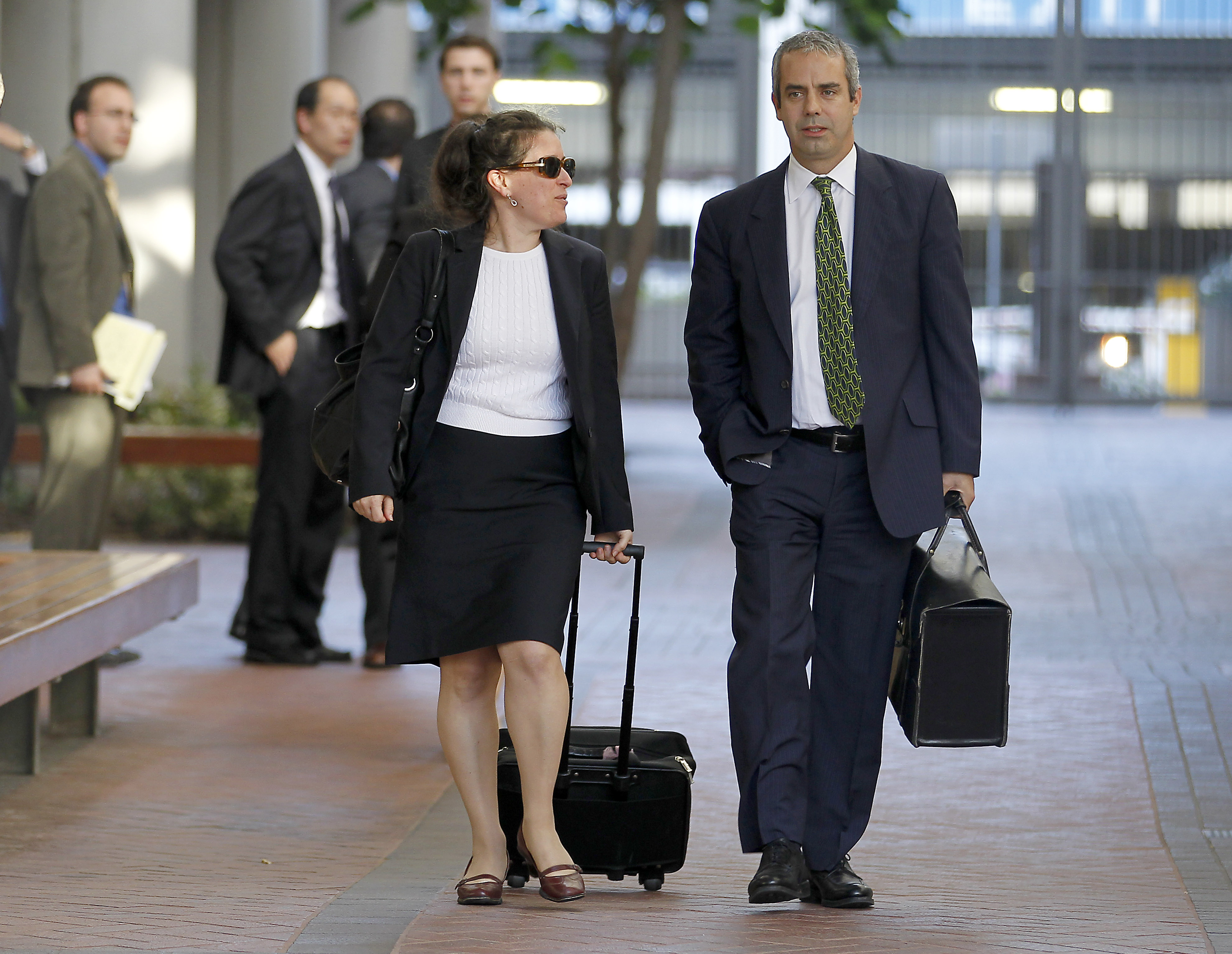
 Kevin Johnson, right, and Victoria Maroulis, left, attorneys for Samsung, leave the US Courthouse and Federal building after a jury reached a decision in the Apple Samsung trial on Friday, Aug 24, 2012 in San Jose, Calif. After a year of scorched-earth litigation, a jury decided Friday that Samsung ripped off the innovative technology used by Apple to create its revolutionary iPhone and iPad. The jury ordered Samsung to pay Apple $1.05 billion. An appeal is expected. (AP Photo/Tony Avelar)
PAUL ELIAS
SAN JOSE, Calif. (AP) – The youngest juror, a 24-year-old whose favorite court attire was T-shirts bearing names of rock bands, chose a Beatles sweatshirt for Friday’s dramatic unveiling of the $1.05 billion verdict in favor of computer titan Apple Inc. One of the oldest was a retired electrical engineer who, as foreman, signed the unanimous verdict that Samsung Electronics Co. copied Apple’s patented technology for the iPhone and iPad. Among the other seven jurors were a homemaker, a bicycle shop manager and a U.S. Navy veteran.
The decision Friday by this panel of people from many walks of Silicon Valley life was one that experts say could dramatically alter the future of computer tablet and phone design if the verdict stands. But the case also is part of a trend that has accompanied an explosion in the number of patent infringement cases, especially in the technology sector.
Increasingly, these highly complex disputes are being decided by juries, rather than judges, and the juries tend to issue more generous awards for patent violations.
That has companies on the receiving end of successful patent infringement lawsuits crying foul and calling for reform in the patent system, but it also has some legal experts questioning whether ordinary citizens should be rendering verdicts and fixing damages in such high-stakes, highly technical cases.