
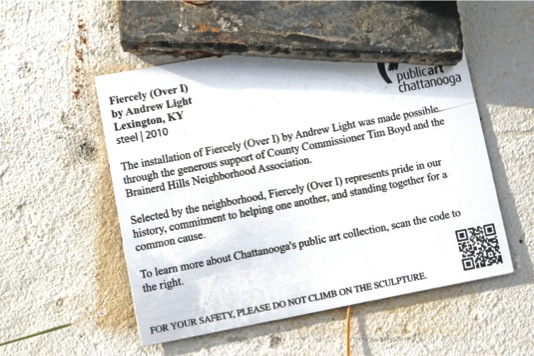
 County Commissioner Tim Boyd says he OK’d but did not suggest the wording on this plaque that will explain a sculpture he funded for a Brainerd Hills neighborhood corner.
It’s all about governing
It’s taken years, but finally this month Hamilton County commissioners and County Mayor Jim Coppinger seem to be getting on to the same page about having real discussions over doing away with high-dollar, individual commissioner discretionary spending.
After some back-and-forth in recent weeks about an $18,000 abstract art sculpture for the Brainerd Hills Neighborhood Association that will be placed on a county-owned neighborhood corner, Coppinger said it is time to have a definitive conversation about discretionary spending.
The county’s current budget is $672.5 million, but a $900,000 carve-out divided among our nine commissioners for spending in their districts is still big money. And it’s money that could shore up the schools budget or pay for 25 employee salaries.
“It’s our responsibility to put together the budget, and I will not submit a budget that includes discretionary spending in the general operating fund,” Coppinger said this week. “And I’m excited to hear that there are commissioners willing to do away with it. It’s a conversation that needs to be had.”
After months of Chattanooga Times Free Press stories by Louie Brogdon about the commissioners using their discretionary money for projects that got their names on school plaques and county park signs — possibly currying election vote favor along the way, commissioners did place some restrictions in last year’s budget about how they could spend their $100,000 a year. The expenditures now are bound to public projects and increased scrutiny thanks to public votes and a county web page posting.
The funds also now are drawn from credit and bond revenues, rather than from the general fund, freeing up general fund money for regular government needs. The down side is that each commissioner’s spending now means interest added to the cost of government for future generations.
But that added cost concern also may be the spark that finally brings an end to commissioners’ localized vote-currying and lead instead to actual governing for the good of all the county — something this page has been recommending for some time. Right now, Hamilton County is the only county in Tennessee that allows individual commissioners to personally direct more than $5,000 in public money each year.
In November, Commissioner Tim Boyd criticized tying the discretionary funds to purse strings that incur interest expense. He said the funds need to be moved back to general fund or ditched completely.
We’re for ditching the discretionary funds that may sometimes help a band get uniforms or bleachers, but mostly help a commissioner get his or her name out where voters will see it.
Instead, we advocate adding the nearly $1 million to the county’s education budget — not just the general fund.
Fleischmann finally has an idea
The U.S. House of Representatives this week passed a diesel fuel tax for barges that was mis-dubbed an industry-supported “user fee.” The tax, er user fee, was attached to the ABLE Act — a bill allowing the parents and grandparents of disabled people to establish tax-free savings accounts for their care. It sounds so Chuck, doesn’t it?
Republican U.S. Rep. Chuck Fleischmann, that is — Tennessee’s 3rd District congressman, who signed a Grover Norquist no-tax pledge so he can’t call a tax a tax to restart work on replacing the nation’s crumbling dams and locks like our own stalled replacement lock at the Chickamauga Dam.
Truthfully, Chuck, you’re not fooling anyone — not even Grover. But we don’t care. We’re just glad you got to stand up in front of the House on CSPAN and call it something.
What in heaven’s name took you so long to find a creative way to do it and still curry your sacred tea party support?