
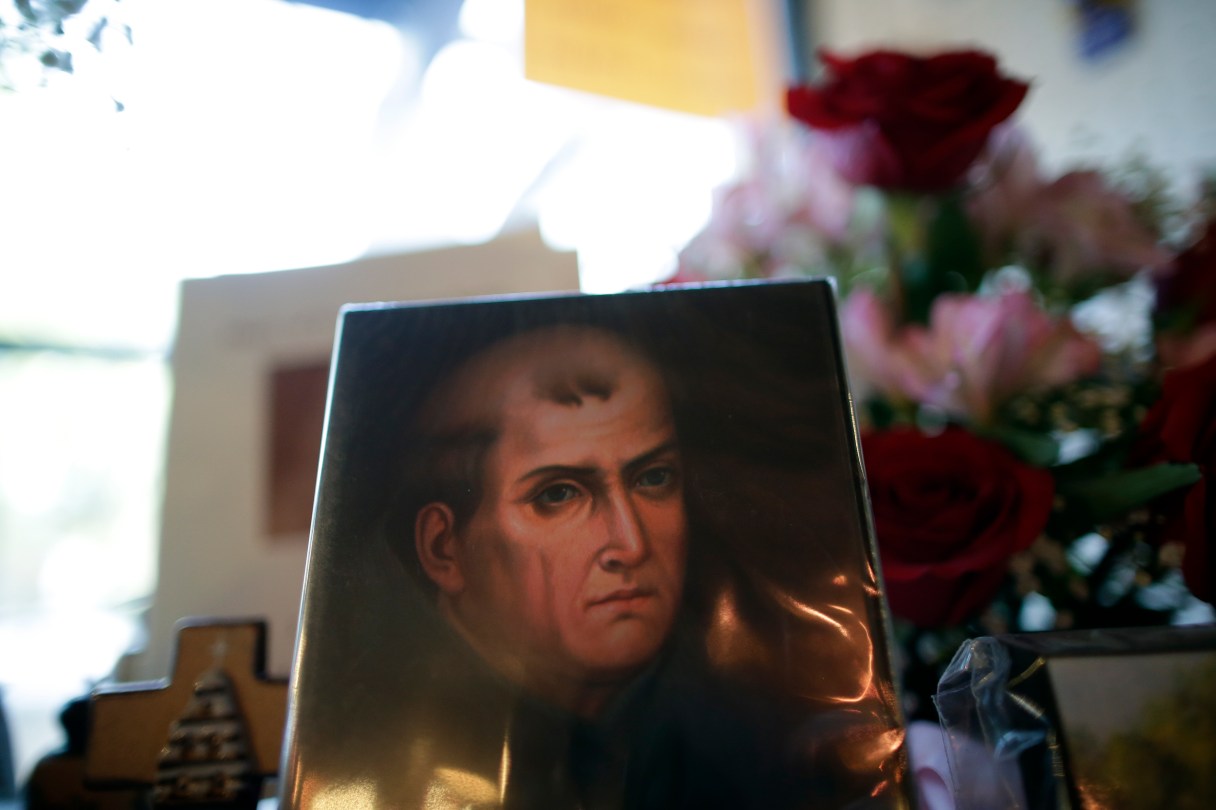
SAN JUAN CAPISTRANO, Calif. (AP) – California’s history can’t be told without Junipero Serra, the 18th-century Franciscan missionary who introduced Christianity and established settlements as he marched north with Spanish conquistadores. Boulevards, public squares, freeways and elementary schools bear his name. A 26-foot statue of the priest looms over Interstate 280 in San Francisco.
He is revered within the Catholic Church, and Pope Francis announced recently that he will canonize Serra, likely during a trip to Washington, D.C., this fall. That pronouncement has opened old wounds for many Native Americans in California and beyond. They say Serra wiped out native populations, enslaved converts and spread disease.
Since Francis’ announcement, Indian groups have staged weekly protests, posted YouTube videos and started an online petition demanding the pope rethink his decision. At rallies outside Our Lady of the Angels Cathedral in downtown Los Angeles, about a dozen protesters wore black T-shirts and beat drums while chanting “Serra was no saint! Serra was the devil!” and holding signs that compared the missionary’s actions to genocide.
“I’m outraged,” said Olin Tezcatlipoca, director of the Mexica Movement, an organization that educates the public about indigenous rights. “This is sad because supposedly this pope is more enlightened and more progressive. This came as really shocking.”
Serra, a theology professor by training, was tasked in 1767 with expanding the Catholic mission system from Mexico’s Baja California into what is now the state of California and converting the Indians he encountered. In 1769, he established his first mission in San Diego and ultimately founded eight of California’s 21 missions – from San Juan Capistrano to San Francisco – before his death in 1784.