
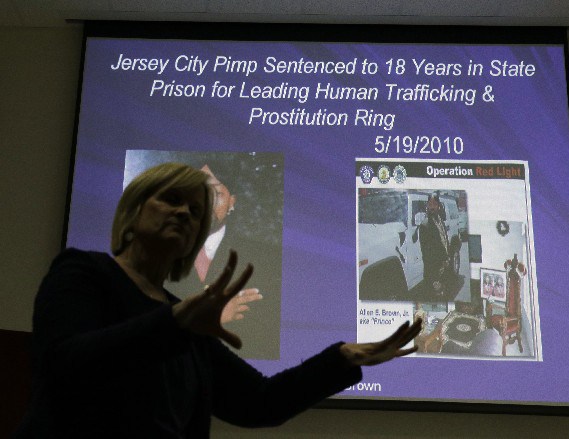
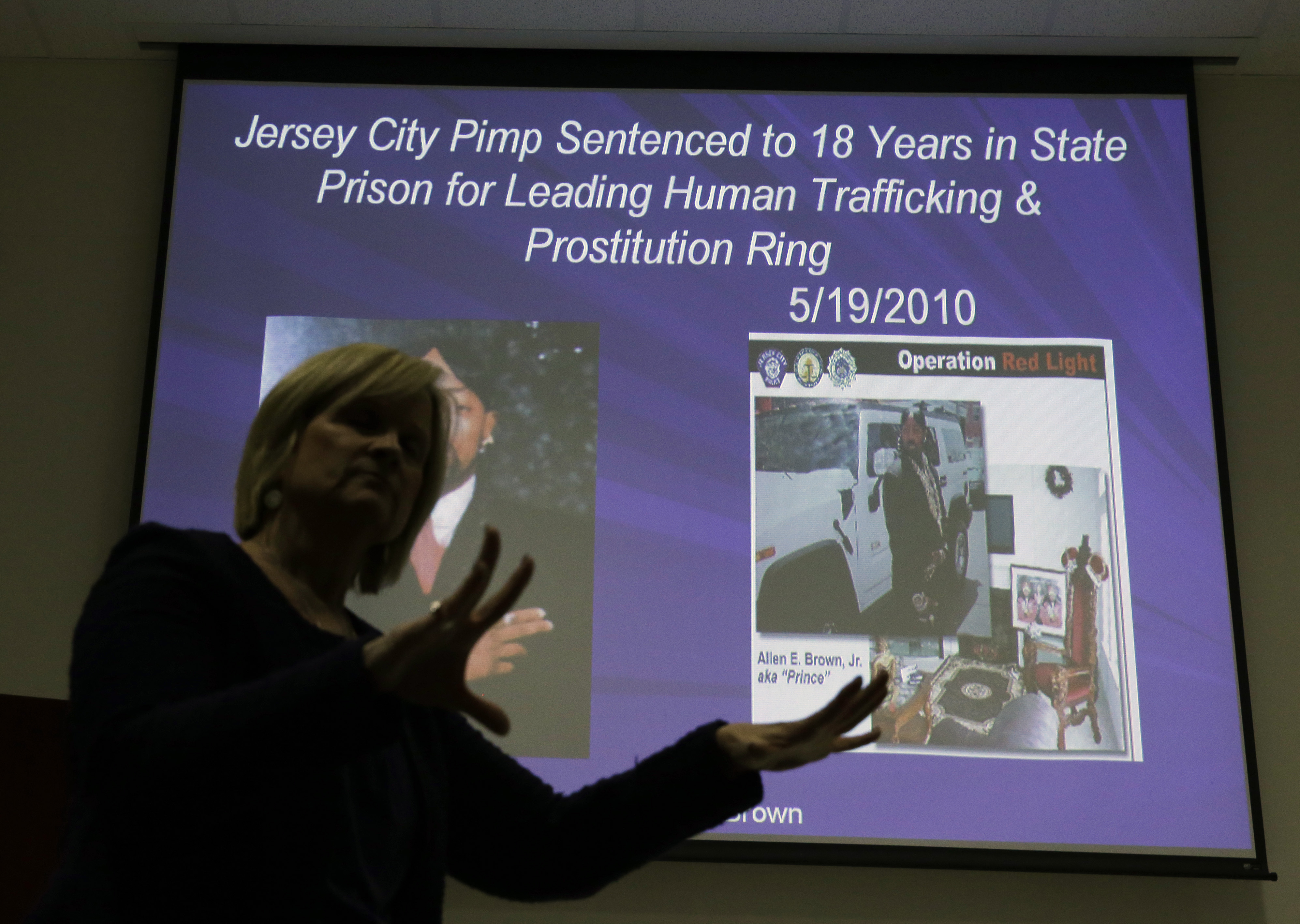
 Kathleen Friess gives a presentation on human trafficking in Hamilton Township, N.J., for hotel and nightclub employees and tries to dispel notions of what human trafficking looks like. Often, Friess said, it’s a local woman forced into sex work by a man she initially thought had romantic intentions. Officials are training legions of law enforcement personnel, hospitality workers, high school students and airport employees to watch for signs of it before the Feb. 2 football game, when hundreds of thousands of people are expected to descend on New Jersey.
EAST RUTHERFORD, N.J. – Law enforcement agents in New Jersey have redoubled efforts to fight what they worry could be one of the biggest menaces to come with next month’s Super Bowl: sex trafficking.
Hundreds of thousands of visitors are expected to descend on New Jersey for the Feb. 2 football game. Many believe the state’s sprawling highway system, proximity to New York City and diverse population make it an attractive base of operations for traffickers.
“New Jersey has a huge trafficking problem,” said U.S. Rep. Chris Smith, R-N.J., who is co-chairman of the House anti-human trafficking caucus. “One Super Bowl after another after another has shown itself to be one of the largest events in the world where the cruelty of human trafficking goes on for several weeks.”
Law enforcement in New Jersey has worked for years to battle forced prostitution. The state strengthened its human trafficking law in early 2013, but it hit a roadblock in August when a federal judge ruled that a portion of the law that pertains to commercial sex ads posted online may conflict with federal legislation. The state is appealing.
There are scant statistics and much debate over how much sex trafficking increases during a Super Bowl or other large sporting event, but it’s been enough of a concern to prompt New Jersey and previous Super Bowl host cities to pay attention to it.