
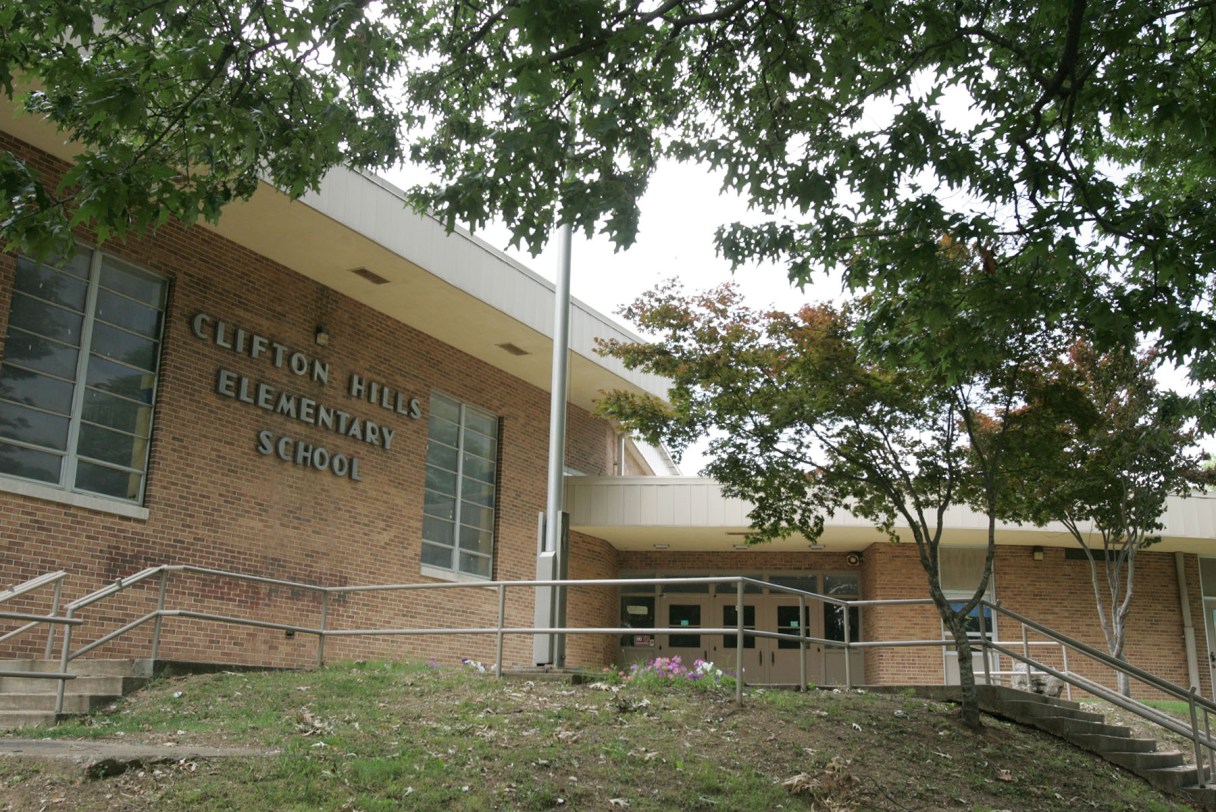

Newspaper archives don’t tell the whole story, but it appears a rush to replace the partially burned Clifton Hills Elementary School in 1966 led to the new school’s siting in a flood plain that would become troublesome for the area for the next 50-plus years.
That could change soon, though, since Tennessee Gov. Bill Lee included the school in a fiscal 2023 budget proposal to spend $200 million to replace 11 schools across the state located in flood plains.
But people may be wondering why the governor tabbed Clifton Hills. Here’s the story:
The March 8, 1966, three-alarm fire that broke out just before 1 a.m. destroyed about two-thirds of the Rossville Boulevard school, according to reports at the time, but the elementary nevertheless opened the following day with classes in the auditorium, library and nearby Temple Baptist Church. Damage was estimated to be around $300,000, and it was initially assumed the damaged portion (itself threatened by the city’s 1917 flood) would be rebuilt.
Within two months, the then-City School Board determined the nearly 600-student Clifton Hills would not be rebuilt but relocated. The site members chose – paying $85,000 for the property – was a four-square block, 14-acre tract on 32nd Street about a block away from the burned building.
A large drainage ditch ran from west to east through the property, reports said, and James D. McCullough, assistant superintendent for business, said “considerable filling” might be necessary to assure a high foundation for the building.
“Some parts of the property are five to six feet below the generally accepted minimum level of 661 feet above sea level,” the news story noted.
How much fill was put in before work by T&C Construction Co. began was not mentioned in accounts, but it was not enough to keep the site from frequently flooding in the 56 years since.
Yet, the Earl Smith-designed building was deemed to be the utmost in modern schools when completed. It was the system’s first elementary school built in the round, the first that was carpeted and the first to be fully air conditioned. It also would have one of the largest elementary campuses in the system.
McCullough, in 1967, said it “should be the finest elementary school in the system,” and during an early 1968 walk-through the $818,850 project was described as “the most flexible building that has yet been constructed” among city schools.
However, disgruntled parent John Crownover, in a 1968 letter to the editor, pointed out the drainage ditch had overflowed during recent heavy rains and the need for covered drainage, noting the school “had been built in a swamp” and calling the building a “carpeted, walkless, hung-over silo.”
And that was just the beginning of the trouble.
It was one of three schools where city administrators were worried about parking and access following the devastating St. Patrick’s Day 1973 flood, but no damage to the school was reported.
“[The three schools] are high and dry, and access to them should be all right by morning,” then-Superintendent James W. Henry said the night before students returned to class.
In May 2003, with the city’s worst flooding since the St. Patrick’s Day event, all Hamilton County schools were closed, but newspaper accounts said custodians had to clean debris from the Clifton Hills playground area from drainage ditch overflow.
In 2005, a Chattanooga manufacturer withdrew his request to buy part of the school property to expand his adjacent business. He had offered to pay $200,000 for nearly three acres and was willing to spring for $250,000 to provide fill dirt to help lift the rest of the school’s land out of the flood plain. The school’s principal at the time was against the move, saying the manufacturer only wanted the part that didn’t get submerged during flooding.
Newspaper reports showed Clifton Hills was one of two schools that had to close during flooding in September 2009, the roads in the area being impassable, according to a schools spokeswoman, and then had to close in November 2011 because of more flooding.
A long-anticipated school sites survey by MGT Consulting Group in 2020 judged the physical facilities to be “fair” but did not recommend rebuilding on the site. Instead, mentioning the flood plain, it suggested students from the elementary be sent to another school or that another 1,000-student school be rebuilt elsewhere.
That brings us to Lee’s proposal, which he said was triggered by the August 2021 flooding in Waverly, Tenn. That flooding occurred on a Saturday, but officials have said four feet of water arrived at Waverly Elementary School 10 minutes after the flood started and would have had a devastating effect if the 480 students at been present.
The Tennessee legislature, of course, must approve the schools spending, but soaring tax revenues and billions of federal stimulus money offer more hope than one might expect in an average budget year for the proposal.
If such a school is built, we trust more time will be taken on the front end to scout for a less soggy, less problematic site.