
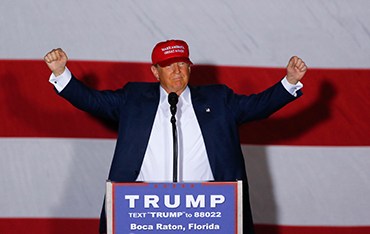
 Republican presidential candidate Donald Trump raises his arms during a campaign rally in Boca Raton, Fla., Sunday, March 13, 2016. (AP Photo/Paul Sancya)
WASHINGTON – Good countries can sometimes go bad. Donald Trump’s supporters implicitly make this argument when they proclaim “Make America Great Again.” And so do those who loathe Trump and see in him a dangerous populist response to the anger of frustrated middle-class voters.
The rise of Trump, love him or hate him, conveys an inescapable message: America’s political institutions are in decay, and voters are angry at a government that they perceive (correctly) to be broken. The evidence of “Trump rage” has been clear in nearly every primary and poll this year. Here’s the puzzle: A country that is angry at “government” or “Washington” will have difficulty fixing problems that result from the breakdown of public services caused by underfunding, incompetence and the predominance of private “special” interests over the public interest. What’s needed isn’t less government, but better government – which costs money and requires good leadership.
America’s political dysfunction is the subject of an important book called “Political Order and Political Decay,” published in 2014 by Francis Fukuyama, a Stanford social theorist. Fukuyama became famous for asserting the triumph of liberal social order in his 1989, post-Cold War essay, “The End of History?” He has been trying ever since to sort out why that forecast proved so premature.
Fukuyama notes long-ago examples of thriving systems that grew rigid and failed to adapt to change, from the Han Dynasty in China to the Mamluks in Egypt to the Old Regime in France. He warns: “Modern liberal democracies are no less subject to political decay than other types of regimes.” Theorists imagine that democracies are self-correcting, but that doesn’t happen if voters “are poorly organized, or they fail to understand their own interests correctly.”
Decay happens when agencies that are supposed to serve the public are captured by elites, or over-managed by elected officials, or buffeted by what Fukuyama calls “adversarial legalism.” Basically, he makes an argument for competent, uncorrupted bureaucrats – “public servants,” as they were once known. His model of an agency shattered by conflicting political mandates and poor management is the U.S. Forest Service, which went from a “gold standard” mission of managing forest resources to a secondary (and misconceived) goal of preventing forest fires.