
Friday, October 30, 2026Oct 30

This story is free to read.

Scientists learn how tiny critters make ocean ‘snot palaces’

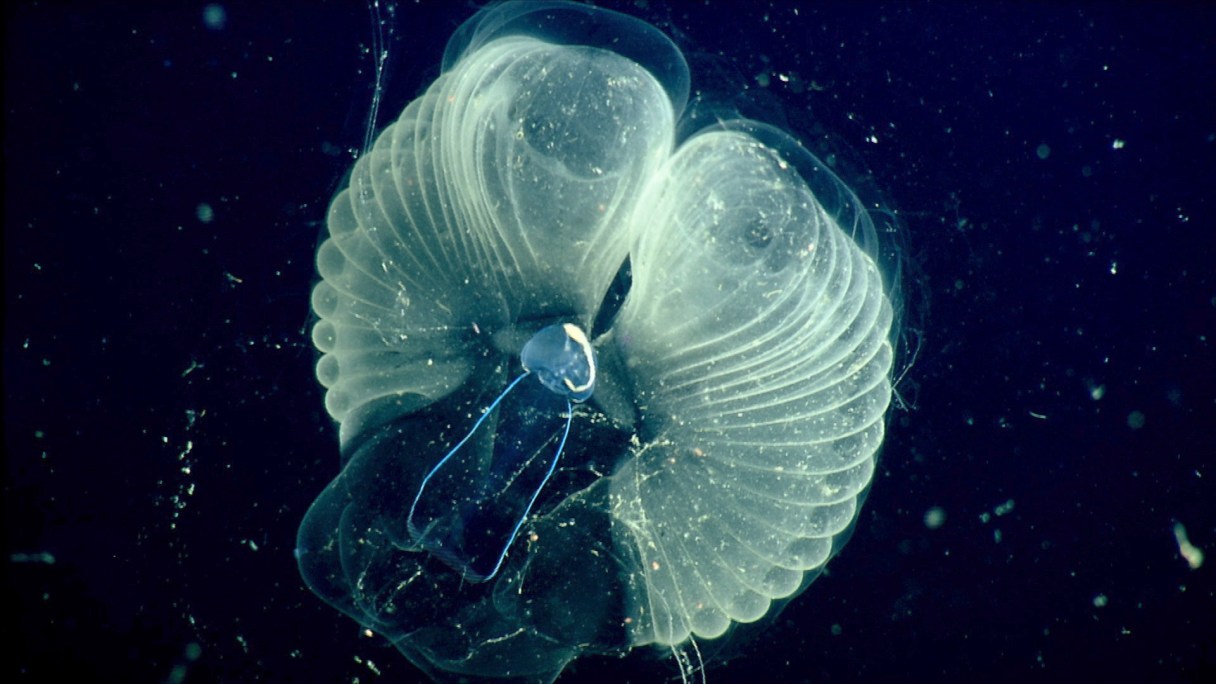
This 2002 photo provided by the Monterrey Bay Aquarium Research Institute shows a close up view of a "giant larvacean" and its "inner house" - a mucus filter that the animal uses to collect food. The creature, usually three to ten centimeters (about one to four inches) in length, builds a huge mucous structure that functions as an elaborate feeding apparatus, guiding food particles into the animal's mouth. When the filters get clogged, the larvacean abandons them. The abandoned filters sink toward the seafloor, and become an important food source for other marine animals. (MBARI via AP)
This 2002 photo provided by the Monterrey Bay Aquarium Research Institute shows a close up view of a "giant larvacean" and its "inner house" - a mucus filter that the animal uses to collect food. The creature, usually three to ten centimeters (about one to four inches) in length, builds a huge mucous structure that functions as an elaborate feeding apparatus, guiding food particles into the animal's mouth. When the filters get clogged, the larvacean abandons them. The abandoned filters sink toward the seafloor, and become an important food source for other marine animals. (MBARI via AP) This 2002 photo provided by the Monterrey Bay Aquarium Research Institute shows a close up view of a "giant larvacean" and its "inner house" - a mucus filter that the animal uses to collect food. The creature, usually three to ten centimeters (about one to four inches) in length, builds a huge mucous structure that functions as an elaborate feeding apparatus, guiding food particles into the animal's mouth. When the filters get clogged, the larvacean abandons them. The abandoned filters sink toward the seafloor, and become an important food source for other marine animals. (MBARI via AP)

KENSINGTON, Maryland (AP) – Master builders of the sea construct the equivalent of a complex five-story house that protects them from predators and funnels and filters food for them – all from snot coming out of their heads.

And when these delicate mucus homes get clogged, the tadpole-looking critters – called giant larvaceans – build a new one. Usually every day or so.

These so-called “snot palaces” could possibly help human construction if scientists manage to crack the mucus architectural code, said Kakani Katija, a bioengineer at Monterey Bay Aquarium Research Institute.

Her team took a step toward solving the mystery of the snot houses and maybe someday even replicating them, according to a study in Wednesday’s journal Nature.

The creatures inside these houses may be small – the biggest are around 4 inches (10 centimeters) – but they are smart and crucial to Earth’s environment. Found globally, they are the closest relatives to humans without a backbone, Katija and other scientists said.