
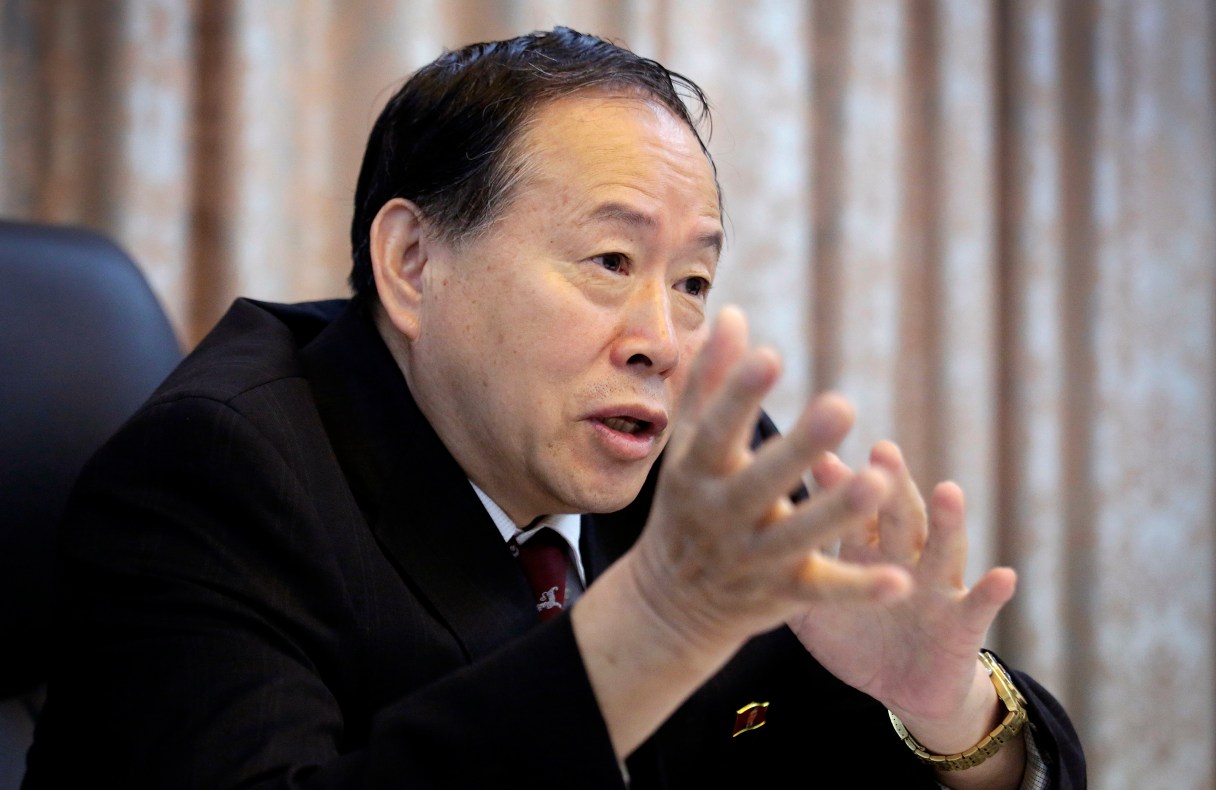
PYONGYANG, North Korea (AP) – The top North Korean official for U.S. relations told The Associated Press on Friday that his country is now a nuclear threat to be reckoned with, and Washington can expect more nuclear tests and missile launches like the ones earlier this week as long as it attempts to force his government’s collapse through a policy of pressure and punishment.
“It’s the United States that caused this issue,” Han Song Ryol, director-general of the department of U.S. affairs at North Korea’s Foreign Ministry, said in his first interview with an American news organization since assuming the post three years ago. “They have to stop their military threats, sanctions and economic pressure. Without doing so, it’s like they are telling us to reconcile while they are putting a gun to our forehead.”
Han defended the North’s test-launching on Wednesday of two medium-range ballistic missiles. Foreign military experts believe that, once perfected, such missiles could deliver nuclear warheads to U.S. bases in Japan and possibly to major U.S. military installations as far away as the Pacific island of Guam, where long-range U.S. Air Force bombers are deployed.
The tests indicate technological advances in the North’s missile capabilities. They were quickly condemned by Washington, Tokyo and Seoul as a “provocation” and a violation of United Nations resolutions.
Han dismissed the criticism, saying North Korea has no choice but to build up its military deterrent as long as the world’s largest superpower – and the country that first developed nuclear weapons – remains an enemy. He noted that the U.S. recently deployed nuclear-powered submarines and strategic bombers capable of dropping nuclear weapons on North Korea to the region, and earlier this year conducted training for precision airstrikes on North Korea’s leadership, along with simulations of an advance into the capital, Pyongyang, with the South Korean military during joint annual exercises.