
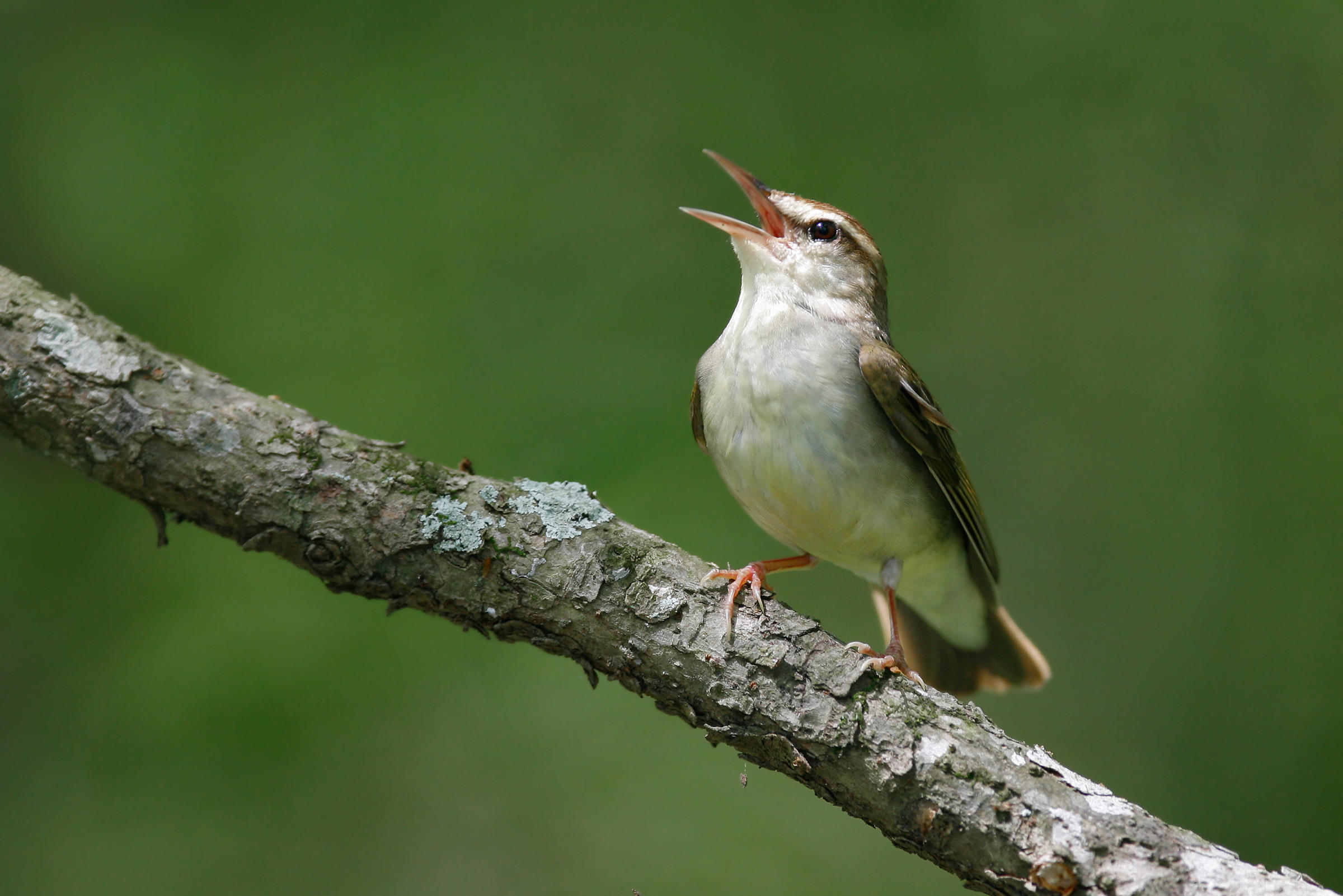
 Swainson’s warbler (Limnothlypis swainsonii) (Photo: Audobon Society)
In 1986, Dr. Charles P. Nicholson, with help from the Tennessee Ornithological Society, began research on what would become the Atlas of the Breeding Birds of Tennessee.
The first comprehensive study documenting distribution patterns – or the geographical areas in which certain birds are found – of 170 species confirmed as breeding in Tennessee, it includes species now extirpated, such as the red-cockaded woodpecker.
After six years of field work and 36,000 hours of bird survey by over 200 participants, the Atlas was published in 1997.
Twenty years later, Nicholson is still on the Tennessee bird scene, regularly leading birding walks throughout the state.
Now, meet the birder behind the book.
What is your earliest memory of being fascinated by birds?
I can’t recall a single event. It was an evolution of seeing birds at our bird feeder and becoming increasingly interested in nature on family camping trips and through Scouting. Then, in high school, it all came together as a classmate and I started going bird watching around Knoxville and joined up with the local bird club.
Do you have a favorite breeding bird of Tennessee? If so, what do you love about it?
It is very hard to single out one favorite. Based on plumage, the scarlet tanager and indigo bunting are favorites. Based on song, the winter wren, with its long, complex song, and the flute-like wood thrush. By habitat, the winter wren in high-elevation forests and the Swainson’s warbler in rhododendron thickets and swamp forests.
Where are some of the best summer birding spots in East Tennessee?
My favorite summer birding areas in East Tennessee are Frozen Head State Natural Area, Big South Fork National River and Recreation Area, and the Tellico District of Cherokee National Forest.
Are there any birds you documented in the Atlas (published in 1997) that have since been extirpated? Or, any other stark changes you might expect to document if you wrote the book today?
Unfortunately, yes. By the late 1980s, when the fieldwork for the Atlas project was underway, the red-cockaded woodpecker was only known from one location near Parksville Lake in Polk County. Just a few years earlier it occurred in the Great Smoky Mountains, Savage Gulf and in the northern Cumberlands in Campbell County. The last individual disappeared from the Polk County location in the early 1990s.
Do you have any bird watching tips for beginner birders?
Get a good pair of binoculars and a good bird identification book. For binoculars, look for a pair with 7X or 8X magnification. Try them before buying to make sure they fit your face, eyes and hands. I recommend avoiding the very small compact binoculars as their field of vision is often limited and they can be harder to focus. If you wear glasses all the time, learn to use your binoculars while keeping your glasses on. You’ll miss a lot if you are constantly swapping between glasses and binoculars.
For beginning bird identification, I recommend the Peterson guide, which remains one of the best for first learning birds. Several smartphone apps are good for learning songs and more on birds, but they are sometimes not as useful as a good identification book in the field.
The local chapters of the Tennessee Ornithological Society, including the Chattanooga chapter, welcome newcomers on their field trips and are a great resource for beginning birders.
For more information visit tnbirds.org.