
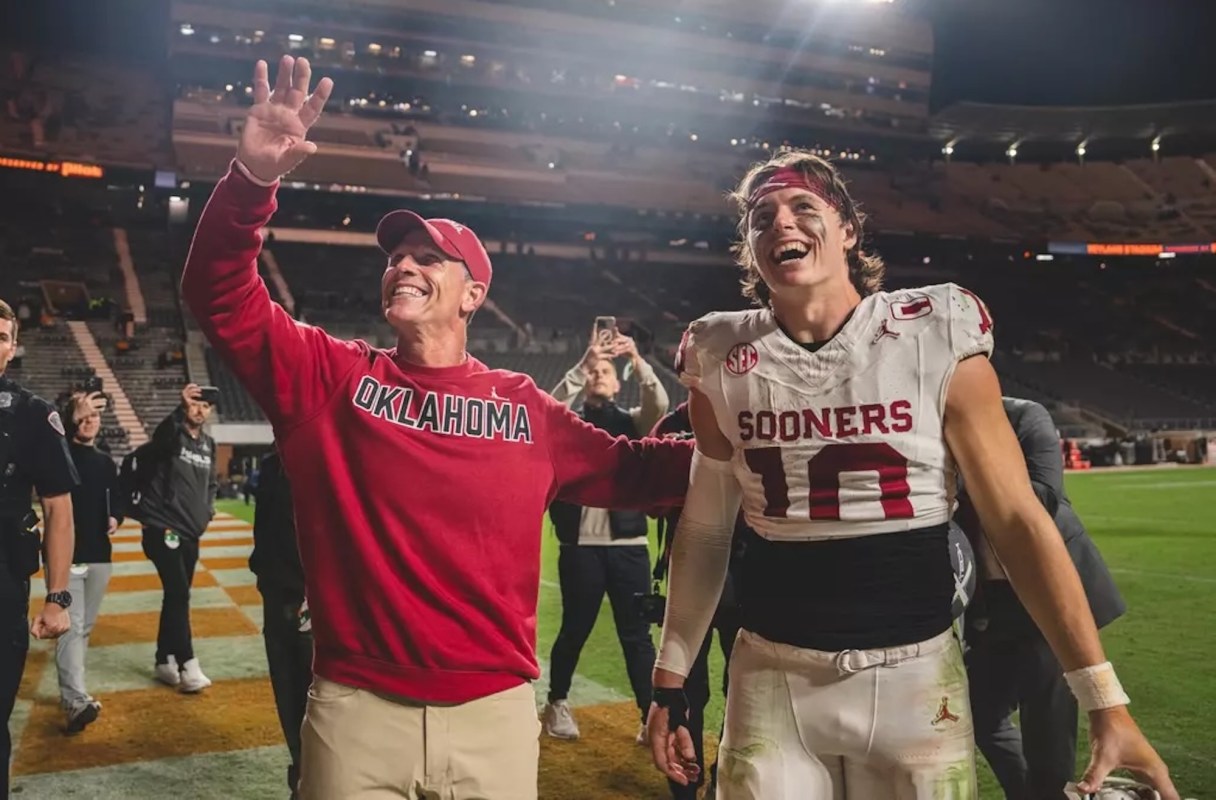
Oklahoma earned a first-round host site in last season’s College Football Playoff with a strong November, winning at Tennessee and at Alabama and downing Missouri and LSU at home.
The Sooners were defeated by Alabama in a rematch and hardly get a reprieve this year, as three of their first five games are against Michigan, Georgia and Texas. None of those three are in Norman.
“You’re not going to sneak up on anybody in Ann Arbor or by going to Athens,” Oklahoma fifth-year coach Brent Venables said last week at the Southeastern Conference’s media days in Tampa. “I think Georgia has lost maybe once in five or six years at home. Georgia has been the gold standard in my opinion for college football for quite some time now, and obviously playing Texas in Dallas is always a tremendous challenge.
“That’s what our conference looks like. Nobody’s going to look past Oklahoma. We’re going to bring out the best in everybody, and our guys are really looking forward to the challenge, particularly early in the season. There are no walkovers after those three games, either.”
SEC teams are less than six weeks away from embarking on the most demanding season in league history, as the conference is implementing a nine-game schedule for the first time. The conference employed six league contests through the 1987 season and then quickly bumped it from seven to eight after the 1991 season, when Arkansas and South Carolina joined to form a 12-team collection.
The SEC set a record for playoff teams by sending five members last season — Alabama, Georgia, Oklahoma, Ole Miss and Texas A&M — and the addition of a ninth conference contest already has league coaches expecting a healthy contingent of playoff teams each year moving forward.
“I saw where every team in this league has one of the 20 toughest schedules in the country,” South Carolina’s Shane Beamer said. “I think nine of the top 10 toughest schedules in the country going into the season are in the SEC. I’m excited. We get to compete against the best.”
PLAYOFF PICTURE
Commissioner Greg Sankey last week expressed being “unapologetic” about the competition and challenges a nine-game schedule will bring to an SEC that won 13 national titles in the 17-year stretch from 2006-22. Three different Big Ten programs have snagged the crown since, and in the two years of the 12-team playoff, the SEC is a disappointing 3-6 against teams from other leagues.
Sankey was hoping to have more clarity about the impact of an enhanced schedule strength in regards to the 13-member CFP selection committee, but that has not come to fruition.
“We had what I’ll call an unsatisfactory conversation with members of the College Football Playoff staff and some of their advisers in Destin,” Sankey said last week. “That’s rehashing from a couple months ago. That’s not a secret. That’s a reminder of that process needing to continually improve.
“My confidence is that people will act with integrity. I do think we have questions about the understanding of the strength and rigor associated with competing in the Southeastern Conference.”
Although Oklahoma’s close to last season was the primary factor in landing a CFP invite, the Sooners also had a 24-13 September victory over Michigan. That proved to be a quality gauge when the Wolverines bounced back to win seven of their first eight Big Ten contests before falling to rival Ohio State.
Yet several quality home-and-home, nonconference matchups have been getting axed in the months since the SEC announced its nine-game format, most notably Alabama-West Virginia (2026-27), South Carolina-Miami (2026-27), Georgia-Florida State (2027-28), and South Carolina-North Carolina (2028-29). Alabama still has Florida State this season and is scheduled to travel to Ohio State next year, while Georgia and South Carolina will continue to end their respective regular seasons against in-state rivals from the Atlantic Coast Conference.
KIFFIN’S CONCERN
LSU first-year coach Lane Kiffin said those nonconference pairings falling by the wayside are his biggest concern with the new nine-game schedule.
“Teams will eventually get out of the bigger nonconference games, because the selection process is not fixed,” Kiffin said. “Until that is fixed to really and truly reward strength of schedule, all you’re going to have is more conference losses. You don’t prove anything. If we’re all in the same conference and we keep playing each other, we don’t really prove that we’re better than anyone else.
“I just think that it’s going to cause more issues than we’ve already seen. Until we can get into a world where people can actually look at teams and say a team that is 9-3 with their schedule is a better team than that 11-1 team in a different conference — we aren’t even close to doing that now — I think it causes a problem, because we don’t have enough nonconference opportunities in our sport.”
(SIGN UP: Get the daily sports newsletter in your email box by clicking here)
The new nine-game schedule contains three annual opponents and six rotating foes, and it has left several notable rivalries now taking place twice every four years. Tennessee does not play Florida or Georgia this season, while LSU doesn’t face Alabama or Florida.
Every SEC school does get to host and visit every fellow league member within a four-year frame under this new format, but the CFP is dictating the sport right now, and only time will tell whether going to nine games will prove beneficial or be a postseason hindrance.
“I look at other sports, like baseball,” Kiffin said. “Oklahoma just won a national championship in baseball, and I think they were 14-16 in SEC play. Think about that. In football we would be nowhere near the playoffs, you know? They finished 11th (in the SEC) in the regular season and then won the national championship, but they also had nonconference games to show how good they were.
“I just think that this system wasn’t ready for this change yet until they change the selection part.”
Contact David Paschall at dpaschall@timesfreepress.com.