
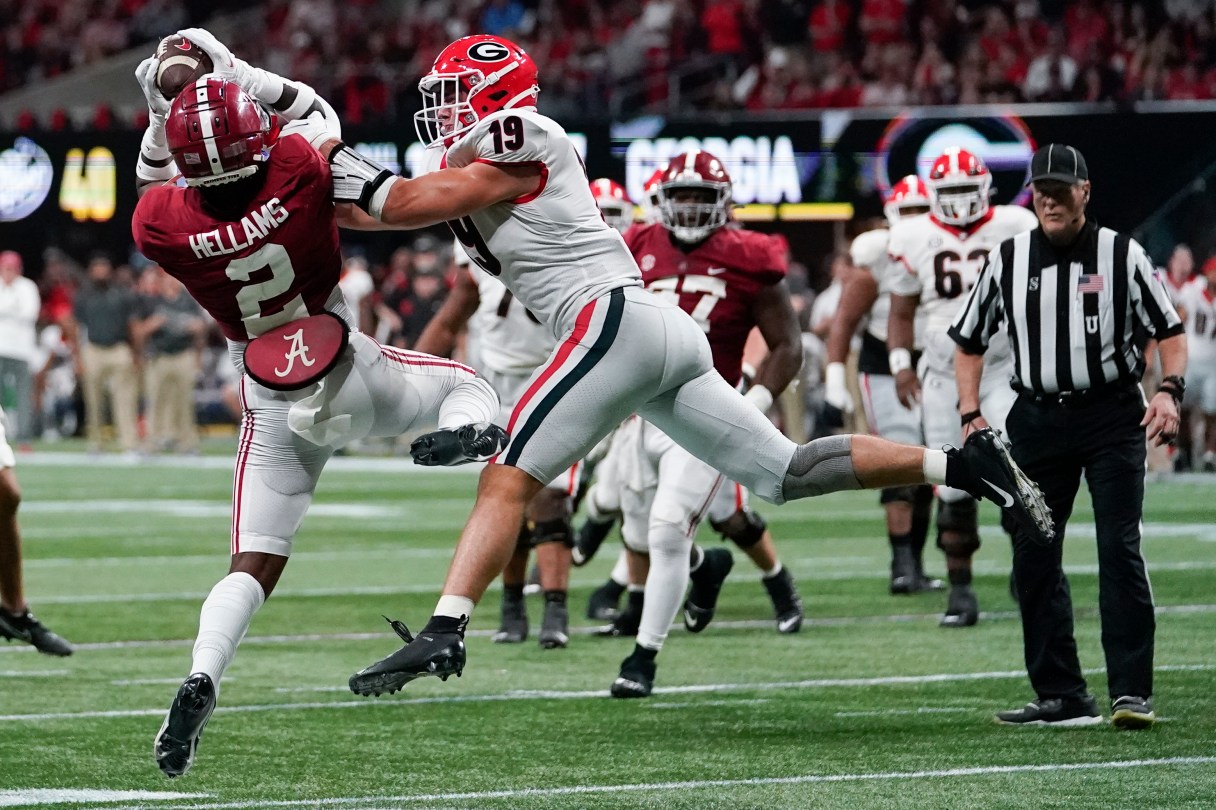
Almost everything about this college football season has been a joyride for No. 2 Michigan, the first team to start unranked in The Associated Press Top 25 and reach the four-team playoff, which debuted in the 2014 campaign.
“We’re happy to be here,” Wolverines coach Jim Harbaugh said, “but not just happy to be here.”
Reaching the College Football Playoff in 2021 was always the expectation for No. 3 Georgia, and it seemed like a foregone conclusion by November as the Bulldogs rampaged through their schedule.
Not even a resounding loss to Alabama in the Southeastern Conference title game this month could keep them out, but instead of bounding into the Orange Bowl semifinal off huge victories – which is what Big Ten champion Michigan is doing – the Bulldogs enter trying to reestablish the air of invincibility they carried much of the season.
“You lose some, and you just go on getting better,” said Jordan Davis, Georgia’s All-America defensive tackle. “Obviously we’re not going to be the same team from last game to this game with Michigan, but we just have to keep moving forward and worry about ourselves and just get ready for the game.”
The Wolverines (12-1) and Bulldogs (12-1), two storied programs that haven’t played in more than half a century, took very different paths to their meeting, set for 7:30 p.m. Friday at Hard Rock Stadium in Miami Gardens, Florida.
The winningest program in college football history, Michigan doesn’t fit the profile of an upstart, but few could have seen this breakthrough coming in year seven under Harbaugh. He said he felt like this year’s Wolverines “created some new buzz” at his alma mater.
“Yeah, let’s face it, it had died down a little bit, and I do feel like our guys have created some new buzz, and it’s been a good thing,” Harbaugh said.
Coming off a 2-4 record in 2020, the Wolverines used the doubters and critics of their coach as fuel, and that’s still the case as center Andrew Vastardis wore a “Michigan vs. Everybody” T-shirt during a Zoom session with reporters this week.
“I’d say that shirt really begins from fall camp and spring ball when we knew that a lot of people would be counting us out,” offensive tackle Andrew Stueber said. “I saw somewhere there was a .05% chance of making it to the College Football Playoff. A lot of people didn’t believe in us, and it kind of drove us this whole season.”
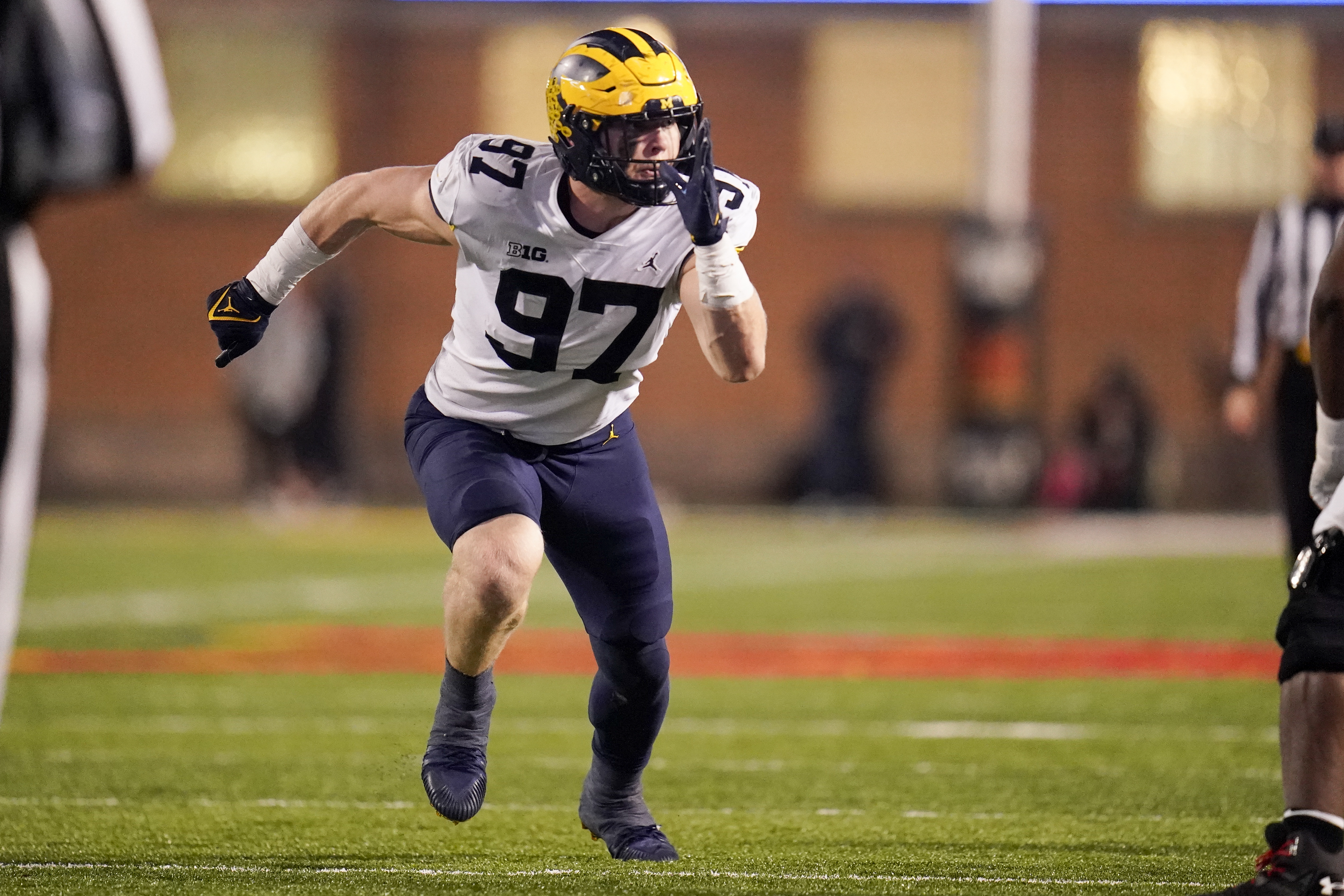 AP photo by Julio Cortez / Michigan defensive end Aidan Hutchinson (97), a Heisman Trophy finalist, and outside linebacker David Ojabo have a combined 25 sacks this season as one of the country’s most potent duos when it comes to pressuring quarterbacks.
“Why not us?” has been another Michigan rallying cry.
Since blowing a 16-point lead in the second half at Michigan State to lose 37-33 to the Spartans on Oct. 30, the Wolverines have won five straight games. That includes rallying late to win at Penn State, snapping an eight-game series losing streak to Ohio State to close the regular season and crushing Iowa to win the Big Ten for the first time since 2004.
“Definitely riding that into this game, and just ready to go out there and take advantage of every opportunity we get,” Vastardis said.
There is a different vibe around Georgia.
Nobody doubted the Bulldogs would be a playoff contender this season. Led by a defense stacked with blue-chip recruits and future NFL draft picks, they allowed less than a touchdown per game through a 12-0 start – and then lost 41-27 to Alabama in the SEC title game in Atlanta.
The Bulldogs haven’t won a national title in football since 1980. While coaches and players don’t worry about that, or at least not publicly, those who support the program do, and a seventh straight loss to Alabama brought on some unwanted familiar feelings for Georgia fans.
Smart said the key to coming back from a defeat is to keep it technical and analyze what went wrong with the players.
“Don’t be judgmental,” said Smart, who is in his sixth season leading his alma mater. “Don’t say things (such as) ‘If you do this and if you do that, you’re going to get your butt beat.'”
While Alabama attacked Georgia’s defense with quarterback Bryce Young, the first-year starter who won the Heisman Trophy, and All-America receiver Jameson Williams, Michigan’s calling card is its running game.
The Wolverines, led by third-team All-America back Hassan Haskins, have averaged 223 rushing yards per game and 5.31 per carry, and they have scored 39 touchdowns on the ground. Meanwhile, a Georgia defense led by Davis and All-America linebacker Nakobe Dean has been an immovable object against the run, having allowed averages of 82 rushing yards per game and 2.61 per carry while surrendering just three touchdowns on the ground.
Davis doesn’t expect maintaining that standard to come easily against the Wolverines.
“They’re definitely a physical team,” he said, “and it’s a tremendous challenge for our front seven.”
Both teams have used two quarterbacks, though in much different fashions.
Michigan has sprinkled in backup J.J. McCarthy to complement starter Cade McNamara all season long. McCarthy’s athleticism is part of how offensive coordinator Josh Gattis brings some diversity and creativity to the offense.
Georgia has had two starters at the position, with JT Daniels beginning in that role before an injury opened the door for Stetson Bennett to return to a job he held at one point last season. Bennett, a former walk-on, will start the Orange Bowl after a rough SEC title game against Alabama.
Wide receiver Kearis Jackson said the Bulldogs have rallied around Bennett and “and let him know he’s not in this alone, even though he was receiving a lot of bad talk about him.”
Daniels’ status seemed uncertain after he arrived in Georgia a day later than the rest of the team.
Hutchinson and outside linebacker David Ojabo have combined for 25 sacks this season, a little more than 75% of Michigan’s total. It will be on offensive tackles Jamaree Salyer and Warren McClendon to keep two of the best pass rushers in the country away from whoever is at quarterback for the Bulldogs.
“They present different matchups,” Salyer said. “Each of them are very good at different things but very talented players, and I’m excited for the matchup.”