
Anyone who watched President Barack Obama’s 45-minute talk with New York Times columnist Thomas Friedman had to be impressed to see him candidly discuss his approach to the volatile topic of nuclear talks with Iran. He explained the evolving agreement and his thinking on its framework, opportunities and pitfalls with thoughtful poise and statesmanship.
And he offered his concerns about congressional reaction to it — specifically the Senate’s efforts to control it through legislation proffered by U.S. Sen. Bob Corker and others. The president said he was open to finding a way for Congress to “express itself” as long as it did not block his ability to carry out the agreement. Despite the myths that the legislation is churning, the Iran nuclear agreement is not a treaty which would require congressional input. It is a sole executive agreement — and one that other nations have signed on to as well. And while not perfect, it is far, far better than no deal or a Congressionally scuttled deal.
The president’s concern is well-founded. This is, after all, the majority-GOP Congress of “no.” There is a reason this Congress has a 9 percent approval rating with Americans: Our members of Congress have shown us time and again that they are interested mainly in obstructionism. And, of course, the Koch brothers’ money.
But similarly, a Congress that wouldn’t be interested in having a role also would be concerning. The trick is finding what that role will be.
If Congress were to show a real inclination to actually care about not taking us to war and about helping to generate a negotiated peace — in short, back the president for a change or at least not make the discussion all about him vs. them — imagine how much stronger our negotiating position would be.
Admittedly, the only chance of that happening is if a few members of Congress grow up and grasp the American public’s incredible disgust with Washington’s partisanship and childish, petulant bickering.
Sen. Corker may be one of those few. That said — the result for Corker might be a razor-like tightrope.
Or it might be opportunity.
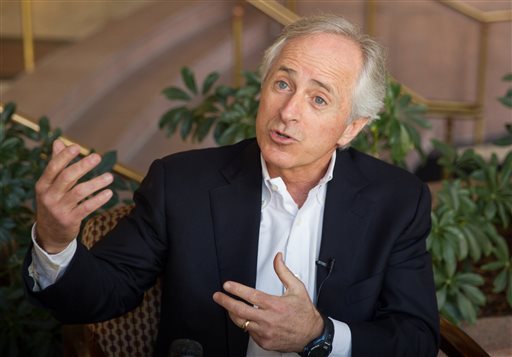
Early this week, The New York Times published a very flattering story about Corker, obliquely likening the new chairman of the Foreign Relations Committee to Republian Howard H. Baker Jr., the late Senate majority leader known as the “Great Conciliator” for his gracious but tenacious negotiating ability. (In 2012, Tom Daschle related an often-told story that “a reporter once said to a Democratic senator: You know, if the Democrats had to elect one of their colleagues president, Howard Baker would probably win a plurality of the votes. You’re wrong, the Democratic senator said, he’d win a majority.”)
But if the New York Times knew Chattanooga’s former mayor as well as we do, they would understand that the great negotiator they see — “the silver-haired senator with the Southern drawl who sees himself as a bridge builder in a Senate known for polarization” — fully loves a challenge and is greatly motivated by opportunity. Some call it bald ambition.
Thursday at the Times Free Press, Corker told editors and reporters that most senators understand the president has the authority to negotiate foreign policy and work with other nations. He says they understand the president has the authority to lift executive sanctions and work with the UN Security Council to lift sanctions. What the Senate wants, says Corker, who authored a bill to force President Obama to send any agreement with Iran to Congress for approval, is front-end ability to approve or disapprove of an agreement that calls eventually for the lifting of the sanctions that the Senate previously OK’d.
“What you’re seeing happen right now is a United States Senate that’s saying that this is probably the most important geopolitical agreement that may occur while we are here,” Corker said. “And what we are requesting with this legislation is that you bring the final agreement … and allow it to lay it before us to allow us time to go through all of the details … and then let Congress, because Congress has in fact put these sanctions in place, … give us the right to make a motion to approve or disapprove. … We are only focusing our approval on the ability to lift our imposed sanctions.”
On one hand, that seems reasonable, and Corker is, after all, getting some traction for being one of the few adults in the GOP.
But that’s just it. He’s one of the few. He acknowledges that 144 amendments were filed on his legislation on Wednesday night alone. And he acknowledges that there are some in Congress and in the Senate who, no matter what, if the president is for something, they will be against it.
“This is the time for … the [other] 80 or 82 or 0f 85 of us … to conduct ourselves as senators on behalf of the American people,” he said. The vote is scheduled for Tuesday.
On Thursday, a Chattanooga Rotary Club member asked Corker if he is running for president. Corker didn’t say yes or no. He said: “That ship has sailed, and Elizabeth (his wife, who reportedly did not want him to seek presidential election,) is happy about it.”
Of course, that doesn’t preclude other aspirations: Secretary of State or Secretary of the Treasury, perhaps. Vice president. Even leader of the free world in some other term. Or maybe even just the implied moniker the New York Times laid on Corker in its story comparing him to that other Tennessean: Howard Baker Jr., the Great Conciliator.
Among the 550 reader comments adjoining the New York Times story were more than a few surmising or suggesting that Corker run for president.
Frankly, taking on the mantle of conciliator in this day and time — in this Congress — may be far more harrowing.