
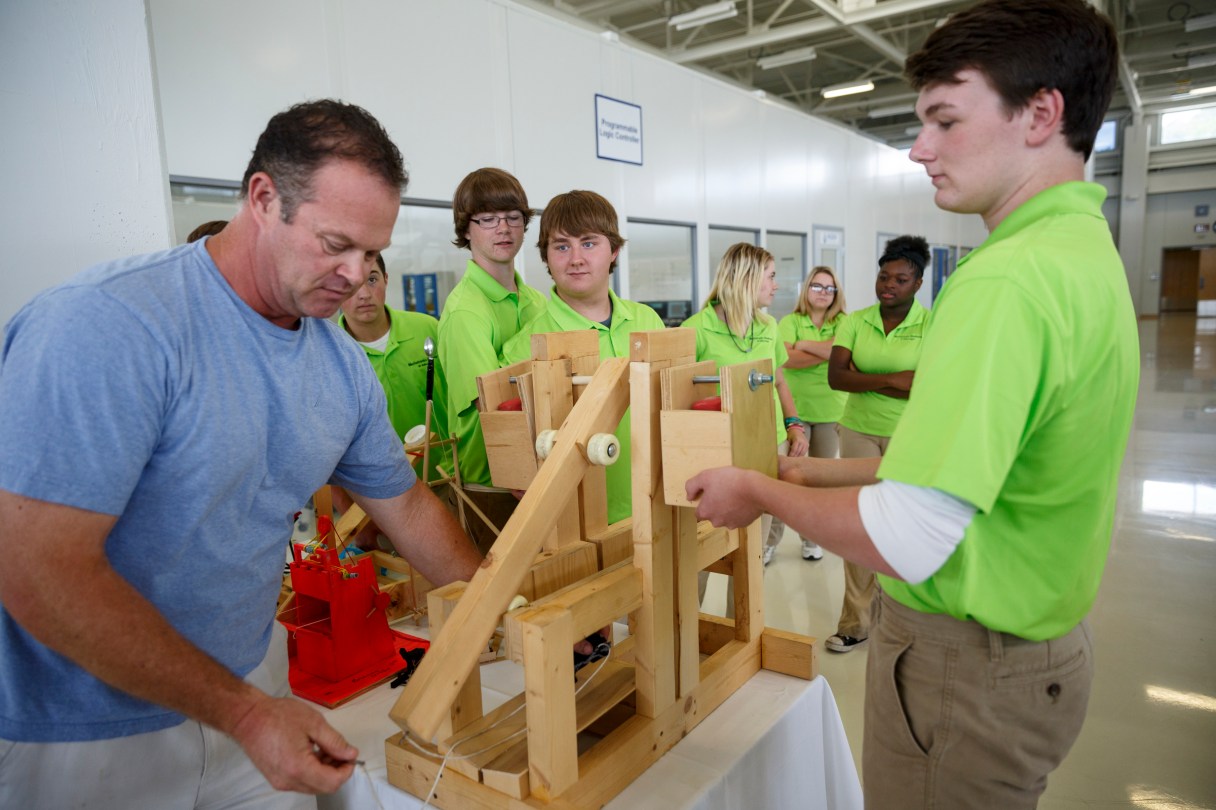
Vocational schools used to be a staple in Chattanooga’s and Hamilton County’s education systems.
They were the bread-and-butter building blocks of our economy until educators convinced us that a college-track secondary school program was better because a college degree for everyone was the only acceptable preparation to help our children make more of themselves – and more money, too.
But it didn’t work out that way.
Kirkman Technical High School – which had trained high school students here for industrial and trade jobs since 1928 – was closed in 1991 to make way for the “progress” on the Tennessee Riverfront. And with the exception of Sequoyah Vocational School in Soddy-Daisy (which largely taught auto mechancis, commercial art and cosmotology) we began steering all our youngsters to Shakespeare and trigonometry – like it or not.
In 1991, the median household income in Hamilton County was about $28,000. In 2014, it was $48,380. That increase sounds good until you realize that in 2014 dollars those 1991 households had an income that spent more like $50,836. So in practical terms, we went backward.
Those plumbers and electricians and mechanics who graduated from Kirkman year after year until 1991 earned more than our young people of today who graduate with high school diplomas that get them $18,000 a year jobs as janitors and fetch-it help on construction sites. They certainly made more than the young men and women who just dropped out of high school. And many made more than some of our college grads who are landing in ordinary service jobs.
We meant well, but we didn’t do well by our children.
Now we have an opportunity for a reset.
Hamilton County educators, faced with a growing realization that employers are finding our workforce unprepared for jobs at Volkswagen, Wacker and Gestamp, are expanding the mechatronics program at Volkswagen Academy and partnering to start a Polytechnic Academy on the Chattanooga State campus.
Last year’s pilot VW academy with 26 high school juniors will soon add another 25 students for its two-year program. And 100 more students will be dually enrolled in high school and college through the polytechnic program.
Last year, the Hamilton County Board of Education set a three-year goal to increase the number of students graduating with an industry certification from 80 students annually (some in more traditional programs like Hixson’s aquaponics program) to at least 450.
There is, as usual, just one little hitch. Money.
The college credits students get come with a price tag: $2,492 for juniors and $5,150 for seniors.
Given that Tennessee Gov. Bill Haslam convinced the General Assembly to pass Tennessee Promise giving two years of tuition-free community or technical college to Tennessee high school graduates, it seems a bit unfair to charge these over-achieving vocational/high school students in dual enrollment. But apparently the state has not yet found a way to accommodate this one-size-does-not-fit-all program. There is a provision for state grants for dual enrollment students pursuing a college degree, according the state’s website, but it’s unclear whether it could apply to the Polytechnic Academy, according to education officials.
Both state Sen. Todd Gardenhire, R-Chattanooga, and state Rep. Mike Carter, R-Ooltewah, say they will try to clarify the questions and find a way to help.
You can help, too, by letting them and other state lawmakers know you think it’s the right thing to do.