
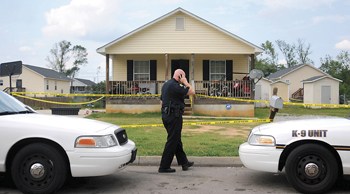
For about the price of a specialty coffee drink each month, Chattanooga taxpayers could adjust police pay, hire and train 40 new officers.
“Some of the people screaming, ‘We need more police officers’ are now screaming, ‘No new taxes,'” Mayor Ron Littlefield said last week. “You can’t hold both positions. That doesn’t make any sense to me.”
A $9 million requested increase over last year’s budget by the police department for the 2010-11 fiscal year would fully fund its operations and staff. That amount makes up 28 percent of the mayor’s 64-cent-per-$100-of-assessed-value property tax increase, records show.
That would cost the owner of a median-priced $131,900 home in Chattanooga an additional $59.40 in annual property taxes, or $4.95 a month, according to a Chattanooga Times Free Press analysis.
But many members of the City Council have said they could not stomach a huge property tax increase at this time and are looking for cuts. Council members have said they want to keep the police department’s portion of the budget intact as much as possible.
“Everybody seems to agree that the police numbers need to go up some,” Councilman Jack Benson said last week.
He said he already came up with one idea as a compromise on not cutting the budget. He said he may bring up funding only one police academy and fixing police officers’ pay. That way the department could bring in some officers while also hopefully retaining officers who otherwise might leave because they are not paid enough, he said.
“If we can start retaining policemen, we wouldn’t have as many academies,” he said.
Councilwoman Pam Ladd has suggested salary increases to any city employee who makes $50,000 or less. But she said that for the police department she wants as much of the proposed budget as possible — more officers getting more pay.
“I’d like to see if we can keep what’s proposed intact,” she said.
Hiring 40 sworn officers and 15 civilian employees for the department still would leave the staff 15 officers short of their ideal level, interim police Chief Mark Rawlston said.
With nearly two years since the last police academy graduated, the department has seen natural attrition leave staffing down 58 officers, the chief said.
The number of total sworn officers for the department recently has hovered about 425.
During that time the chief and his predecessors have shuffled bodies to patrol, to shore up that division of the force, often at the expense of other areas.
“We have cannibalized everybody else for patrol,” Chief Rawlston said.
By hiring the officers, he said, the department could fill patrol zones and allow each zone to target hotspots, thereby hitting troublesome areas harder.
“They’ll be more self-sufficient and fluid,” the chief said.
With a near full-staffed patrol division, investigations, crime prevention and other divisions would be freed up to do more work, he said.
“If we don’t hire this year, we will be at a staffing level at or below when I came to work in 1982,” Chief Rawlston said.
But simply bringing in new hires isn’t the only factor in boosting policing in Chattanooga.
Detective Phil Grubb, president of the local chapter of the International Brotherhood of Police Officers, said retaining current officers is even more important than new hires.
“I’ll be honest with you, adding those officers will help with the shortage,” he said. “But those officers aren’t going to stay.”
Many officers he spoke with say their main concerns are lack of pay and worry that city hall is working to take away portions of the pension, reduce benefits and eliminate the use of take-home patrol cars.
Officers have complained that a pay plan introduced in 2007 was not fully funded and was stopped altogether last year, leaving some lower-ranking police officers having received pay increases that surpassed some of their more experienced supervisors.
The issue, referred to as overlap, would cost about $1 million to correct, according to the city’s proposed budget.
64-CENT BREAKDOWNA portion of Mayor Ron Littlefield’s 64-cent-per-$100-of-assessed-value property tax increase pays for different portions of the budget. A breakdown of estimated portions of the tax increase includes:* 19 cents: General government* 18 cents: Police* 8 cents: Public Works* 8 cents: Fire* 3 cents: Parks and Recreation* 8 cents: Other departments (Neighborhood services, Personnel, Education, Arts & Culture and Executive Branch)Source: Proposed city budget
And Detective Grubb said that, although both new hires and pay solutions are needed, retaining officers simply is cheaper than losing them and having to replace them.
“Right now, if it were between getting the money or getting the academy, we’d rather have the money,” he said.
Vivian Hixson, site director for the East Chattanooga Weed and Seed program, has seen the direct result of staffing problems.
Two officers assigned full time to her area were pulled back to cover their zones because of staffing shortages in the last month.
The federal grant-funded program still pays overtime for officers to work the area, especially during busier times of the year such as the coming summer season, she said.
But without police visible in the community it’s hard for residents to build trust and communicate — a key for both crime response and prevention, she said.
A retired Chattanooga police captain, Ms. Hixson said adequate staffing lets police stay in an area longer during a shift and not simply drive through from “point A to point B” responding to 30 calls or more in a shift.
That’s when inadequate staffing can create a stressed working environment for the officers, leading to retention problems, she said.
Continue reading by following these links to related stories:
Article: East Ridge approves $500 pay increase of police officers
Article: Chattanooga: Better pay, worse economy boost police applicants