
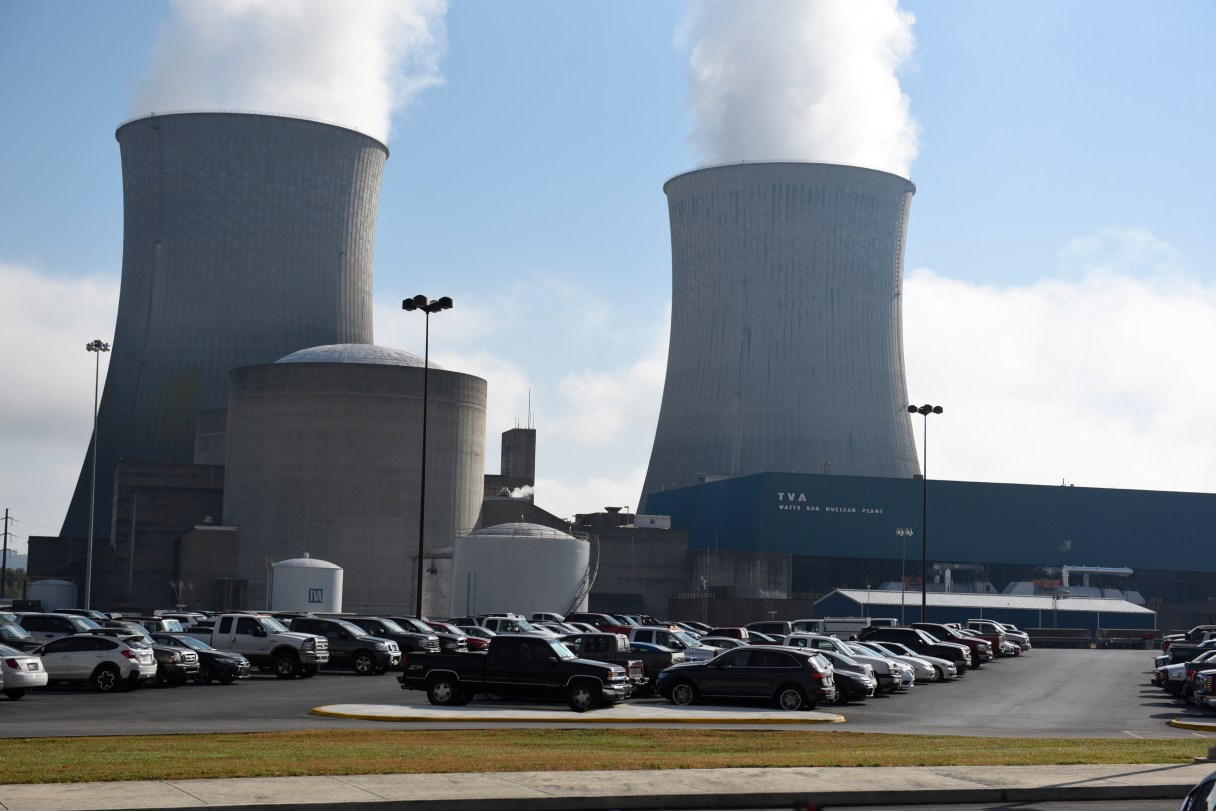

The Tennessee Valley Authority firmly anchored America’s foot back in nuclear power Thursday when its Watts Bar Unit 2 received its operating license.
It is the first U.S. nuclear plant to receive a license in the 21st century but is not scheduled to be the last. Work is currently underway at plants in Georgia and South Carolina, and energy companies would be smart to examine the efficacy of building others, especially given that renewable wind and solar power have nowhere near the ability to supply the amount of power needed and can’t compete on cost without being subsidized.
Read more
* Watts Bar Unit 2 ready to be fueled by year’s end* Watts Bar nuclear reactor granted operating license – first new U.S. reactor in 19 years* Regulators complete inspections for new TVA nuclear unit
Just over four decades ago, in 1973, the United States Atomic Energy Commission predicted that by 2000 there would be 1,000 nuclear reactors providing electricity for American homes and businesses.
One of those reactors was expected to be Watts Bar’s Unit 2, which was started that same year. But power demand slowed, fossil fuel prices were low and questions were raised about initial construction work at the Spring City plant. Indeed, work was suspended there between 1985 and 2007.
Incidents at Three Mile Island in Pennsylvania in 1979, Chernobyl in Ukraine in 1986, and Fukushima in Japan in 2011 also soured the public on the clean, carbon-free energy source, but advocates say improvements spawned by the incidents have only made the industry safer.
Watts Bar’s Unit 2 was 40 percent complete when work stopped in 1985, but TVA officials said the improvements – ordered by the Nuclear Regulatory Commission (NRC) after Fukushima – make it “essentially a new plant built on an existing platform.”
Even given that no new nuclear power plant had been licensed in the country since Watts Bar Unit 1 received an operating license in 1996, nuclear energy – available in 30 states – still accounts for 19 percent of the electric power in the U.S., 35 percent of TVA’s power mix and 63 percent of the country’s zero-carbon electricity supply.
Today, in addition to the work by Southern Co. and Scana Corp. on the reactors in Georgia and South Carolina, the nuclear industry is spending about $4 billion on safety upgrades at other plants, according to the Nuclear Energy Institute.
With the Obama administration’s war on coal, and restrictive policies put in place that will make fossil fuel production even more expensive, Unit 2’s scheduled start-up in early 2016 appears prescient.
Indeed, since 2012, TVA has either officially retired, idled or announced pending retirements of 33 coal-fired units, or about 46 percent of its coal fleet, according to Jim Hopson, TVA’s manager of media relations.
Yet, clean energy advocates couldn’t have been very heartened earlier this week when TVA released an analysis of solar power and distributed energy that concluded the overall value of solar power is 40 percent less than what TVA has been paying some solar producers.
That analysis found that the average value of solar generation for TVA to be 7.2 cents per kilowatt hour, well below the 12 cents per hour it is paying (based on a 2-cents-per-kilowatt hour premium paid above its average retail rate of 10 cents per hour). As recently as 2012, TVA was paying 22 cents per kilowatt hour.
Not surprisingly, industrial customers and some TVA distributors, during renewable energy public hearings, have urged TVA to pursue the cheapest source of power in order to keep electric rates low and remain competitive.
Watts Bar’s Unit 2 certainly fits in with that.
Bill Dean, director of the NRC’s Office of Nuclear Reactor Regulation, told World Nuclear News that more than 200,000 hours in eight years have been spent on Unit 2’s license application review. That process, extensive safety reviews and multiple inspections have satisfied regulators Unit 2 is safe to operate and should receive a 40-year license.
“Significant greenhouse gas reductions in the electric sector can’t be achieved unless our nation keeps the nuclear facilities we already have and builds more of them,” Marvin Fertel, head of the Nuclear Energy Institute, told Bloomberg Business.
Though Watts Bar’s Unit 2 means there are only 100 commercial nuclear reactors licensed to operate in the U.S., a far cry from the 1,000 predicted by the turn of the 21st century by the Atomic Energy Commission, the new unit should be able to provide economical power – even given its $6 billion price tag – for the next 80 years.
Although energy companies should look closely at the cost as TVA did, the long-term value of nuclear power makes it a sound investment as part of an all-of-the-above energy strategy for the nation’s portfolio.