
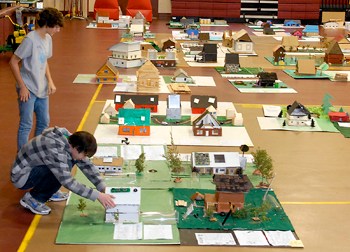
TRENTON, Ga. — The gymnasium at Dade County Middle School on Thursday looked more like a miniature suburb than a basketball court.
More than 320 scale-model homes, each based on one of four Habitat for Humanity house plans, sprouted this week to culminate Dade’s fall Project Synergy program dubbed “Habitown.”
For Project Synergy 2010, the school and local Chamber of Commerce partnered with Catoosa County Habitat for Humanity. School officials said students were challenged to build an accurately scaled model home, outfit it with green technology and compose and deliver a sales pitch for potential buyers.
Up to four students teamed up on home plans that were combined into subdivisions with common themes such as farming, sports or shared recycling and resources, officials said.
“I’ve always wanted to be an architect, and I’ve loved building,” said student Nathanuel Oxford, 14. He and three partners built a four-home subdivision that incorporates environmentally friendly power, waste and water recycling and geothermal heating, among other green technology.
Teammate Peyton Elrod, 13, said he likes architecture and drafting and that the project gave him the idea of including green technology in his future construction ideas.
Not only was the experience valuable in putting his knowledge to real use, “we had a lot of fun making it, too,” Peyton said.
Dade middle school teachers and program mentors Matt Jelley and Tom Randolph say the experience is invaluable for students and teachers.
Jelley said students learn more because “the learning becomes meaningful when it has an application outside the classroom.”
“It’s the relevance to the real world,” he said.
Randolph said the sales pitch is one of the most revealing parts of the project because all the students’ knowledge comes together in their presentations.
“Under No Child Left Behind, we live in a testing world. A computer-scored test can never judge anything like this,” Randolph said as Nathanuel and Peyton launched their spiel for visitors.
Principal Karen de Marché said Project Synergy is like life: It’s about problem solving, new ideas and students understanding their role in society.
“It’s a lot more effective than just recalling facts,” de Marché said. “It really makes you do higher-order thinking about the ‘whys’ and ‘what ifs.'”
Dexter Mills, executive director of the Northwest Regional Educational Service Agency, said he was impressed by the program.
“It’s taking what kids need to know — what we’re asking them to learn — and making it relevant to the real world,” Mills said.