
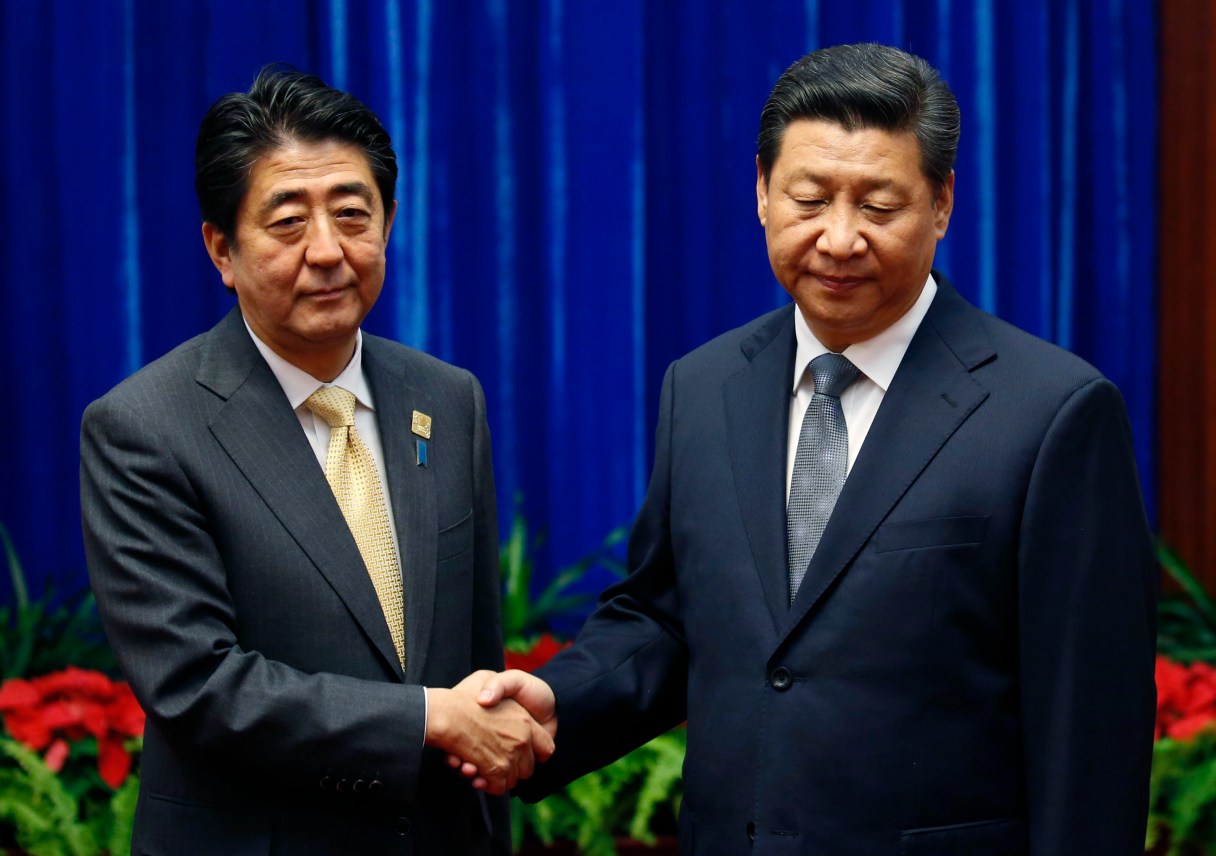
BEIJING (AP) – Chinese President Xi Jinping and Japanese Prime Minister Shinzo Abe took a major step in easing more than two years of high tensions over contested islands and wartime history with an ice-breaking meeting Monday during an Asia-Pacific conference.
The spat between China and Japan over uninhabited East China Sea islands has raised concerns of a military confrontation between Asia’s two largest economies, which could draw the U.S. into the fray alongside ally Japan. China also deplores what it sees as Japan’s efforts to play down its brutal 20th century invasion of China, a lingering sore point for its 1.3 billion people.
The closed-door meeting raises hopes that the countries can dial down tensions and burnishes Xi’s image as a statesman ahead of a summit Tuesday of 21 world leaders including President Barack Obama and Russian President Vladimir Putin. China hopes to use the Asia-Pacific Economic Cooperation summit to assert its ambitions for a larger leadership role in U.S.-dominated trade structures.
Although core divisions between China and Japan won’t be resolved soon, Abe told reporters that the countries made a “first step” toward reconciliation.
“I believe that not only our Asian neighbors but many other countries have long hoped that Japan and China hold talks,” Abe said. “We finally lived up to their expectations and made a first step to improve our ties.”