
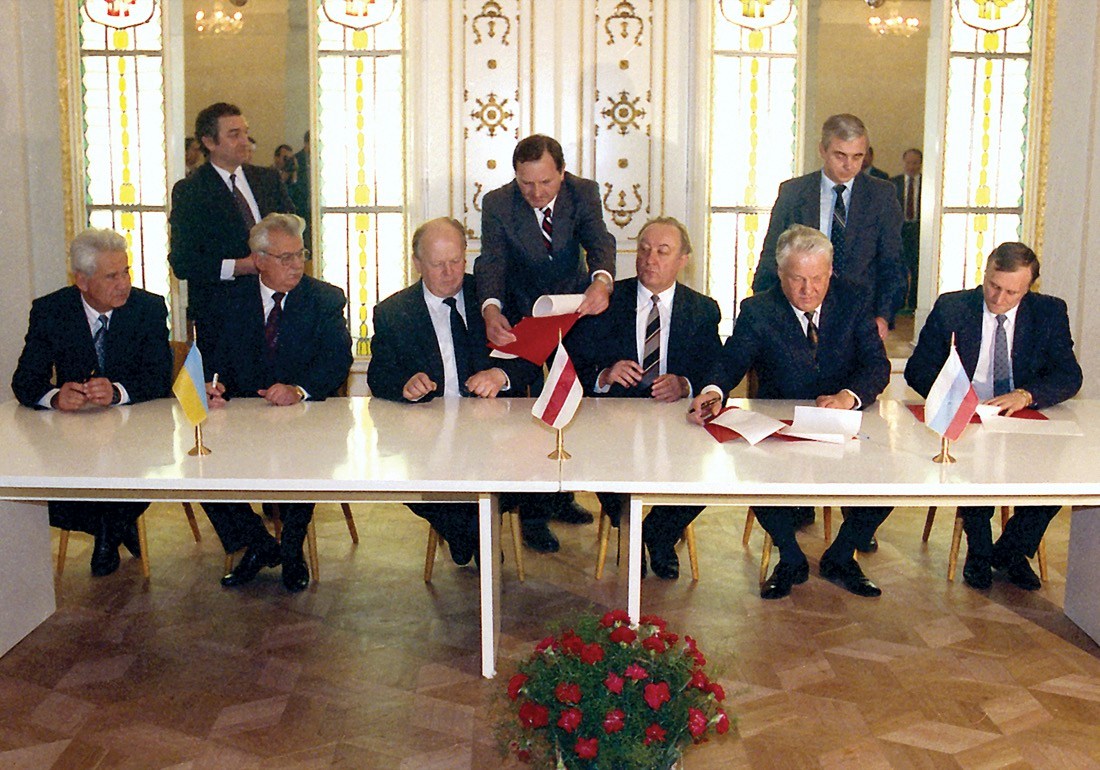
MOSCOW (AP) – When the leaders of the Soviet Union’s three Slavic republics met at a secluded hunting lodge on Dec. 8, 1991, the fate of the vast country hung in the balance. With a stroke of their pens, they delivered a death blow to the USSR, triggering shockwaves that are still reverberating three decades later in the tensions between Russia and Ukraine.
The agreement they signed at the dacha in Viskuli, in the Belavezha forest near the border with Poland, declared that “the USSR ceases to exist as a subject of international law and as a geopolitical reality.” It also created the Commonwealth of Independent States, a loose alliance of ex-Soviet republics that still exists but carries little meaning.
Two weeks later, eight other Soviet republics joined the alliance, effectively terminating the authority of Soviet President Mikhail Gorbachev, who stepped down on Dec. 25, 1991, with the hammer and sickle flag lowered over the Kremlin.
Stanislav Shushkevich, the head of the republic of Byelorussia, as Belarus was called at the time, spoke about the signing of the agreement with pride. The accord reached with Boris Yeltsin of Russia and Leonid Kravchuk of Ukraine, marked a “diplomatic masterpiece,” he said.
“A great empire, a nuclear superpower, split into independent countries that could cooperate with each other as closely as they wanted, and not a single drop of blood was shed,” added Shushkevich, 86, in an interview with The Associated Press.