
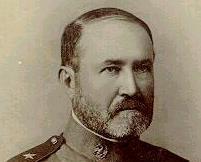
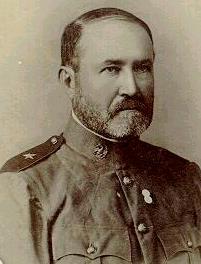
 Gen. Frederick Dent Grant, the son of Ulysses S. Grant / Contributed photo
A story in the July 1, 1928, Chattanooga Times included this remembrance in its introductory paragraph: “What memories of military panoply, of the glory and tragedy of armed conflict, of service for country and of patriotism aflame can be recalled by the older and later generations of our citizenry. For Chattanooga, since its infancy has been a theater of war; the scene in the [18]60s of mighty battles and, later, with Chickamauga National Park, at our doors, of military preparation, a spot where Mars donned his armor for battle.”
As Chattanooga prepares for the commemoration of Memorial Day almost 100 later, few citizens may be aware of the city’s military history.
Chattanoogans awoke on the morning of Feb. 18, 1898, to the news that the battleship Maine had been bombed in the Havana harbor, with more than 250 casualties. Within hours, the explosion was blamed on Spanish forces. By April 18, when a joint session of Congress declared war on Spain, preparations had already begun for Chickamauga to be designated as a concentration point for training soldiers.
The 25th Infantry, a regiment of Negro soldiers commanded by Col. Burt, arrived on April 14 to the cheers of more than 500 people awaiting their arrival at Union Station. Within days, six regiments of cavalry had been ordered to Chickamauga, and, by April 20, the city erupted in the “pomp and circumstance of war” as Gen. H.V. Boynton, Gen. A.P. Stewart, Maj. Watkins and others greeted the arriving command staff led by Major Gen. J.R. Brooks.
A local emergency company was formed by Champe S. Andrews and Charles T. Craine while the 2nd Battalion of Chattanooga organized with “lightning speed,” with J.P. Fyffe, major, commanding. Chattanoogans C.T. Brown and E A. Turner were named lieutenants, with G. Manning Ellis, surgeon, and H.V. Stevens, R.J. Arnold, C.S. Steward, George W. Brown, S.P. McIntyre and F.H. Phillips chosen as company commanders. The troops immediately went into camp at Driving Park [now Warner Park].