
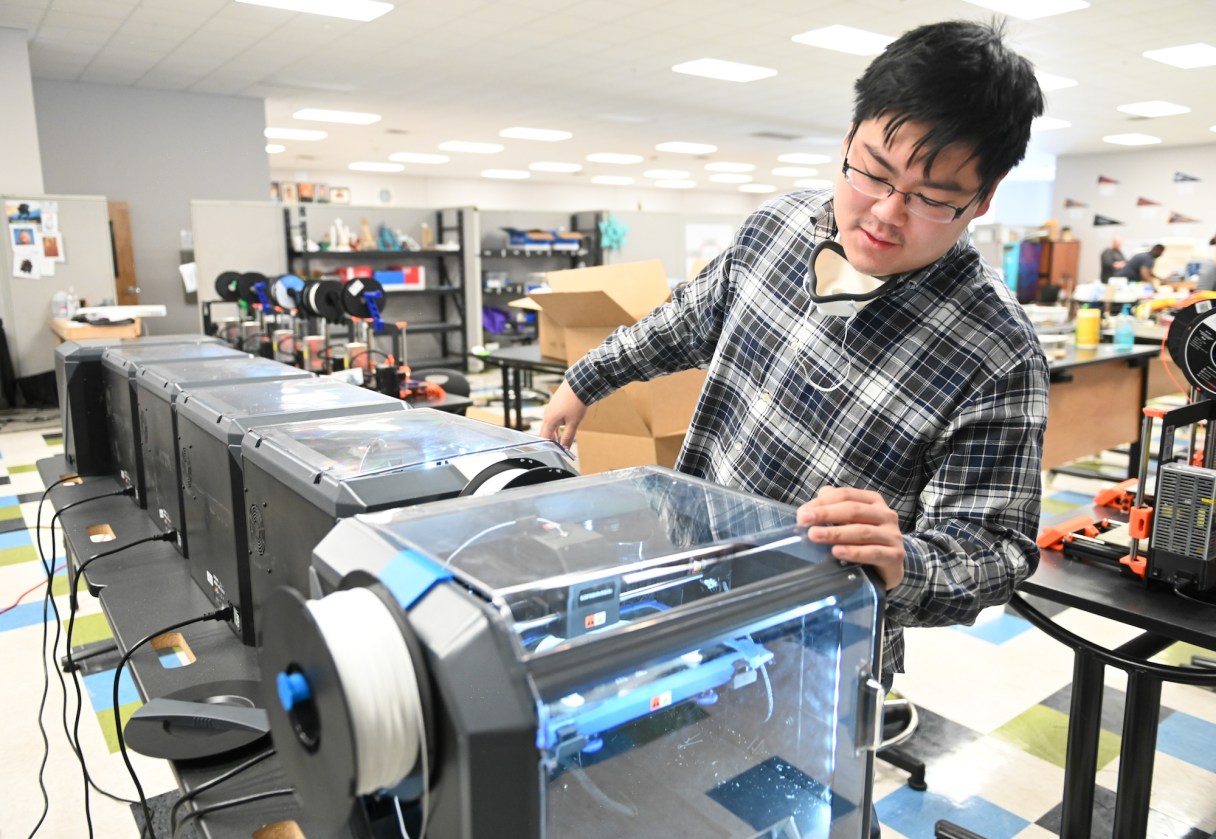
Sixty-two printers sit on tables arranged in an enormous rectangle. The wide-open space is filled with the zzzhh-zzzhh-zzhhh of the machines at work.
These aren’t your average printers, though, and what they’re producing is far from average. They’re 3D printers churning out parts for the transparent face shields used by health-care workers treating patients during the coronavirus crisis.
Every day for the past few weeks, UTC graduate Chantz Yanagida has spent eight hours with the printers, in charge of maintaining and repairing them. Located in the Hamilton County Schools’ STEM School on the Chattanooga State Community College campus, production of the 3D-printed pieces is a collaboration between the STEM School, Public Education Foundation, Hamilton County Schools and eLab Repairs, the company Yanagida created soon after graduating from UTC in 2019 with a degree in mechanical engineering.
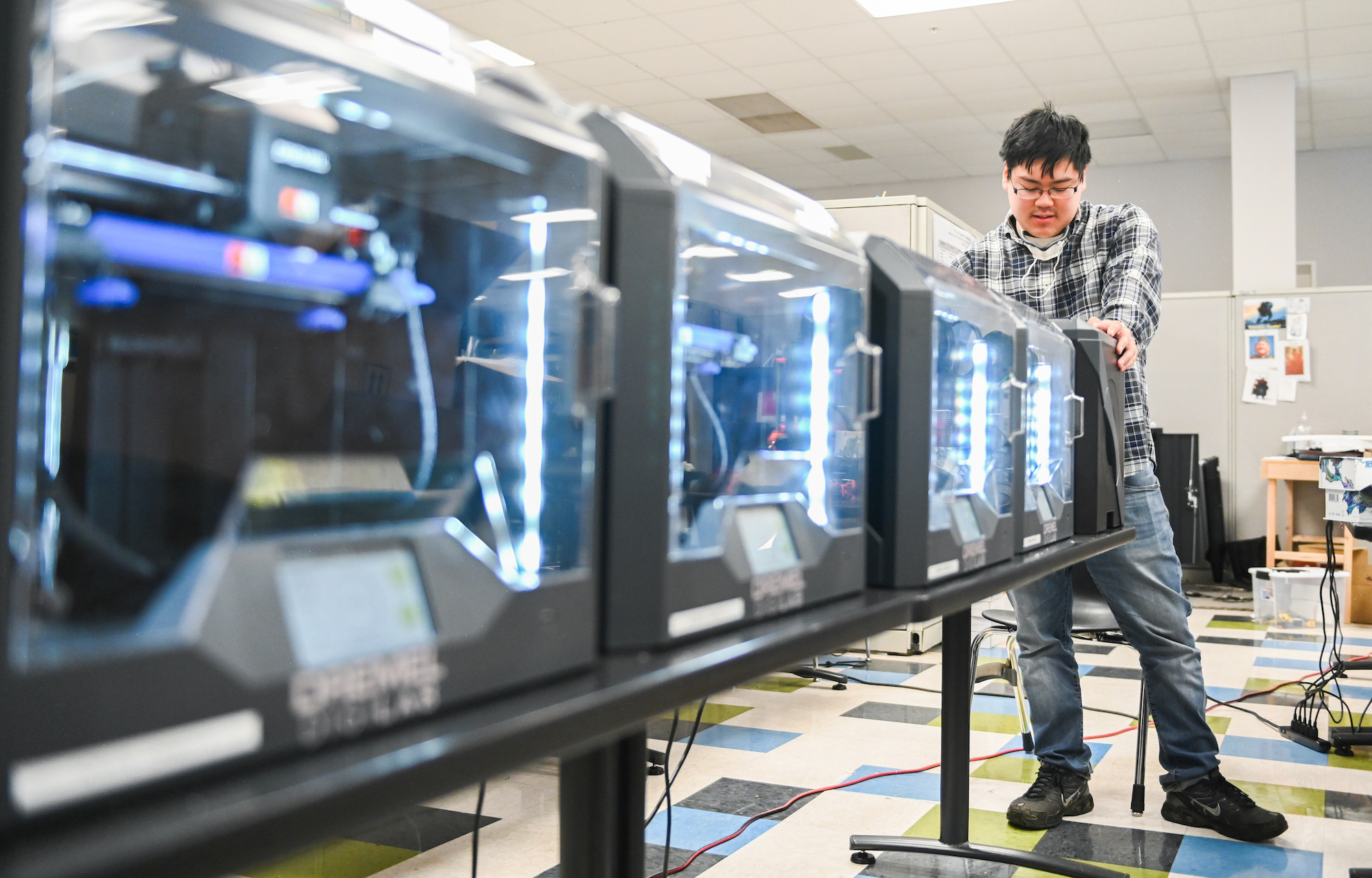 Contributed Photo by Angela Lewis Foster / UTC graduate Chantz Yanagida checks a 3D printer he’s using to make transparent face shields at Hamilton County’s STEM School at Chattanooga State Community College.
Right now, days are long, he said. He usually gets to the STEM School about 10 a.m., works a full day, goes home, eats dinner, then starts another eight hours of work designing 3D prototypes for the N95 respirators that, like face shields and surgical masks, are in desperately short supply across the nation.
“My workday is usually from 10 a.m. ’til 3 a.m.,” Yanagida said, smiling with grim humor because he’s not kidding. “I’m having a lot of fun, but, yeah, I’m tired.”