
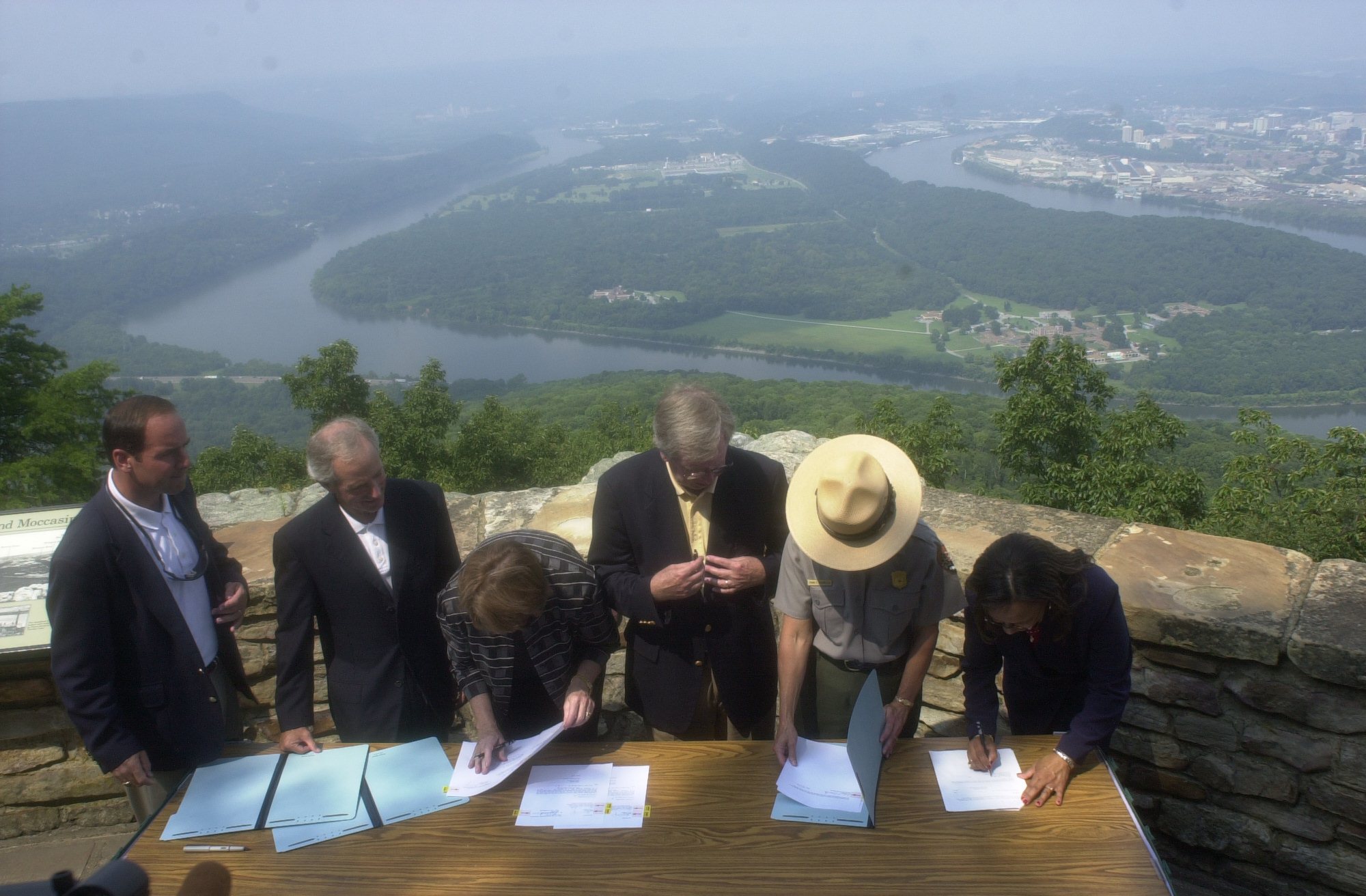
 At the Ochs Museum at Point Park in 2004, officials sign documents transferring land to the National Park Service making the Bend a national park. From left tare U.S. Rep. Zach Wamp, Chattanooga Mayor Bob Corker, Tennessee Department of Mental Health and Developmental Disabilities Commissioner Virginia Betts, Hamilton County Mayor Claude Ramsey, National Park Service Director Fran Mainella and National Park Service Regional Director Patricia Hooks.
Read morePresence of firing range shoots holes in plans for national riverfront park at Moccasin Bend
Efforts to save Moccasin Bend have never moved in a straight line.
The first attempt came in 1920, when Adolph Ochs, publisher of The Chattanooga Times and The New York Times, offered to put up half the cost of making Moccasin Bend a park — if local interests provided the other half. The matching money never came. Similar grassroots efforts at preservation were launched in 1926 and 1944, but crucial local or state dollars failed to materialize.
In the early 1950s, Congressman J.B. Frazier introduced federal legislation authorizing the addition of up to 1,400 acres at Moccasin Bend to Chickamauga and Chattanooga National Military Park. Supported by Sens. Estes Kefauver and Kenneth McKellar, the bill passed and was signed into law by President Harry Truman. More than two years of miscommunication between Washington and Nashville ensued over the state’s required $100,000 for land purchase. Gov. Gordon Browning requested the check Jan. 31, 1953, his final day of office. Gov. Frank Clement held up the payment on his first day in office, Feb. 2, 1953, because of budgetary concerns. The national park initiative stopped dead in its tracks.
Over 20 years of mostly public development followed: a state mental hospital, police firing range, wastewater treatment plant, model airplane field and golf course.