
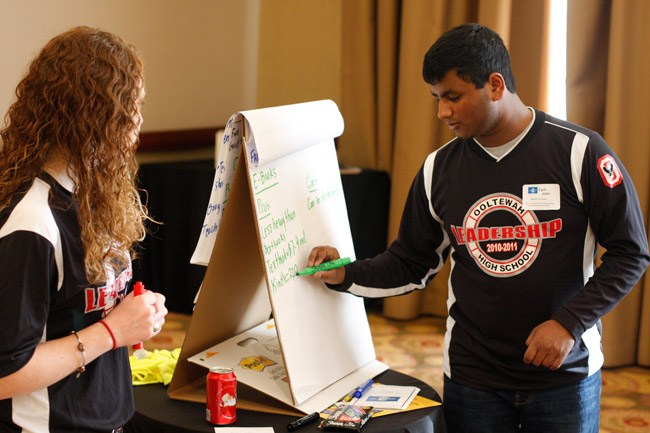
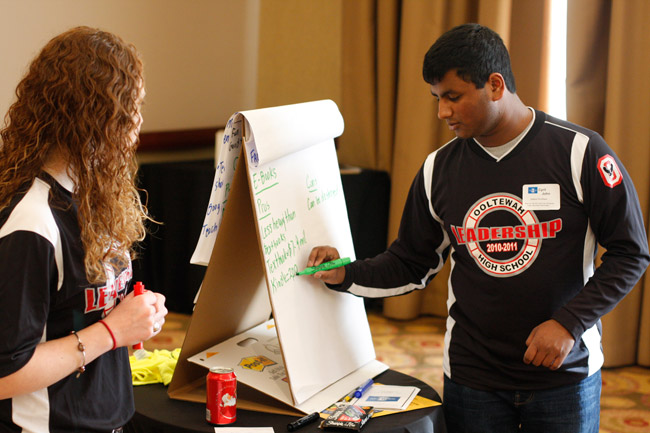
 Lexie Hearrell, left, and Cyril John, members of the Superintendent’s Student Advisory Council, facilitate a discussion about using the internet and social networking in schools.
For students in the Hamilton County school system, one of the best-kept secrets may be a group intended to represent them.
The Superintendent’s Student Advisory Council was established in 1983 to serve as the representative voice between the district’s high school students and the officials making decisions affecting them.
However, few students polled for this report said they are aware of the council’s existence.
“I really had no clue about the group until I was told I was picked to be on it,” said Lexie Hearell, 17, a junior from Ooltewah High School.
The council is composed of two students and one alternate from Hamilton County’s 17 public high schools. All representatives are handpicked by principals and must have at least a C grade point average.
Each April new members are selected for the following year and begin their term in May.
Nahomi Ortiz, 17, chairperson of council, said most students are unaware of the group’s existence. That lack of awareness creates fundamental problems, she said.
“We can’t really know what problems students are having or that need to be discussed unless the students know we are there to help,” the Red Bank senior said.
Brad McCormick served as SSAC chair in 2000-01. During his chairmanship, the council sought to increase student awareness by creating a website.
“Once we did that, we began to see that people would bring not only their own issues to the meeting but the things they heard in their school,” said McCormick, now director of admissions at Chattanooga State Community College.
According to newspaper archives, the idea for creating the position of a student representative on the Hamilton County School Board came from a suggestion by McCormick during his term as chairman. At the time, the school system was applying for $14 million in funding for school reforms from the Carnegie Corp. and the Public Education Foundation.
Now, the chair of the council is invited to serve as student representative but can refuse the position, according to the Hamilton County Department of Education website.
“A big part of our proposal to Carnegie was about student voice and about the real impact of decision-making on students,” McCormick said. “At the time, everyone in school leadership was very serious about listening to students.
“With the addition of a student school-board member, you brought student voice into direct contact with board members every month.”
Although SSAC is slated to meet monthly from September to May with Hamilton County Superintendent Jim Scales, the group has met only once during the current term. That meeting, which took place in November, featured a guest speaker who discussed “What’s the Rush?” a teen pregnancy prevention initiative of the Tennessee District Attorneys General Conference.
With only one meeting, Jenison Owens, 16, a junior at Lookout Valley High School, said she doesn’t believe SSAC has had an opportunity to have any noticeable impact upon the school system.
“Maybe it’s more of an awareness group,” she said. “I knew that graduation rates and religion were big issues in the school system before I went. [From SSAC] I learned that teen pregnancy is obviously a problem and that social networking is apparently a really big issue, although I don’t actually know anyone who has problems with social networking.”
Scales said SSAC was late in getting started this year and that a meeting was canceled due to weather. “It was not deliberate, just circumstances,” the superintendent said.
Ortiz said she is frustrated no effort was made to reschedule the canceled meetings. “We make an effort to make up every other event. Even basketball games get rescheduled. How much can you accomplish in one year with one event? Not much.”
McCormick said that, during his term, his group not only met monthly, but its officers met on a weekly basis.
“If a group only meets a few times a year, it diminishes their ability to really have their voices heard,” he said.
