
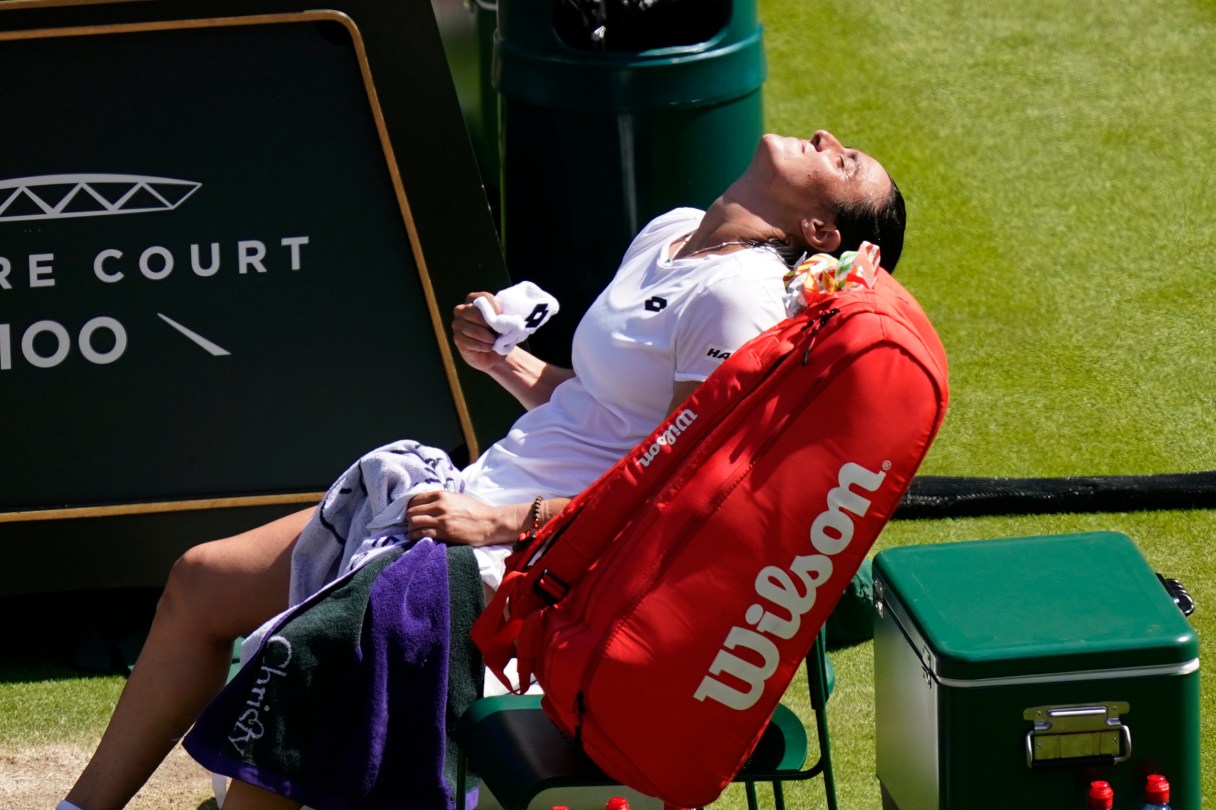
WIMBLEDON, England – Ons Jabeur’s steady progress from year to year – up the WTA rankings, through the draws of various tournaments and now at Wimbledon – has carried her to a Grand Slam singles final, making her the first African woman and first Arab woman to advance that far in the professional era.
The No. 3-seeded Jabeur, a 27-year-old from Tunisia, got past her good friend Tatjana Maria of Germany, 6-2, 3-6, 6-1 during a semifinal Thursday on a sun-splashed Centre Court.
“I want to go bigger, inspire many more generations. Tunisia is connected to the Arab world, is connected to the African continent. … I want to see more players from my country, from the Middle East, from Africa,” said Jabeur, who sat on her sideline chair and threw her head back after the biggest victory of her career. “We didn’t believe enough, at a certain point, that we can do it. Now I’m just trying to show (we can). Hopefully people are getting inspired.”
On Saturday, she will face another player making her major final debut, No. 17 seed Elena Rybakina. Rybakina, a 23-year-old who was born in Moscow but began representing Kazakhstan four years ago, overpowered 2019 Wimbledon champion Simona Halep of Romania, 6-3, 6-3 in the second semifinal.
“I already did a lot,” Rybakina said, “and it’s just time to enjoy.”
This is the first Wimbledon final since 1962 featuring two women both appearing in their initial Grand Slam title match.
After a surprising first-round loss at the French Open in May, Jabeur is on quite a run: She has won 11 consecutive matches, all on grass courts, and 22 of her past 24. Since pro players were first admitted to major tennis tournaments in 1968, never had an African woman or Arab woman been to a final.
Jabeur has been rising in the tennis world in recent seasons. At the 2020 Australian Open, she became the first Arab woman to reach the quarterfinals at a major. Last year produced all sorts of milestones: first Arab player to break into the top 10 of the men’s or women’s rankings; first Arab to win a WTA title; a quarterfinal at Wimbledon.
Now she’s done that two steps better.
“I really don’t know what to say. It’s a dream coming true from years and years of work and sacrifice. I’m really happy it’s paying off,” Jabeur said through a wide smile. “One more match now.”
When their semifinal ended, she and Maria – a 34-year-old mother of two who is ranked 103th – met at the net for an extended hug. Jabeur whispered something in her pal’s ear. After depositing her racket on the sideline, Jabeur returned to the middle of the court for the usual victor’s wave to the crowd – except, instead of going alone, she playfully tugged Maria along with her, an uncommon gesture, and encouraged the spectators to salute the player on the wrong end of the scoreline.
“I definitely wanted to share the moment with her at the end, because she’s such an inspiration for so many players, including me,” Jabeur said. “Coming back after having two babies – I still can’t believe how she did it.”
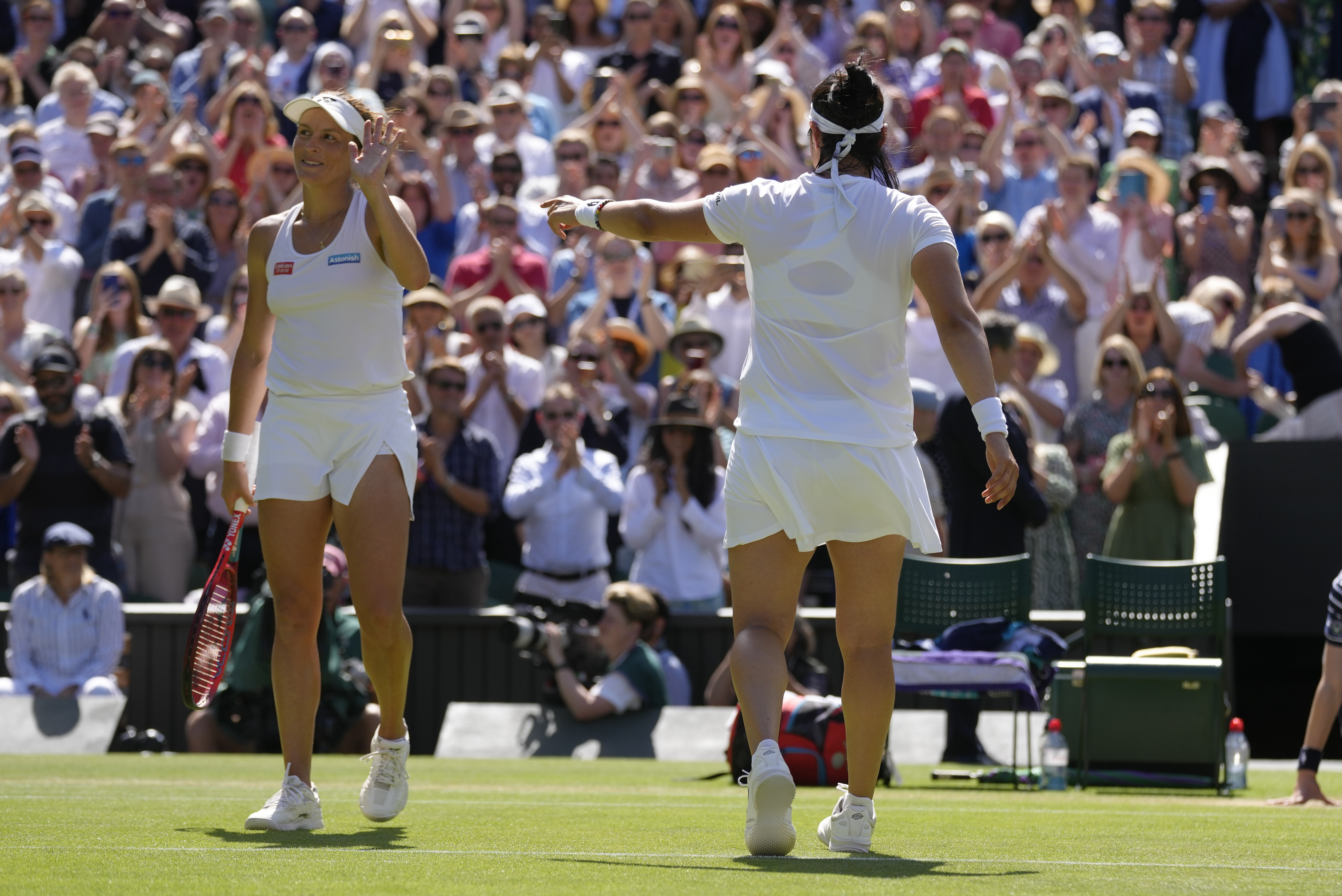 AP photo by Kirsty Wigglesworth / Ons Jabeur, right, gestures to Tatjana Maria to receive applause from the crowd after their semifinal Thursday at Wimbledon. Jabeur and Maria are close friends off the court.
Rybakina, who upset Serena Williams in the 2021 French Open’s fourth round, drew several questions from reporters about her Russian background. Players from Russia and Belarus were banned by the All England Club from competing this year because of the war in Ukraine.
“I feel for the players who couldn’t come here,” Rybakina said, “but I’m just enjoying playing here on the biggest stage, enjoying my time and trying to do my best.”
Rybakina, never beyond a major quarterfinal until now, leads the tour in aces this year and added five to her total Thursday. More surprising was the way two-time major champ Halep never got going, especially on her serve, double faulting nine times.
Halep, 30, had won her past 12 matches at the All England Club, a streak that began with her title run three years ago. Wimbledon was canceled in 2020 because of the coronavirus pandemic, and Halep was unable to compete a year ago because she tore her left calf muscle.
Before their semifinal, Jabeur and Maria stood beside each other, waiting to take the walk through the halls of the stadium that lead to the court. Close as they are, the pair avoided exchanged any glances or chatter.
Close friends, yes. On this day, opponents, too, with quite the setting, stage and stakes.
Neither had been to a Grand Slam semifinal previously. Maria never had been past the third round in any of her 34 prior majors – and she only got that far once, at Wimbledon in 2015.
They are, to use Jabeur’s term, “barbecue buddies.” Jabeur knows Maria’s two daughters so well the German referred to her as “Aunt Ons.”
“She’s part of our family,” Maria said.
Both offer unusual brands of speed-mixing, variety-filled tennis. On the second point of the match, Jabeur won a point by using a drop shot on a return of serve. Maria loves to hit slice forehands; Jabeur, quite capable of powerful groundstrokes, joined in on that occasionally.
“Very tricky player,” Rybakina said about Jabeur. “It’s not going to be easy to play against her.”
After a strong first set, Jabeur was far less effective in the second. Suddenly, mistakes began accruing rapidly. Her serving showed less confidence. Maria took full advantage. And then, just as suddenly, Jabeur switched back to her best self, pulling out to a 5-0 edge in the third in 20 minutes.
After 17 unforced errors in the second set, Jabeur made a remarkably low total of three the rest of the way. Maria simply could not keep up.