
Monday, November 16, 2026Nov 16

Japanese bills would expand military’s role

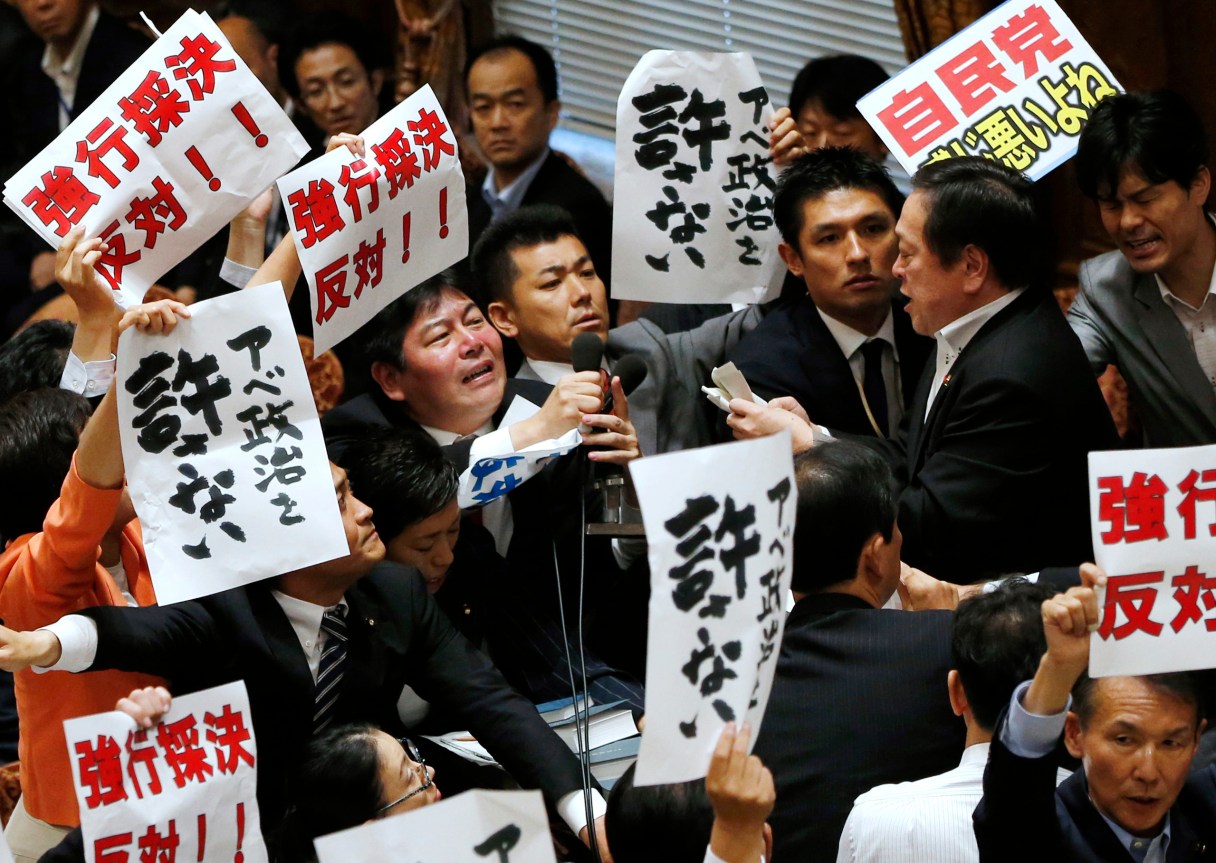
Opposition lawmakers surround Yasukazu Hamada, right, chairman of the lower house special committee on security legislation, as Hamada continues the committee proceedings at the parliament in Tokyo, Wednesday, July 15, 2015.  The parliamentary committee has approved a package of highly controversial security legislation in a vote forced by Prime Minister Shinzo Abe’s ruling bloc disrupted by opponents' massive protests.  The banners held by opposition lawmakers read  "Oppose forcible passage (of the bills)" and "Never forgive Abe's politics." (AP Photo/Shuji Kajiyama)
Opposition lawmakers surround Yasukazu Hamada, right, chairman of the lower house special committee on security legislation, as Hamada continues the committee proceedings at the parliament in Tokyo, Wednesday, July 15, 2015. The parliamentary committee has approved a package of highly controversial security legislation in a vote forced by Prime Minister Shinzo Abe’s ruling bloc disrupted by opponents' massive protests. The banners held by opposition lawmakers read "Oppose forcible passage (of the bills)" and "Never forgive Abe's politics." (AP Photo/Shuji Kajiyama)

TOKYO (AP) – A parliamentary committee on Wednesday approved legislation that would expand the role of Japan’s military after Prime Minister Shinzo Abe’s ruling bloc forced the vote in the face of protests from some lawmakers and citizens.

Opposition lawmakers tried to stop the committee vote as hundreds of citizens protested outside.

The unpopular legislation was crafted after Abe’s Cabinet adopted a new security policy last year that reinterpreted a part of Japan’s post-World War II constitution that only permitted the nation’s military to use force for its self-defense. The bills in question would allow Japan to also defend aggression against its allies – a concept called collective self-defense.

Abe has argued that Japan should better prepare for China’s regional threat and do more to contribute to international peacekeeping efforts.

But opponents, including legal experts and academics, counter that the new interpretation is unconstitutional.