
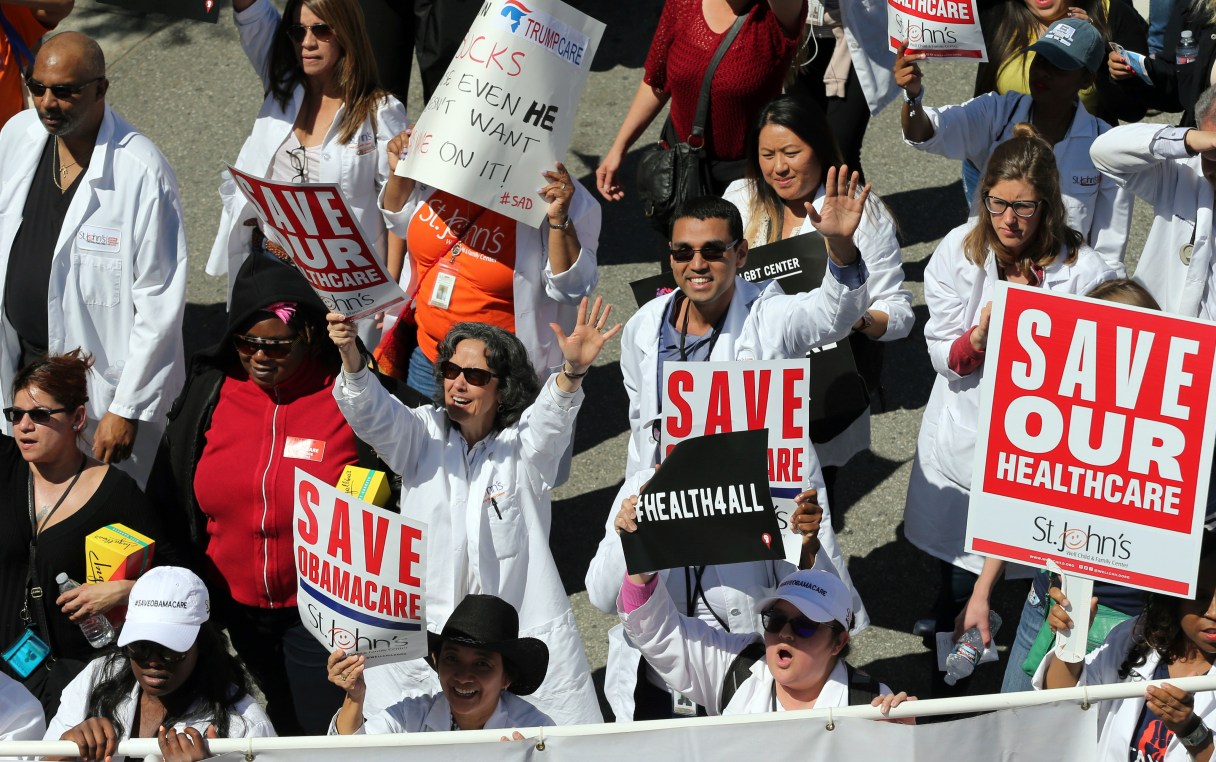

Recall that the frenetic first six months of the Trump administration in 2017 dealt largely with the Republican Congress trying to repeal and replace the Affordable Care Act (ACA), former President Barack Obama’s singular legislation that passed in 2010 over the objection of a majority of the American people and without a single Republican vote.
The Republicans had a number of good ideas for health care reform, but what people in both parties were unable to get around were the Congressional Budget Office (CBO) estimates from the analysis of the GOP plans of how many people would “lose” their health care coverage.
The number mostly widely used was 14 million, which was said could balloon to 24 million in 10 years.
That was a bridge too far for many people, it sounded mean and heartless, and ultimately the Republican plans went nowhere.
Since an estimated 20 million people gained health care coverage from the ACA, the majority from the expansions of their state’s Medicaid programs, the CBO estimates assumed seven out of 10 people who had health care coverage either would choose not to be covered by the GOP plans or would choose not to be covered at all.
In 10 years, the estimates would assume that everyone who had health care coverage through the ACA – and an additional 4 million people – would not have health care coverage either through a Republican plan or because they chose not to be covered at all.
At the time, we admit we were bumfuzzled by these figures. Why would seven out of 10 people who had health care coverage choose not to have it? Even if some rules were tightened, even if what the plans covered was right-sized (men being covered for some women-only issues, for example), even if the plans were slightly more expensive for those who could afford to pay more, how was it possible that many people would choose not to have coverage anymore?
And in 10 years, how was it possible that whatever GOP plan was adopted would not cover one net single person once covered by the ACA and that a fifth again as many more would have no coverage?
It turns out, the numbers appear to be as bogus as we thought they might be.
Unfortunately, the numbers for how many might “lose” coverage couldn’t be fully analyzed until after the ACA enrollment period for 2019 had ended, which also marked the end of the ACA’s individual mandate. That individual mandate, reduced to $0 by the December 2017 tax reform legislation, essentially was a fine or tax levied against those people who didn’t choose to buy health care coverage.
So, according to the Centers for Medicare and Medicaid Services (CMS), after the numbers were crunched, once people no longer were mandated to buy health insurance, only 2.5 million more people will be uninsured. That includes “1.5 million fewer direct-purchase-market enrollees, who are expected to be somewhat younger and healthier than those retain coverage, as well as about 1 million fewer employer-sponsored-insurance-market enrollees”.
And most of them, according to CMS, will be uninsured because they choose to be uninsured. That’s a far cry from the 14 million expected right out of the box.
The CBO, apparently, never adjusted its figures from the halcyon days of the ACA’s creation when it was expected many more millions of people would sign up for the health care program than ever did.
The same Democrats who brought you the ACA, the same ones who reminded you that you could keep your doctor and your insurance plan, the same ones who said you’d save as much as $2,500 a year with the ACA, the same ones who said health care insurance markets would be more competitive – they’d now like you to consider a single-payer, government-run health care system.
Their plan would eliminate health insurance premiums, deductibles and co-pays. In fact, health insurance companies would be unnecessary. Their idea would wipe out the current Medicare eligibility age of 65, extending it to everybody. And such a plan would include all the goodies you’d want coverage for – prescription drugs, dental, substance abuse, maternal care, etc.
Sounds like a paradise, right?
Oh, uh, someone would have to pay for it, though, and the cost estimate by The Mercatus Center of a similar plan by U.S. Sen. Bernie Sanders, I-Vermont, is $32 trillion over its first 10 years. The House bill offered last week by U.S. Rep. Pramila Jayapal, D-Washington, has not been cost-scored by the CBO yet.
And if you haven’t been keeping up, the federal government already is $22 trillion in debt.
Although the Medicare For All proposals are unlikely to see passage in this Congress with a Republican Senate, they’ll continue to be talked about in the national media as if they are tantamount to becoming law. But those who hear such talk – Democrats and Republicans – should be reminded of all the failed ACA promises and how incorrect CBO estimates were at least partially responsible for the lack of success of ACA replacement plans.
The federal government, frankly, is not the bank in which to invest all our health care plans.