
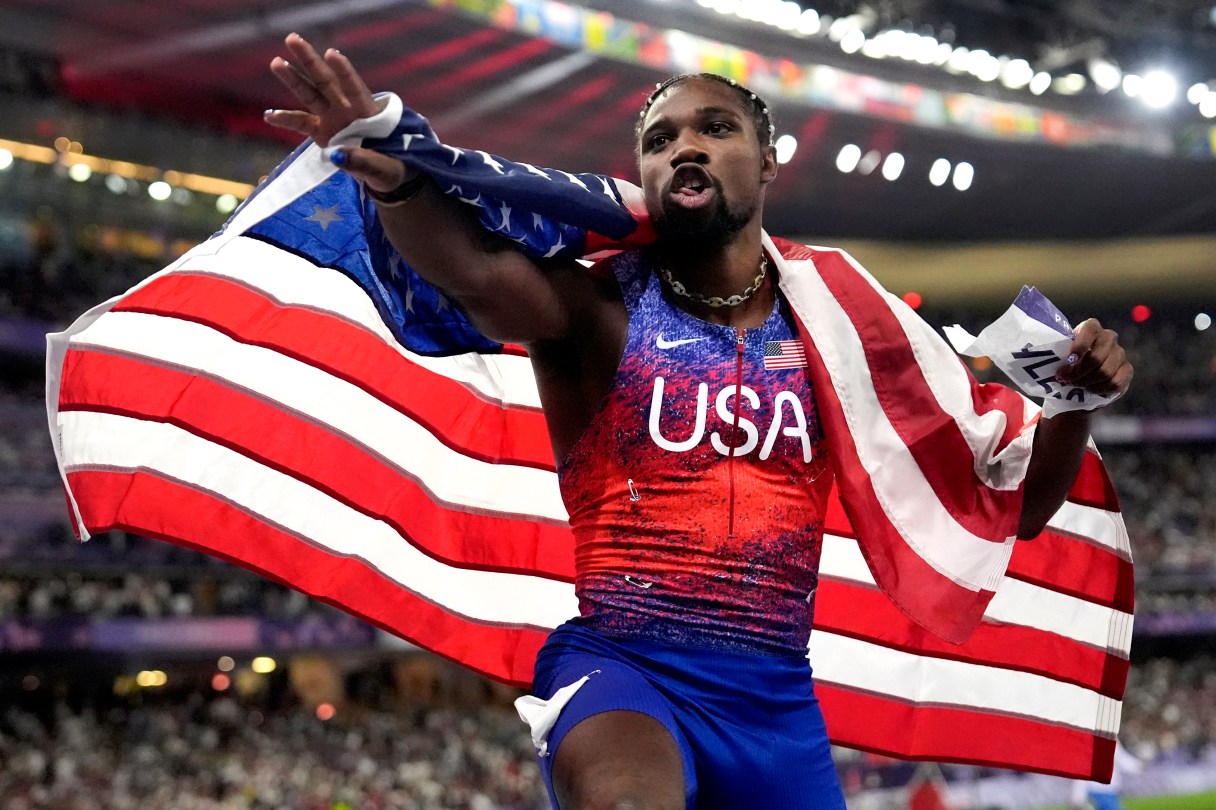
SAINT-DENIS, France — Noah Lyles paced on the far end of the track, hands folded over the top of his head, wistfully looking up at a scoreboard that would, sooner or later, flash an answer he’s been seeking over three sweat-soaked years.
Was all that toil since the last Olympics — all the work on the practice track and in the weight room in the name of finding a centimeter here or a millisecond there — really going to be worth all the trouble?
Ten seconds passed, then 20, nearly 30. And last, the answer popped up.
Yes, Lyles is the 100-meter champion at the Paris Olympics. The world’s fastest man.
Just not by very much.
The American showman edged Jamaica’s Kishane Thompson on Sunday by five-thousandths of a second — that’s .005 of one tick of the clock — in a race for the ages.
The final tally in this one: Lyles 9.784 seconds for gold, Thompson 9.789 second for silver.
The new champion, a 27-year-old from Florida, said that before he left for Paris, a member of his support team ensured him this race would be a squeaker.
“He said, ‘This is how close first and second are going to be,'” Lyles said as he pinched his thumb and his forefinger together so they were almost touching. “I can’t believe how right he was.”
For perspective, the blink of an eye takes, on average, .1 second. That was 20 times longer than the gap between first and second.
It was so close, that when the sprinters crossed the line and the word “Photo” popped up next to the names of Lyles, Thompson and five others in the eight-man field, Lyles walked over to the 23-year-old Jamaican and said, “I think you got the Olympics, dog.”
Thompson, who raced three lanes to the left of Lyles and had no clue where he was on the track, wasn’t convinced.
“I was, ‘Wow, I’m not even sure, because it was that close,'” the Jamaican said.
Time would tell. It always does. When Lyles’ name came up first, he snatched his name tag off the front of his bib and held it to the sky. Moments later, he shouted at the TV camera: “America, I told you I got this!”
The first four racers were separated by less than .03. The top seven all finished within .09 of each other.
Fred Kerley, another U.S. runner, came in third at 9.81.
“That’s probably one of the most beautiful races I’ve been in,” the bronze medalist said.
In the photo finish, Kerley’s orange shoe crossed the line before anyone, or anything — but it’s the chest breaking the barrier that counts. Lyles’ chest crossed first in he closest 1-2 finish in the 100 since at least the 1980 Moscow Games — or maybe even ever.
Back then, Great Britain’s Allan Wells narrowly beat Cuba’s Silvio Leonard in an era when the electronic timers didn’t go into the thousandths of a second. The same was true in 1932, when Eddie Tolan won the Olympics’ first photo finish.
The 9.784 marked a personal best for Lyles and made him the first American champion in the marquee men’s race at the Olympics since Justin Gatlin in 2004.
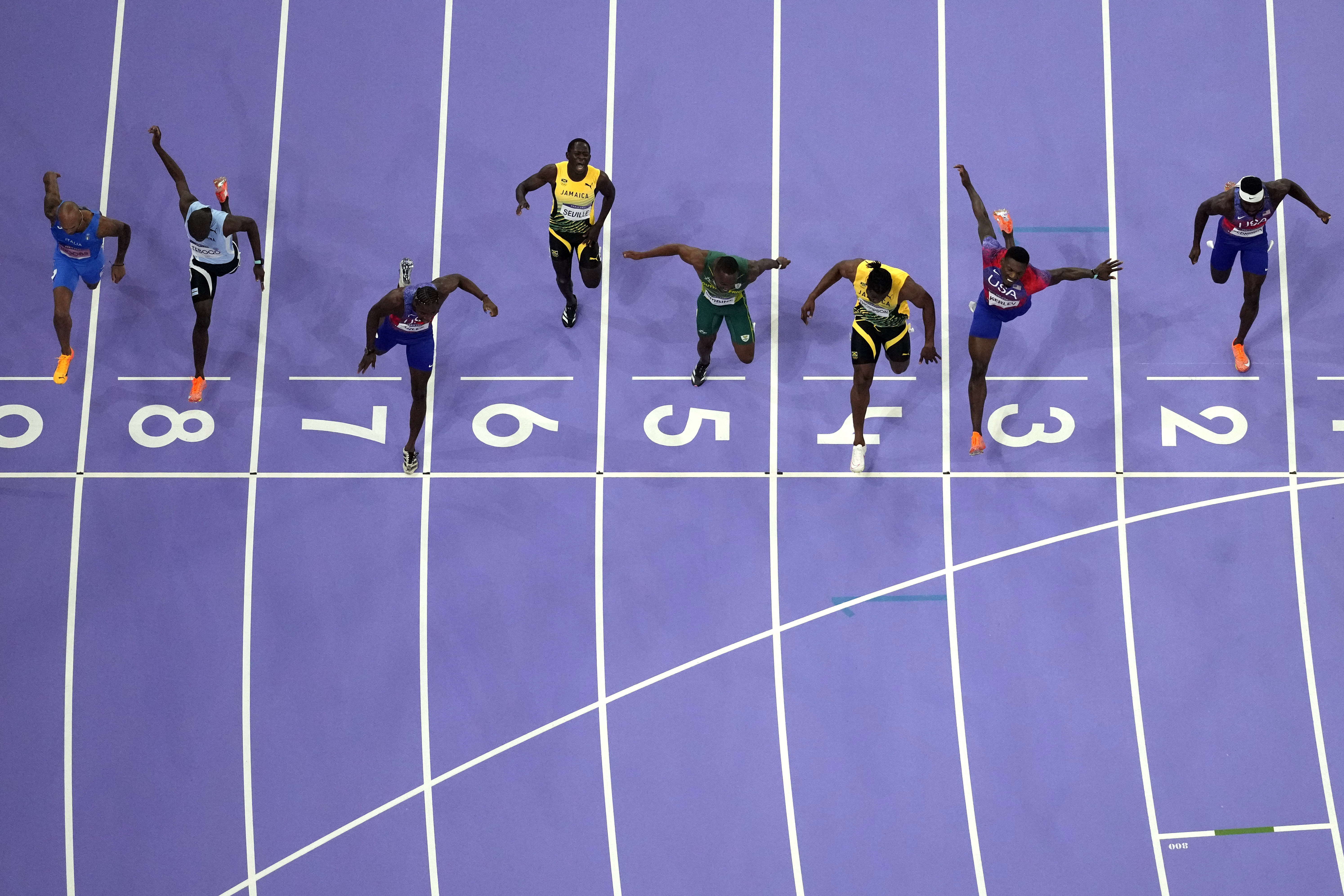 AP photo by David J. Phillip / U.S. sprinter Noah Lyles, in lane seven, wins the men’s 100-meter final at the Paris Olympics on Sunday in Saint-Denis, France.
Out of the pool
NANTERRE, France — The final night of swimming at the Paris Games stirred a wide range of emotions for an American team that no longer rules the world in the pool.
A world record from Bobby Finke. Elation.
A historic loss that reignited gripes about Chinese doping. Stunning.
Finally, another world record for the women’s 4×100-meter medley relay team to edge rival Australia for the top spot in the gold-medal table. Whew!
“Just an awesome way to cap off the meet,” said Lilly King of the winning relay team, who joined her teammates in strolling around the deck holding up the stars and stripes as the crowd filed out of La Defense Arena.
Finke set the standard in the men’s 1,500 freestyle — he touched in 14 minutes, 30.67 seconds to break the record of 14.31.02 set by China’s Sun Yang at the 2012 London Games — before the American women closed a thrilling nine days of swimming in style.
The U.S. finished with eight gold medals to top Australia, which won seven events. Still, it was the lowest victory total for the Americans in the pool since the 1988 Seoul Games, when they were beaten by a doping-tainted East German program.
This time, American swimmers finished with 28 medals overall, two shy of their total three years ago at the Tokyo Games. In all, 13 countries won at least one gold and 19 teams made the medal podium.
After a bevy of disappointing performances by some of its biggest names, the U.S. team was very much aware of its gold battle with the Aussies.
“I knew Bobby had tied it up,” King said. “Bobby’s swim was electric. That was amazing. He definitely got my energy going for the relay. I was pumped to hopefully assert that lead and get the gold.”
That’s just what she did.
King made up for a disappointing showing in individual events at her third and final Olympics by powering to the lead on the breaststroke segment. Then it was Gretchen Walsh and Torri Huske bringing it home in 3:49.63 to break the record of 3:50.40 set by the U.S. at the 2019 world championship meet.
Regan Smith led off in the backstroke leg, earning a relay gold for the second night in a row after starting her Olympic career with five silvers and a bronze.
Australia (3:53.11) won silver and China (3:53.23) took bronze.
China stunningly won gold in the men’s 4×100 medley relay with a time of 3:27.46, ending the American run of dominance that stretched back to the introduction of that event at the 1960 Rome Games. The Americans were left with the silver in 3:28.01, with France taking bronze in 3:28.38.
The only time the U.S. didn’t win gold in the event was in 1980, when it boycotted the Moscow Games.
The winning team in Paris included Qin Haiyang and Sun Jiajun, both among the nearly two dozen swimmers who tested positive for a banned substance before the Tokyo Games but were allowed to compete. The result stirred more hard feelings from other nations that feel the Chinese might have gotten away with cheating.
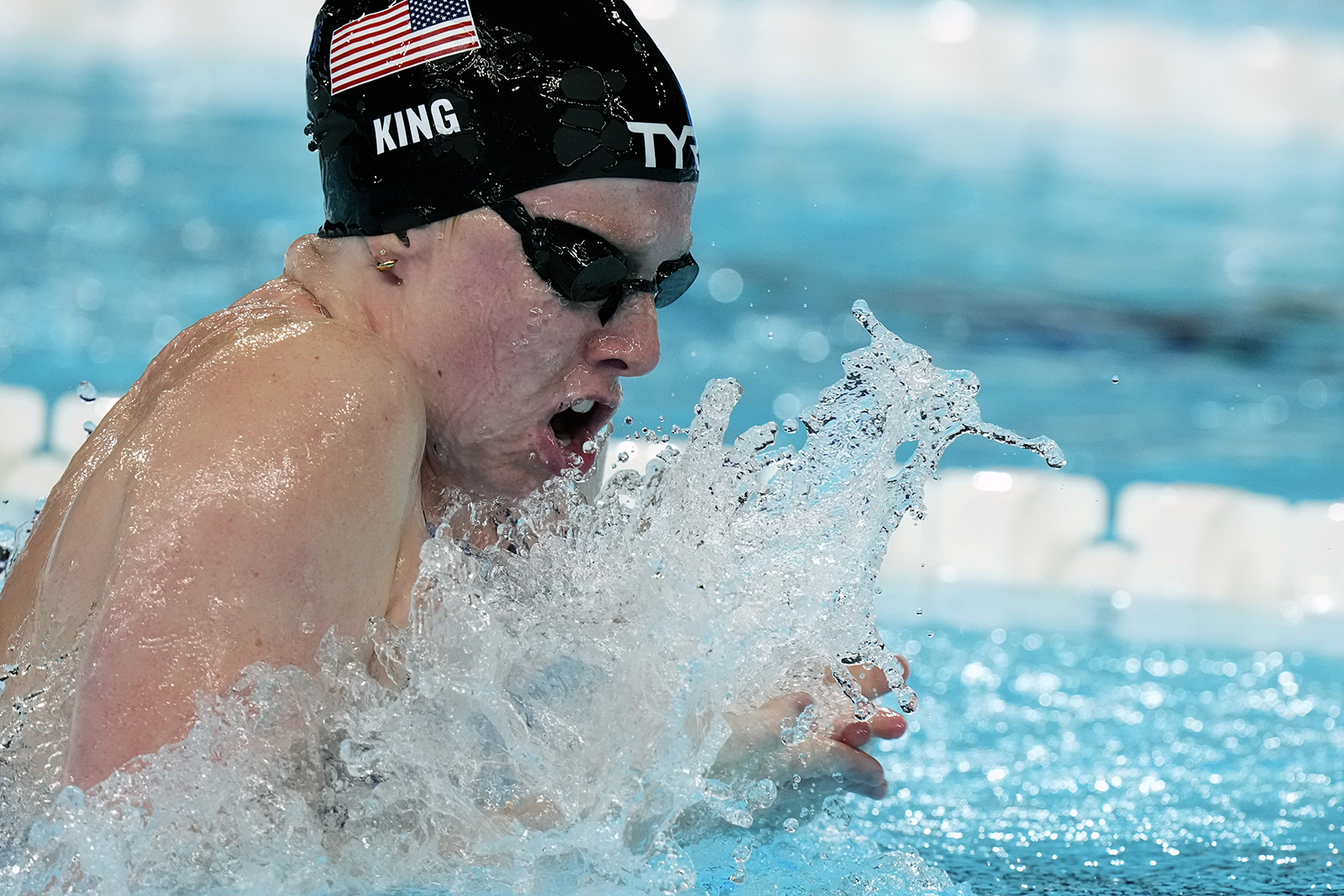 AP photo by Brynn Anderson / Lilly King swims the breaststroke for the U.S. in the women’s 4×100-meter medley relay final at the Paris Olympics on Sunday in Nanterre, France.
Same as always
The Americans continued their domination in women’s basketball as they chase an eighth consecutive gold medal. The United States beat Germany 87-68 to extend its record winning streak to 58 consecutive games dating to the 1992 Barcelona Olympics. The team clinched the top seed in its pool as it moves into the quarterfinals.
Lee’s latest prize
American gymnast Sunisa Lee picked up her third medal in Paris and the sixth of her Olympic career by grabbing bronze in the uneven bars, exactly where she finished in Tokyo three years ago. Lee was part of the gold-winning U.S. team Tuesday and two days later added a bronze in the all-around individual competition.