
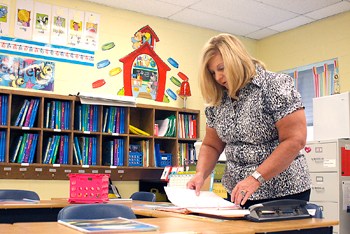

TRENTON, Ga. – Jonathan Wood’s last day of summer was Wednesday but, as a teacher’s child, he wound up spending it at school.
Jonathan, the 10-year-old son of Dade Elementary School kindergarten teacher Jennifer Wood, said school was not his plan for the last day of summer break, but he was still anxious to get the school year started.
“I’m looking forward to recess and to getting back in language class – that’s my favorite subject – and basketball starts back up,” said Jonathan, who’s going into fifth grade.

As school bells ring for Jonathan and other students across Northwest Georgia, most school officials say money is the looming hurdle for the next school year.
Dade students are back in class today (Thursday), Dalton and Whitfield start Friday and Walker launches a new school year on Monday.
There are fewer teachers in all systems, officials say, larger classes in most and all are eyeing the grim prospect of the Legislature making midfiscal year budget cuts this winter.
Dade Elementary third-grade teacher April Yarbrough said Wednesday that she’s concerned about the system’s money problems but they won’t affect her classroom.
“Here, we have what we need,” Yarbrough said with a wave around her freshly decorated classroom. “Overall, the morale here is high.”
Dade’s teachers, like many teachers everywhere, will take it upon themselves to see that students don’t go without, she said.
Larger class sizes are a little extra burden, but nothing the 19-year veteran teacher hasn’t seen before.
“I’ve taught with 29 or 33 in class before,” said Yarbrough, whose classes this year start out with 21 students.
DADE
Dade Superintendent Patty Priest said challenges are everywhere this year.
“Some of our biggest challenges are finance, class size and having enough folks to do the job,” Priest said.
Money, as in most systems, is Dade’s biggest problem.
The system joined Georgia’s 26-county contingent in the second round of the federal Race To the Top competition, and that might produce some grant opportunities, she said, but there are no certainties.
“We will again need to dip into our reserves to complete the year,” she said. “Our reserves are dwindling year by year.”
Priest expects Georgia school districts to get at least a 4 percent cut at the end of the calendar year as state officials make midterm budget adjustments.
And things won’t get better even after this year, she said. In the fiscal year ending in June 2012, Dade will lose between $500,000 and $750,000 in state funding, she said.
DALTON
Dalton Public Schools’ reopen following a budget season that forced officials to cut 60 people from 52 positions, cut salary schedules by 10 furlough days and nip the school calendar by four student days, just to save a little more than $5 million.
“While the economic woes are an unfortunate undercurrent as we begin our new school year, we are determined to stay focused on the work we give students so that our students learn what they need to know to be successful both now and in the future,” Superintendent Jim Hawkins said in an e-mail.
“Unlike the private sector, where less demand for products and services is driving budget cuts, the number of students in our schools is not declining and we are being asked to do more with less,” he said.
Staff, parents and people in the community are working hard “to find innovative ways to partner with, and for, our students,” he said.
WALKER
Walker County Schools still benefit from previous years’ efforts to curb costs, and a calendar shortened by 11 days will help this year on utility costs, Superintendent Melissa Mathis said.
“We have operated below our expected budgetary needs for the past three years and this has allowed us to meet unanticipated needs to date,” Mathis said in an e-mail.
Those efforts will be especially important if expected midterm state cuts are handed down, she said. Those early cost-saving efforts mean “our students and their instruction are not compromised,” she said.
Walker’s longer school day, created by the shorter school calendar, allows more planning time at every level, and officials will keep improving student performance despite funding cuts, she said.
The staff knows “extreme conservatism” in budgeting and spending is an ongoing consideration, she said.
Spokeswoman Elaine Womack said a major challenge this year is “keeping positive attitudes in place in all respects.”
Womack said the poor economy affects the attitude of the whole community. A thriving school system, as a major employer in any community, produces jobs, tax revenue and stability, she said.
WHITFIELD
A $13.5 million shortfall forced Whitfield officials to chop five days from the students’ calendar, whack electives from the curriculum and make reductions of 4.8 to 10.5 percent in support staff, teachers and administrators.
Teachers and students will start school this week ready to “weather another fiscal storm if it comes during the school year,” spokesman Eric Beavers said. “Since 2003, the state has withheld more than $30 million that the state funding formula says we need to operate.”
Eight years’ experience with those reductions, called austerity cuts, led Whitfield to expect and prepare for more cuts, he said.
“Our staff has learned to be flexible and proactive, and they are ready to help our students find success,” he said. “With every challenge, we first consider what is best for the students.”
Continue reading by following these links to related stories:
Article: Local schools vie for Safe Routes funding
Article: Most North Georgia graduation rates short of goals but improving