
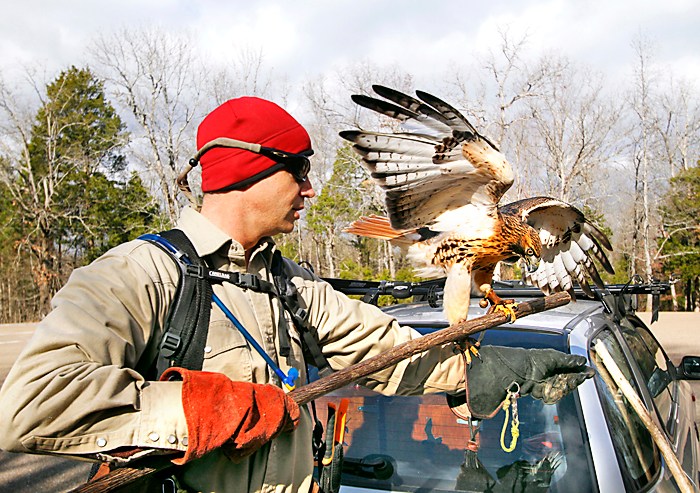
 John Kern gets his red-tailed hawk, Choo-Choo, to climb onto his walking stick as they set out for a morning’s hunt.
The next “ho, ho, ho” you hear may be your last.
If you’re a squirrel, at least.
On any given day, there is the chance that Cai or Choo-Choo, the red-tailed hawks caught and trained by John and Jenny Kern, may be waiting in the treetops for a Santa-like call from their trainers below. From that signal, the birds of prey know that some little morsel is on the move.
“It’s the falconer’s universal signal for ‘there’s game over here,'” John Kern explained. “The birds get used to hearing that; it gets their attention. A well-trained bird will fly over and kind of focus in on where you’re saying that.”
Though it may seem that the bird is the actual hunter, the Kerns say hunting with their red-feathered predators is more a partnership. The trainers roust prey from the ground, shouting the “ho, ho, ho” call and rapping trees with their walking sticks, while the birds wait above for a flicker of movement.
“What you want is a cooperation with the bird,” John said. “You don’t want him going off by himself. We want to have that partnership where he’s sticking with us.”
The hawks are kept at “hunting weight” — fed enough to have the energy to fly and hunt, but not to the point that the bird feels confident enough to fly off. Food is the glue that keeps the hawks and their trainers together.
Hunters usually release the animals after a hunting season or two, though Jenny Kern admitted that it’s hard to let go — at least for one side of the equation.
“Before you let go of them, you break your relationship with them,” she said. “You feed them up, and once they get really, really fat, they really don’t like you anymore. When they no longer need you for food, they couldn’t really care less about you.”
MOMENT is a weekly column by the Times Free Press photo staff that explores the seldom-told stories of our region. Click here to hear this story in their own words.