
By Shelia Byrd
JACKSON, Miss. — Filmmaker Stanley Nelson says his new documentary about the courageous activists who defiantly opposed the 1960s segregation of the South may help inspire a new generation of youth.
The film, “Freedom Riders,” recounts the 1961 crusade by daring young activists intent on ending segregated travel on interstate buses in the Deep South. The American Experience film, set to air May 16 on PBS, has been generating buzz on the film-festival circuit since its showing at Sundance in January.
Most of the riders were college students coached in the art of nonviolent protest by veteran activists, including the Rev. James M. Lawson Jr. The students, both black and white, knew they were risking their lives by traveling on Greyhound and Trailways buses into the rigidly and violently segregated South.
Nelson said the great lesson of “Freedom Riders” is how ordinary citizens can bring about change.
“It really says that this movement was a movement of people,” Nelson said. “Nobody else will ever be a Martin Luther King. What ‘Freedom Riders’ said is that you don’t have to be.”
That’s the message Nelson wants to impart to students now being recruited to join some original participants in retracing the route of the Freedom Rides next year on their 50th anniversary. More than 165 students from across the nation have applied ahead of a mid-January deadline for one of the 40 seats available for the trip, organized by American Experience.
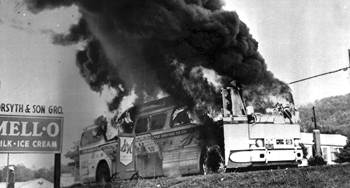
The tour will begin in Washington, D.C., and cover flashpoints of the civil-rights era, including Anniston, Ala., where the bus was firebombed and Montgomery, Ala., where riders were beaten by a white mob.
One of the original riders, Hank Thomas of Stone Mountain, Ga., recalled the dangers.
“I was on that bus that was firebombed in Anniston, and the Klan held the door shut while the bus was burning. The fuel tank exploded and the people who were holding the door scattered,” Thomas said.
When the bus reached Rock Hill, S.C., Thomas was arrested, carted off to jail and then taken to a Ku Klux Klan meeting. An athletic 6-foot-4 student at Howard University, he was able to flee the klansmen and local deputies.
“Luckily, I was an athlete in high school and college, and I was able to outrun the mob just in the nick of time. An old black minister was monitoring the situation and following police and told me to jump in the car,” Thomas said in an interview with The Associated Press.
The 2011 bus tour is to culminate in Jackson, Miss., the city where riders were detained and roughly hauled off to the state’s notorious Parchman prison. There, at least one of the riders was struck so hard that he bled.
Nelson said his latest project resonates even more than some of his previous documentaries, including “The Murder of Emmett Till,” a film he produced and directed. The 2003 documentary was an account of the 14-year-old black youth’s brutal murder in Mississippi for supposedly whistling at a white woman in 1955.
The New York-based filmmaker said bringing youth activists on a tour retracing the “Freedom Rides” promises to be a vivid experience. “Talking about the civil-rights movement in the actual places (where it happened) is important,” he said.
The new generation of riders will hear from the movement’s veterans, including Bernard Lafayette Jr., who was a 20-year-old seminary student when he got involved. Lafayette said his parents initially refused to sign a consent form, fearing the rides would be his “death warrant.”
Lafayette, now a distinguished senior scholar-in-residence at Emory University who teaches students about Martin Luther King Jr.’s philosophy, said the strategies of the civil-rights movement are applicable to such issues today as “the bullying, the high dropout rate, the violence that takes place.”
“Once students realize what existed before and what we did to bring about those changes, that becomes the teachable moment. The worst thing that could happen is that people come to believe that things cannot change,” Lafayette said.
Lafayette said “Freedom Riders” recalls a time in U.S. history that must never be forgotten.
The documentary includes black-and-white footage of the buses under attack, as well as interviews with participants and government officials who sought to quell the situation for the Kennedy Administration.
John Seigenthaler, a Tennessee native who served as a special assistant to Attorney General Robert Kennedy, said on film that he wasn’t aware of the plight of blacks on segregated buses before the rides.