
The reported health consequences of excess weight and an inactive lifestyle are increasingly severe.
“These people have medical complications that you just can’t begin to fathom,” said Dr. Leonard Reeves of Floyd Medical Center in Rome, Ga., and president of the Georgia Academy of Family Physicians.
Almost one-third of U.S. adults now have high blood pressure, and the condition isn’t getting enough attention, according to a recent report from the Institute of Medicine. High blood pressure causes one in six adult deaths every year, a 25 percent increase from 1995 to 2005, the report stated.
Obesity is not only an independent risk factor for heart disease, it also exacerbates other conditions that increase the risk of heart disease such as diabetes, high blood pressure and high cholesterol, said Dr. Andrew Fowler, cardiologist at Memorial Hospital in Chattanooga.
PDF: Obesity document PDF: Obesity in USA
“Big-time problem”
Heart disease “is a big-time problem and it costs a lot of money in the health care industry to fix these things,” he said. “It would be a lot more cost-effective if we could prevent these things from happening.”
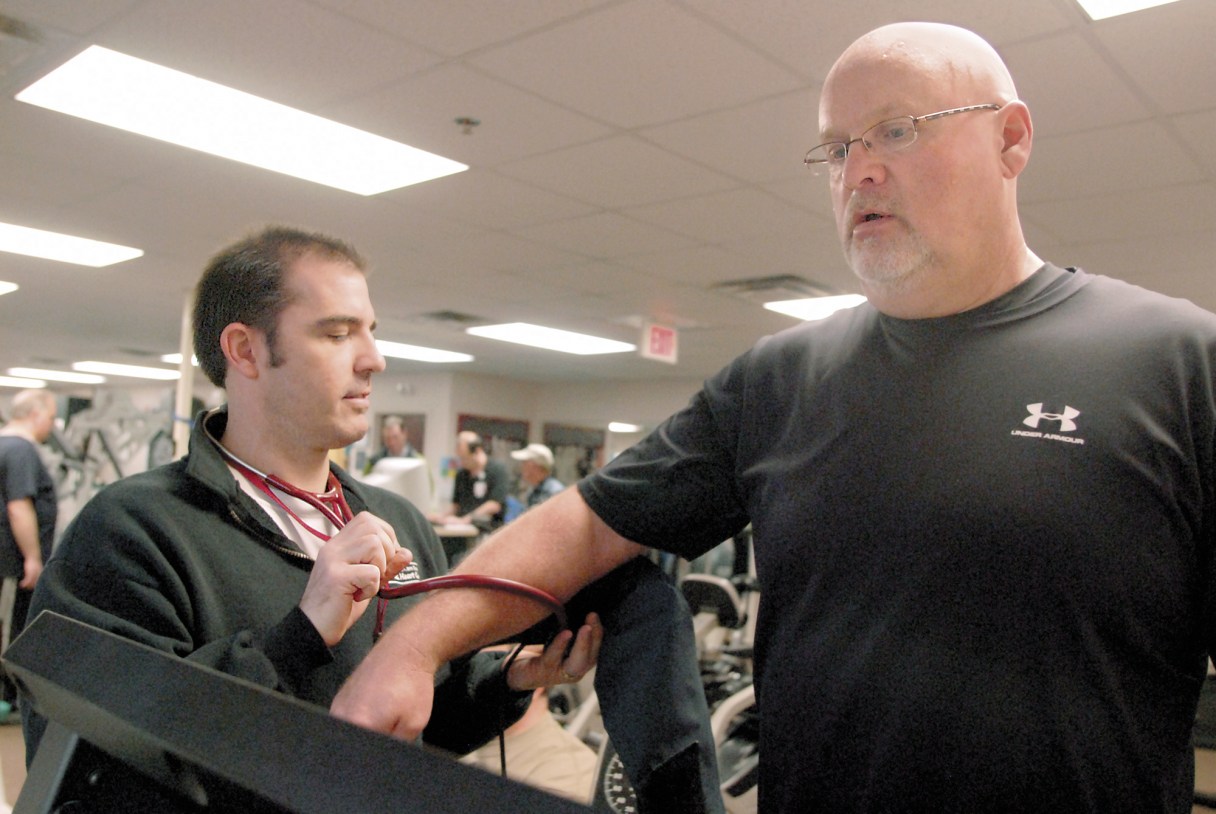
Hixson resident Don Faulkner — a patient of Dr. Fowler — said he learned the hard way that putting off health improvements is a dangerous gamble.
He got married in 1979 as a 135-pound teenager working in construction. He soon was promoted to a supervisor position that involved no exercise and, after years of indulging in his wife’s Southern-style cooking, his weight ballooned.
“I blew up to 274 pounds,” said Mr. Faulkner, now 48. “You think you’re invincible. When you’re young, you just feel like, ‘That’s a problem I’ll worry about later.'”
In 2007, he was shocked into action when he realized he’d have to wear a size 52 coat at his son’s wedding. So he started following a Weight Watchers program and cut out some of his favorite foods — fried chicken and hamburgers on the grill.
He also started moving. Barely walking a mile on his first trip to the track, he built up his strength and began running the bleachers. In 2008, he started teaching spin classes at Rush Fitness.
He lost 70 pounds, but the damage of 20 years of unhealthy behavior, combined with a family history of hypertension, wasn’t easy to reverse. In November, Mr. Faulkner had to undergo quadruple bypass heart surgery to open up arteries nearly completely clogged.
Mr. Faulkner said he feels as though he’s been given a second chance at life and is even more determined to stay healthy.
“It’s a tough lesson to learn,” he said. “Don’t wait until that cardiologist says you need surgery. Don’t wait until you’re laying on the table from a heart attack. You may not have another chance.”
WORST YET TO COME?
Maps of obesity rates tend to mirror maps of diabetes, coronary heart disease and stroke rates, and foretell a barrage of even greater costs to individuals and society in the future, said Greg Heath, head of the department of health and human performance at the University of Tennessee at Chattanooga.
“Are we not going to be seeing a coronary heart disease tsunami down the road?” he said.
Diabetic children
Today, one-third of children are overweight or obese, and Type 2 diabetes — formerly called “adult onset diabetes” — is increasingly common in youngsters, said Ali Donahue, marketing director for the Northwest Georgia Healthcare Partnership.
“Children shouldn’t be getting Type 2 diabetes,” she said.
To try to prevent childhood obesity, the group is organizing competitions to encourage North Georgia residents to log how many miles they have walked, she said.
Many intervention efforts in Tennessee and Georgia are focusing on reaching children, including the passage of laws limiting what can be sold in vending machines at schools.
A major challenge is that many people just don’t want to hear that getting healthy must involve more than a passing commitment to a fad diet or workout regimen that promises quick results; it requires an overhaul of one’s lifestyle, Dr. Reeves said.
“I always tell my patients, ‘If you go on a diet, that means sometime you’re going to go off a diet. It needs to be something you can do for the rest of your life,'” he said. “Those kind of fad diets just don’t work. Nobody’s going to eat grapefruits every day for the rest of their life.”