
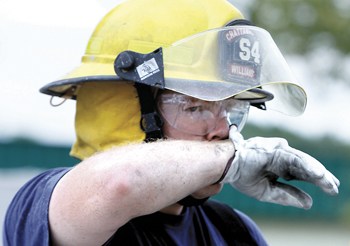
Chattanooga Deputy Fire Chief Chris Adams has a unique comparison to describe firefighting in the heat of summer.
Imagine donning multiple layers of winter clothes, heading out to mow the grass in July and sprinting while you do it, he said.
“And they can’t take a break,” Chief Adams said of the department’s firefighters.
Though fatalities from heat exhaustion or heat stress are rare, a summer fire can knock firefighters out of commission if they aren’t carefully prepared and properly monitored.
At a June 10 house fire, two firefighters were treated for heat exhaustion and one was taken to Parkridge Medical Center after complaining of chest pain.
Chief Randy Parker said gear has improved over the last few decades of firefighting, but the suits that keep fire out also hold in heat. When the outside temperature breaks 90 degrees or more, that can be a strain.
“You’ve got to pace yourself, especially on a large event where you know you’re going to be there for hours,” he said.
Hydration is key, fire leaders said. And from the start of training, recruits carry a half-gallon jug of water with them everywhere they go.
But even if a firefighter is fully hydrated and ready to go, vital fluids and electrolytes can sweat out in as little as 40 minutes, said Chief Adams.
Capt. Phil Hyman, who handles tactical operations, said a rush of decisions faces the incident commander at the scene.
While directing the firefighters, they must also gauge fatigue among personnel battling the blaze because energetic young firefighters may not have learned their limits yet.
A dehydrated firefighter can be weak-legged and making poor decisions, but be too flooded with adrenaline to realize it.
The incident commanders do get a little helpful reminder, though.
Procedures require 911 dispatchers to call the commander every 15 minutes for a “time elapse,” which lets the leaders know how long they’ve been on the scene.
There are other checkpoints, as well.
Air tanks usually provide 15 to 20 minutes of air, Chief Parker said. While firefighters are swapping tanks, the medical team checks their vital signs and decides whether they should take a break.
Chattanooga-Hamilton County Rescue teams often are called as firefighters approach the scene, especially if incident commanders know it will be a long job. The rescue team’s rehab truck supplies cold drinks and other items.
Capt. Hyman said that it takes practice for firefighters to learn how to pace themselves.
“You’re not conditioned to wear that gear,” he said.