
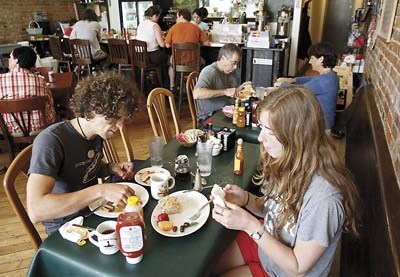
Sometimes the line at Blue Grass Grill gets a little long and tables start to fill up, but there are still seats open. That’s usually when Joan Marie Worsham offers diners an option — share a table with other guests.
“There’s a mentality that it’s just like sitting at the bar,” she said.
The practice is widespread in Europe and many major cities across the United States but not as common in the South.
Ms. Worsham, who owns the grill and also ran another restaurant of the same name in Charlottesville, Va., said she notices some regional difference in customers.
Those familiar with the practice, mostly Northerners, have no problem sitting at the table, eating and not feeling the need to talk. But the Southerners feel almost obligated to start a conversation with others seated next to them.
Betsy McCright, a Boston native, said communal dining is very common in the North.
“We’re accustomed to it because there’s so little space for so many people,” she said while eating breakfast at the grill.
At the grill, communal dining is spontaneous and can happen with any open seat, so long as both those seated and those waiting agree.
Just down Main Street at Alleia, a formal dining restaurant, one 32-seat long table in the center of the floor serves as the communal table.
Mark Denis, operating partner in Alleia, said the hand-carved table from Belgium was designed by Rodney Simmons of Revival Studio as the “heart of the restaurant,” which everything else was built around.
Parties both large and small can reserve the table, but often smaller groups of two, four or six sit at the table with others.
Mr. Denis said one of the pleasures of the table is seeing strangers talking and even sharing food.
The location isn’t bad either.
“They’re level with the kitchen, they get a show,” he said.
He estimated that 70 percent of guests will sit at the table, and the rest prefer their own tables.
“It’s definitely either loved or hated,” he said.
He hopes the seating can push locals to take pride in the restaurant scene of the city, that not only in food buy in methods Chattanooga is bringing diverse experiences to dining out.