
Margie Leahu thought the noise she heard outside the library was a medical helicopter landing on campus.
She was right, but there was no emergency.
When the UTC graduate student went outside Wednesday morning, she found an Army Black Hawk medevac helicopter landing on Chamberlain Field.
Like children wanting to pet a pony, she stood off at a distance with other backpack-toting students until coaxed by camouflage-clad soldiers who said it was OK to touch the 64-foot, six-ton aircraft.
Cell phone cameras in hand, Ms. Leahu and another student climbed inside the helicopter, snapping photos and shooting videos of themselves in the pilot’s seat.
Just watching the helicopter land was “exhilarating; it gets the adrenaline going,” Ms. Leahu said.
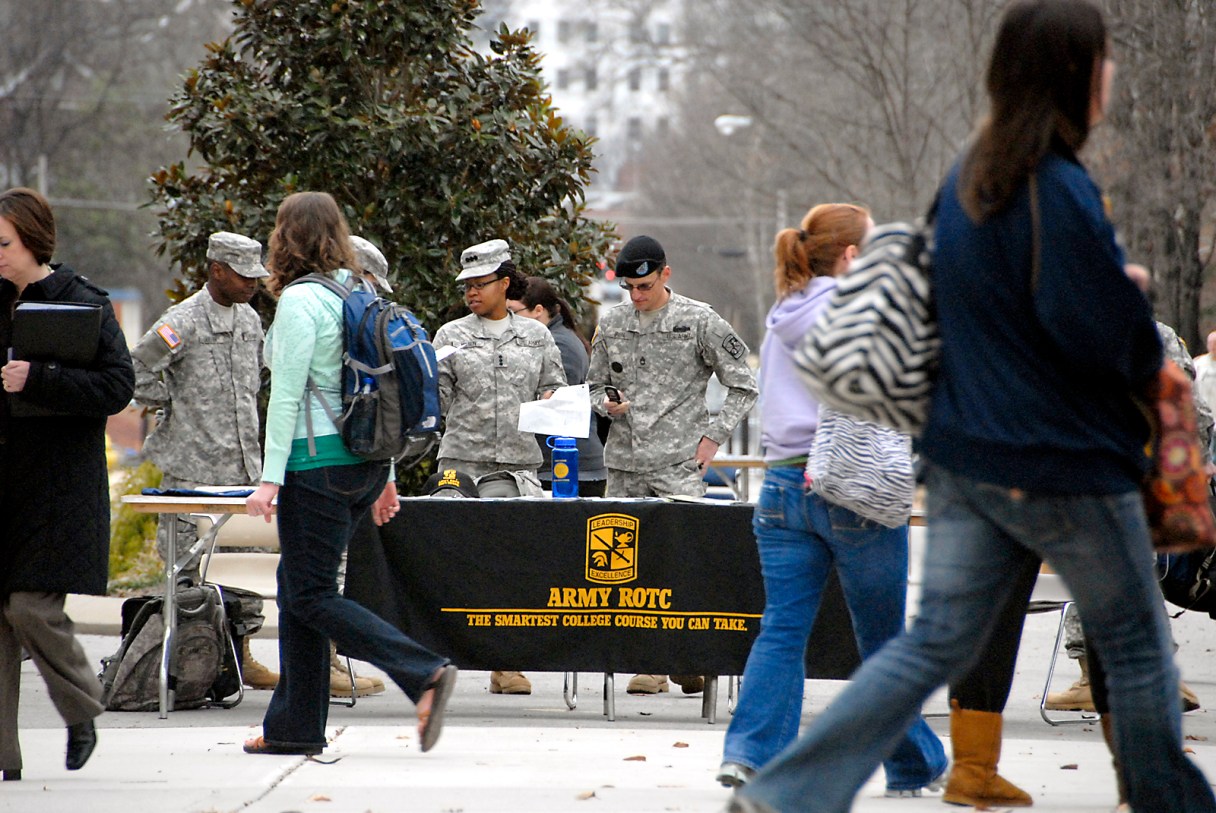
Soldiers with the Reserve Officer Training Corps unit at the University of Tennessee at Chattanooga wanted to draw attention to their program Wednesday.

They did.
Second Lt. Matt Palumbo said the helicopter, along with other displays of guns and trucks, catches students’ eyes as they walk around campus.
“It’s been effective in the past,” he said. “This is stuff you don’t normally see.”
Last year, two Apache helicopters landed at the university and, after the event, 10 to 15 students signed up for the UTC military science elective course, Second Lt. Palumbo said.
ROTC cadets Mark Vines, Alistair Fider and Payton Brogdon said the events draw attention, but they joined up after taking the elective courses offered by the school.
In the courses, cadets learn leadership training, land navigation and weapons operations, said military science department head Maj. Ben Smith.
Cadet Command Sgt. Major Fider said he decided to sign the ROTC contract after seeing “tangible results” in each course.
After being shut down in the late 1990s because of low enrollment, ROTC was brought back to the UTC campus in 2007. Since then, Maj. Smith said his approach to growing the program has been to offer a variety of options and training, then let the students spread the word about what ROTC does.
“One thing is, (students) think they’re joining the Army if they go into ROTC. That’s not the case,” he said.
Students can try the classes for two years with no commitment, he said.
He and the other training commanders started up with 30 students in 2007, and the program has grown to 73 this semester with 27 on Army contracts, he said.
Cadet Capt. Brogdon said he thought of enlisting in the military before college, but an officer friend told him to look at ROTC. After one year, he’s decided to join.
“It allows me to be a leader,” he said. “I’d much rather be the person telling people what to do than being told what to do.”
Continue reading by following these links to related stories: