
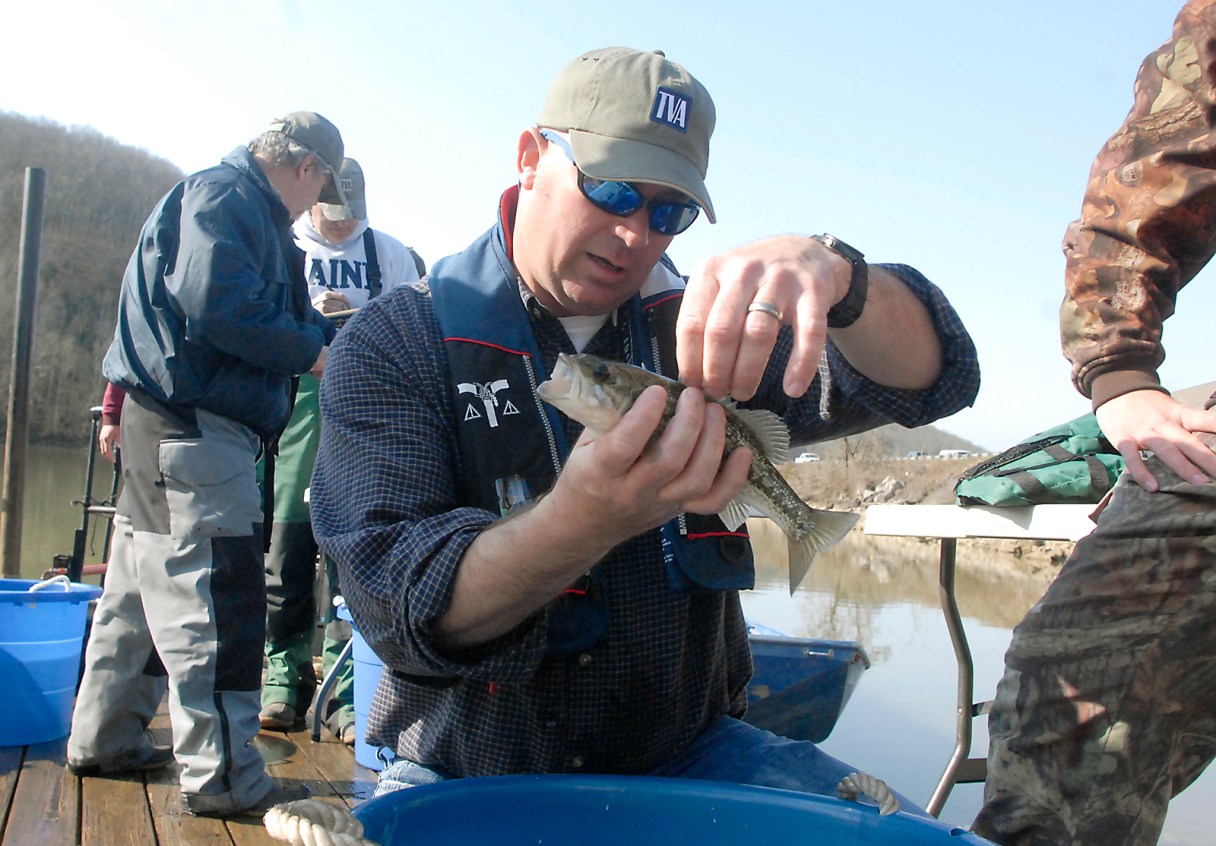

Fish in the Chickamauga Reservoir at Harrison Bay have been increasing in size for about six years and are continuing to get larger, local fisheries biologists said.
Each spring, a group of biologists from the Tennessee Valley Authority surveys more than a dozen reservoirs across the Tennessee Valley to gauge the health of the ecosystems. The crew surveyed Harrison Bay at the Wolftever Boat Ramp on Tuesday and will continue the annual TVA Sport Fish Survey today and Thursday at Skull Island and Sale Creek.
“In the last six to seven years, there’s been an increase in catch rate and an increase in average size,” said TVA fisheries biologist Donny Lowery, who has helped conduct the survey since it began in 1995. “The quality of the fishery seems to be getting better.”
To collect the fish, biologists use a method called electro-fishing, which sends between 400 and 600 volts of electricity into the water and stuns the fish to bring them to the surface. They are then scooped into a large net and put in an open water tank where they are kept until they can be measured, weighed and counted.
The electro-fishing unit is attached to the front of a boat and the stainless steel electrodes extend about 4 feet into the water, Mr. Lowery said. The voltage forms an oval area that can reach about 8 feet deep, stunning the fish for up to one minute.
“Physiologically it stuns them, shocks them, and their air bladder fills up with air and that makes them buoyant and they float to the surface,” he said. “It’s pretty user-friendly on the fish. Even though it sounds bad, electro-fishing, it’s really not that bad.”
Kurt Lakin, a fisheries biologist for TVA, said the group concentrated on five types of sport fish – largemouth, smallmouth and spotted black bass and black and white crappie. He said bass, which are top predators in the food chain, can give an accurate representation of the rest of the food web in the ecosystem, as well as the water’s overall health.
“This will be one piece of indicating that the water quality and the reservoir is healthy,” Mr. Lakin said. “And we’ve seen a lot of quality fish.”
HOW IT WORKSTVA fisheries biologists conducting the annual Sport Fish Survey use a method known as electro-fishing, which sends about 600 volts of electricity into the water and stuns the fish to bring them to the surface. They are then scooped into a large net and put in an open water tank, where they are kept until they can be measured, weighed and counted. Information about the fish population, distribution, age, relative weight and general health is collected and recorded.Source: Donny Lowery, TVA fisheries biologist.FISH COUNT* 352 black bass at a catch rate of 58.7 per hour – an increase from last year’s rate of 52 per hour.* 330 of the bass caught were largemouth black bass; the remaining 22 were smallmouth and spotted black bass.* 90 crappie (a combination of black and white).Source: Source: Donny Lowery, TVA fisheries biologist.
At Harrison Bay, biologists skimmed the contours of the shoreline in search of the fish, with two boats conducting the survey in 30-minute increments to measure the catch rate per hour. Barrels of bass and crappie were unloaded, with more than 100 caught during one run, as the team counted and
measured the fish, also checking for disease, parasites and general health before releasing them back into the water.
Tuesday’s survey was open to local fishermen and the public, but only a handful showed up to see the crew in action. Connor Plaas, a 17-year-old sophomore at Central High School who plans to study biology in college, said his biology teacher told him he should attend the survey.
“I thought it was a pretty good idea because I fish, too, and I wanted to be out here,” said Mr. Plaas, who said he fishes nearly every day. “I think it’s a really great experience, just for me personally, to learn about what they’re doing out here.”
He said his usual fishing trips are no comparison to the volume and size of the fish the biologists collected, but he plans to test his luck in spots bass weighing almost 9 pounds were found.
“I’m remembering all the spots that those big bass came out of,” he said with a laugh.