

Sheila Boyington is proud to display her colorful Indian heritage in her family’s home in The Enclave, but she said she is in the minority among people she knows in doing so.
“Fewer than 25 percent of Indians (either India-born or with an Indian background) decorate,” she said.
People in 2010, according to www.colesfineflooring.com, want to revisit their heritage.
“A return to one’s roots is a growing interior décor trend,” the online site noted.
Mrs. Boyington, who was born in the United States but whose parents were born in India, said she and her husband wanted to combine her Indian heritage with a modern feel.
“We wanted a very ethnic feel,” she said, “but we didn’t want to go over the top.”
The ethnic feel is evident in the warm wall colors, furniture and decorative accents. Almost every Indian-themed accent piece in the house was purchased in India, she said, but other accent pieces came from many of the 40 countries she and her husband, Dane, have visited in the last 10 or 12 years.
Even the entryway to the home reflects the heritage. The glass in the double doors has a geometric theme, while the transom above the double doors reflects the Taj Mahal, the world renown mausoleum in Agra, India.
“It’s sort of Frank Lloyd Wright meets the Taj Mahal,” Mrs. Boyington said of the entry.
The Mughal influence, of which the mausoleum is considered the finest example, is reflected elsewhere in the home such as the Nicle Smith-made window treatments of Indian fabric in the master bedroom.
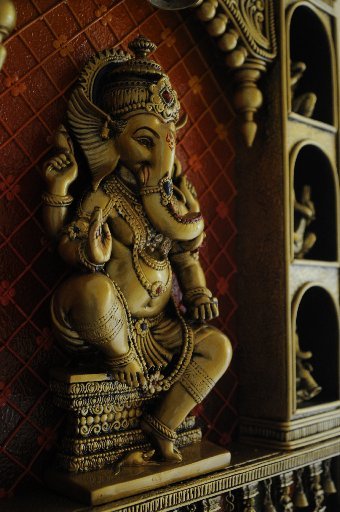
The living room and adjacent master bedroom wing also have multiple influences of the family’s Hindu religion. Most prominent among those are statues, wall hangings and other artwork of the god Ganesh.
The god with the elephant head is known as the remover of obstacles, according to Mrs. Boyington, and is a sort of personal god for her family.
Depictions of Ganesh are also evident in the Boyington’s religious area, which contains a carved rosewood, altar-like mandup in a small corridor off their bedroom.
“We do our prayers there in the morning after our baths,” she said. “That’s when we’re our most clean.”
The Indian influence also may be seen in windows, now decorative but once in a Mughal inspired building in India, which are on either side of the actual windows in the home’s dining room. One of the repurposed windows is made of mother of pearl and the other of fine camel bone.
Also in the dining room is a work of handmade beaded art depicting Indian dancers in the Hindu religion’s annual Diwali celebration.
One of the home’s few accent pieces not purchased in India, but Indian made, is a screen in the living room, Mrs. Boyington said. It was part of a store display during an Exposition of India theme at a J.C. Penney store more than 20 years ago, she said, and she and her husband were able to talk the store into selling it.
The family’s kitchen has dark orange-brown cabinets made of high-density fiber, wall tile in light and dark colors, pendant lamps in swirled glass of red and orange, and countertops of red dragon granite.
An adjacent pantry contains Indian spices and other ingredients for the exotic dishes Mrs. Boyington prepares for her family and up to 100 people when she and her husband entertain.
The couple’s most recent trip to India yielded several items that will become part of the home, she said. Hand-carved living room furniture from South India is on order, and a clay outdoor oven in the planned outdoor kitchen off the couple’s office waits to be installed.
Mrs. Boyington also purchased a number of beaded bracelets and a variety of saris, both beaded and embroidered, in a multitude of colors.
“Indian women love vibrant colors, clothes and jewelry,” she said.
Mrs. Boyington said the exotic influences in the family’s home are a carryover from her parents’ home. The Boyingtons themselves always had Indian influences in their homes, she said, but now have more room to display things in their open and expansive Enclave home.