

After an astronaut on the International Space Station boots up a laptop computer on Monday morning, he’ll take out a CD and install software developed by a UTC professor.
Meanwhile, at NASA’s Johnson Space Center near Houston, a Tennessee Valley native will have just two more space shuttle flights for which he’ll oversee the transfer process of the equipment to and from the shuttles and the International Space Station.
Dr. Jim Henry, a professor of engineering at the University of Tennessee at Chattanooga, said the Express Payload Simulator software program he developed at the request of Boeing Corp. will allow researchers on the ground to conduct experiments and collect data remotely from the space station.
“The holdup in the past has been the difficulty of doing communications according to NASA’s way of doing things,” he said. “What I have done along with Boeing people is develop this way so researchers (who) get used to doing something in their laboratories and their buildings can shift the experiment to space and continue doing what they’re doing from their computer in the lab that’s familiar to them.”
Dr. Henry was invited to be an observer at the Johnson Space Center tomorrow about 2 a.m. CDT when the program is installed and will then work with other engineers to test the program’s reliability.
“It’s very exciting,” he said. “I’ll be sitting in a room where my Boeing colleagues are talking to the astronauts.”
Jeremy Owen, an Ooltewah High School alumnus and an aerospace engineering graduate from the University of Tennessee, was hired at Johnson Space Center in 2001.
In his job, he trains astronauts in Texas on the use of equipment bound for space and frequently travels to Kennedy Space Center in Florida to work on the final check of equipment before it is loaded onto a shuttle.
On several missions, including the flight of Discovery in March, Mr. Owen was the lead specialist for equipment transfer. That flight, he said, was a large logistics resupply mission and carried some 20,000 pounds of hardware. The process of preparation began a year out, he said.
At the end of that flight, in a NASA tradition, his team was presented one of only three plaques given by flight directors and crew.
“It was a real honor for us,” he said. “It shows the level of work, the level of detail we do.”
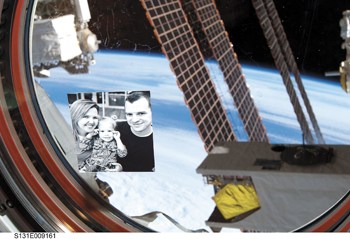
Also on the March shuttle flight, a photograph of his family was used to continue another NASA tradition among shuttle crews. Crew members are allowed to carry into orbit a family memento from their favorite trainer, and Japanese astronaut Naoko Yamazaki asked to carry something from the former Tennessee Valley resident.
So, while the ISS circled 200 miles above Earth at more than 17,000 mph, the mission’s equipment manager let a photograph of Mr. Owen with his family – his wife, Elizabeth, and 3-year-old daughter Audrey – float weightless in front of the station’s large window.
Like the plaque, he said, the honor recognizes the amount of preparation done by an individual ahead of a flight.
Mr. Owen said he has been on vacation during part of the current Atlantis flight, but his general role during shuttle flights for which he is not the lead specialist is that of overseeing transfer operations.
When shuttle flights stop at the end of the year, his direct function as trainer and transfer manager between vehicles will end, he said, but his skills are applicable to unmanned vehicles that will be involved in flights to the ISS.
Also looking ahead, Dr. Henry said that assuming things go well in this week’s software demonstration aboard the space station, the program he developed can open the door for numerous remotely monitored biology-related experiments.
“(The demonstration) is a proof-of-concept showing we can do that with something that’s not very complicated,” he said, “but to add complications to it is not a problem for the platform.”
Dr. Henry said the express payload simulator, which he developed with UTC chemical engineering student Marie-Christine Labrie and UTC information technology administrator Trevor Elliott, was tested without a hitch on an ISS simulator in Huntsville, Ala., in February.
“I have high confidence there will be no problem on Monday and next week,” he said.