
New rules that raise standards for who can lead sleep studies will go into effect this summer, making Tennessee one of the first states to take part in a movement toward greater regulation in the field.
Licensure standards absolutely are needed to ensure sleep studies are run by qualified professionals, said Dr. Vince Viscomi, a pulmonologist and immediate past president of the Chattanooga and Hamilton County Medical Society.
“We’ve had some very inappropriately trained individuals doing sleep studies,” including medical assistants who have no training in sleep medicine and people who aren’t even in the medical field, Dr. Viscomi said.
In one case, “literally a doctor’s wife was doing it,” he said. “There have been some abuses that did need to be remedied.”
Not everyone is in favor of the new requirements. Critics say some sleep techs will lose their jobs, small sleep labs will close and patients potentially will have longer wait times for the studies.
“This legislation has caused a huge blow to the practice of sleep medicine in Tennessee,” said Dr. Anuj Chandra, director of the Advanced Center for Sleep Disorders. He said he supports licensure for sleep techs but Tennessee’s new rules go too far.
“It’s going to discourage people from going into this field because it’s too burdensome,” he said.
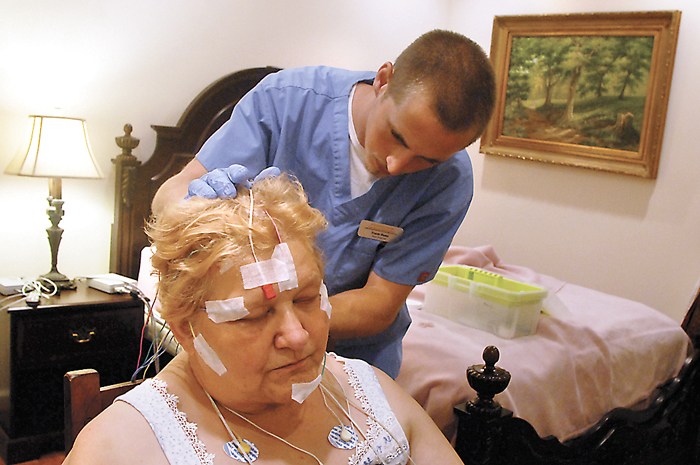
Sleep techs, or polysomnographic technologists, run nighttime sleep studies in which patients are observed while they sleep. Electrodes measure patients’ brain waves, heart rate and other vital signs to track the stages of sleep and help diagnose sleep-related disorders, such as sleep apnea.
Bruce Blehart, the American Academy of Sleep Medicine’s director of health policy and government relations, said seven states – including Tennessee – plus Washington, D.C., have passed licensure requirements for sleep techs.
Tennessee’s new rule states that after July 1, to practice as a sleep tech, a person must pass a Board of Registered Polysomnographic Technologists exam, which used to be optional. There also are additional requirements to take the test.
Previously 18 months of on-the-job training were enough, Dr. Chandra said. Now, a sleep tech must pass an accredited training program at a college or an A-STEP – Accredited Sleep Technologist Education Program – course, which includes online modules and nine months of on-the-job training. Some exceptions will be made for those with extensive experience in sleep studies.
Pam Dalton, director of the Chattanooga Sleep Center, said the licensure requirements are well-thought-out and necessary to maintain quality in the sleep medicine field. She helped craft the legislation in partnership with the Tennessee Society for Respiratory Care, which the Tennessee General Assembly passed in 2007.
“We gave a three-year period … for everybody to get boarded,” she said. “It’s a change. But it’s a change for the good, as far as benefiting the patients.”
The law also made provisions encouraging colleges to add sleep tech programs, which today are few and far between, so that the A-STEP system can be dismantled, she said.
“Ultimately, you want this (sleep tech training) to be no different than nursing. You want this to be no different than respiratory care, or medical school,” she said.
IMPACT ON THE FIELD
WHAT IS A SLEEP STUDY?During a sleep study, or polysomnogram, specialists observe a patient overnight to evaluate sleep-related disorders, such as sleep apnea and insomnia. The study records sleep patterns and vital signs to determine various sleep stages and any breathing-related problems. Using electrodes attached to the patient, specialists measure brain waves, muscle movements, eye movements, breathing and heart rate throughout the night.Source: Chattanooga Sleep Center
Cost is one drawback to the licensure requirement, said Dr. Andrew Vernon, a sleep specialist with physician-owned Specialists in Pulmonary Care and the Chattanooga Sleep Center. He said it costs $5 to $10 an hour more to employ licensed sleep techs, which could be a burden for small sleep labs like his.
“I really do think it’s a good idea that people are qualified and are licensed,” he said. “The only concern is that it will be more expensive.”
Dr. Viscomi acknowledged the change could result in some sleep techs leaving the field. Particularly in rural areas, the loss of sleep techs could result in an access problem for people seeking sleep studies, he said.
One of his qualified sleep techs recently quit rather than take the board test required for licensure, Dr. Viscomi said.
“She does very poorly on these types of standardized tests, even though she does well on sleep studies,” he said.
The change has thrown a wrench into the plans of some local sleep techs.
Recent University of Tennessee at Chattanooga graduate Joel Pollom, 24, has been working as a sleep tech at the Advanced Center for Sleep Disorders for about a year, intending to take the board exam after 18 months of on-the-job training. He is planning to go to medical school next year.
But now that a costly training course is required before he can take the board exam, Mr. Pollom said he’s skipping it.
“This is just Tennessee passing a law saying I have to spend $3,000 to go to an eight-day class when I know all this stuff already. I can’t afford all the applications for medical school and traveling for interviews” plus the class, he said.
Click here to vote in our daily poll: Should techs in sleep labs be licensed?