
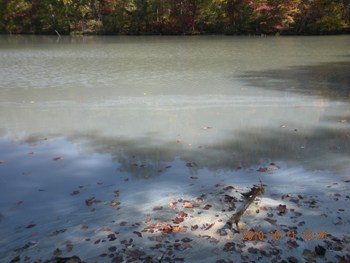
One of four lakes at South Cumberland State Park’s Grundy Lakes has turned milky white and prompted an environmental investigation over the past several days.
Though residents and rangers said they’ve never seen anything like it, Dick Urban, head of the water pollution division of the Tennessee Department of Environment and Conservation’s Chattanooga field office, said samples and testing indicate that weather, not people, may be the culprit.
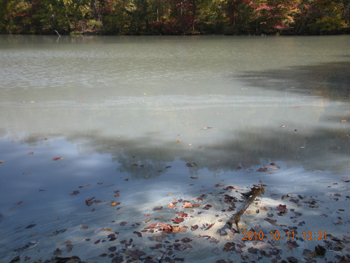 Contributed Photo
Grundy Lake has a milky look at South Cumberland State Park. The park has four lakes, but only one so far has been affected.
He called it a “lake turnover” with an added bloom of a type of blue-green algae he’s never seen before.
“We initially thought maybe somebody had dumped something in the lake, and we looked for depressions, wheel or tire marks all around the lake,” he said. “But there were no signs whatsoever that there was any man-induced intrusion.
Samples and testing found no foreign pollutant, he added.
Lake turnover is a process in which water at the surface of the lake cools rapidly and sinks, causing the “cold” water at the bottom to rise. That, in turn, causes algae to bloom and die quickly.
South Cumberland State Park Superintendent John Christof said the Cumberland Plateau has recently had days with wild fluctuations in temperature.
“Some weeks ago, we had one good frost, then we had a warm-up. And lately we’ve had a 40-degree difference in morning and afternoon temperatures. Usually there’s only a 20-degree difference,” he said.
That temperature change was key to the phenomenon, Urban said. But there was no fish kill because intense summer heat wasn’t present to help deplete the water of oxygen. Urban said TDEC plans no lake treatment to nudge a natural recovery.
“A nice rain event would speed it up,” he said.
Christof said the lakes are man-made – a product of the South Cumberland coke ovens industry that operated there in the early 1800s.
“It’s been fascinating really,” Christof said of watching the lake turnover. “I guess it’s a once-in-a-lifetime observation.”