
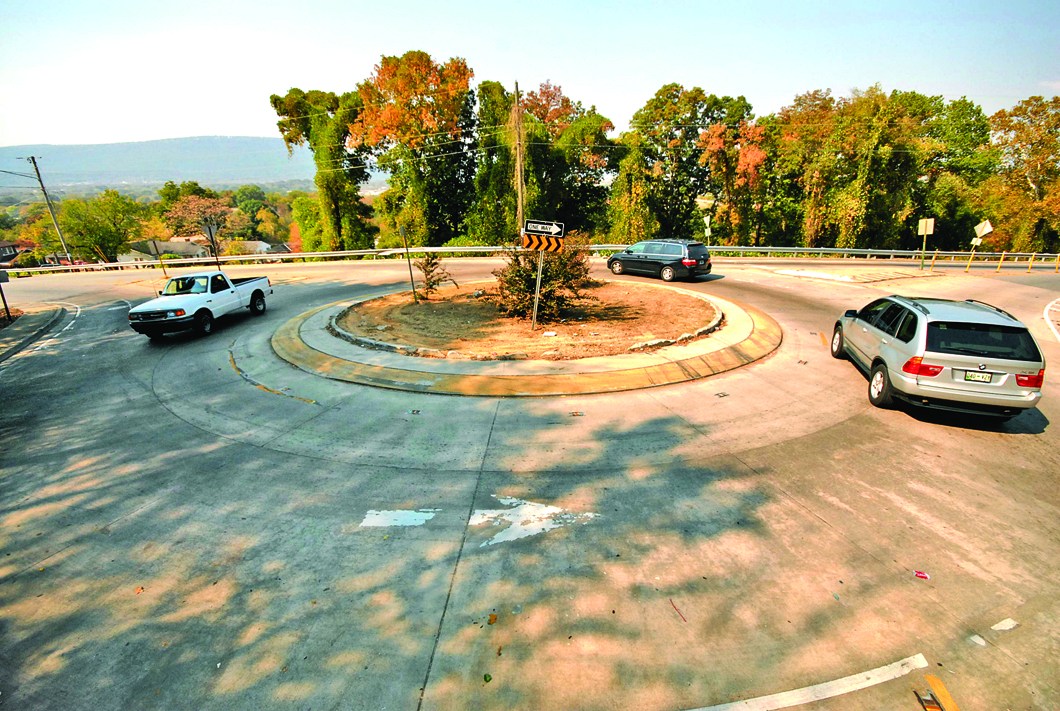
Chattanooga traffic engineers have installed more than a dozen roundabouts over the last decade, and now Georgia is headed down the same road.
Two roundabouts are set for installation in Whitfeld County, Ga., next year, though not because county leaders want the traffic management devices that long have been popular in Europe.
Instead, Georgia’s Department of Transportation is pushing the circular intersections as a replacement for conventional traffic lights. Traffic in a roundabout is not regulated by a signal. Instead motorists yield on entry, then exit the circle, a process that — technically — is supposed to keep traffic flowing smoothly.
“Georgia DOT’s roundabout policy states that roundabouts shall be considered as an alternative for all new intersections and those that are being reconstructed, including those where a traffic signal is being proposed,” DOT spokesman Mohamed Arafa said. “This is especially true for intersections that have been identified as needing major safety or operational improvements.”
Georgia has for years encouraged governments to look at roundabouts, Arafa said, but in March 2009 the state formally changed its policy essentially to require traffic planners to prove that a traffic circle wouldn’t work before they can install lights.
The idea didn’t sit well with Whitfield County commissioners, who reluctantly agreed to have the circles installed at the intersection of Dug Gap Mountain Road, Walnut Avenue and College Drive as well as the intersections of South Spring Street and Prater Mill Road near Varnell, Ga.
“I’m still concerned about the installation of a roundabout, just from a safety standpoint,” Commissioner Randy Waskul said at a recent County Commission meeting. “Can’t we just install a stop light? … Wouldn’t that be a whole lot easier?”
But on roads with fewer than 40,000 vehicles a day, roundabouts are seen by state officials as a better option than stoplights. They say the intersections reduce congestion, result in fewer and lower-speed crashes and are cheaper to maintain over the long haul.
Georgia won’t force a roundabout if there are questions about its safety, Arafa said. The state will evaluate line of sight, how much land is available and traffic counts during peak times before building a traffic circle, he said.
“Analysis and its reporting have to be meticulously done,” he said. “This is because a traffic control mechanism, be it a traffic signal, stop sign, a roundabout … is all about safety.”
Making a comeback
Roundabouts have been widely used in Europe for decades, but largely were abandoned in the United States after the 1950s. In recent years, though, roundabouts have seen a resurgence.
Traffic planners say roundabouts often cost more to install, because they may require the purchase of more right-of-way property, said John Van Winkle, Chattanooga’s traffic engineer.
But in some instances roundabouts can be cheaper. This is particularly true on new installations in relatively undeveloped areas, because buying the land from the outset is cheaper than going back later and buying developed land, he said.
TRAFFIC CIRCLES PROS* Traffic doesn’t congest* Fewer high-speed, right-angle crashes* Cheaper maintenance costs* More visually appealingCONS* Motorists are scared of them* There may be more accidents initially* Not suitable in areas with high traffic counts* Can lock up if traffic counts are high* More expensive installation costsSource: Prisme Engineering
Engineers declined to offer an estimated cost of installing a traffic signal, saying there are too many case-by-case variables.
But Van Winkle noted that the roundabout on Standifer Gap Road cost $300,000, while a signal would have required widening the road and resulted in a far higher price.
Van Winkle said he has been a fan of roundabouts for about a decade. Drivers’ worries — How do they work? How do I get in and out of them? — are normal at first, he said, but once motorists understand roundabouts they warm up to them, he said.
The city has installed 14 of the circles since 2001, he said.
“I’ve considered encouraging the administration to change the policy similar to Georgia’s here,” Van Winkle said. “If a roundabout is feasible, it is effective and efficient.”
At four major Chattanooga roundabouts — near the Bachman Tubes on Westside Drive, on Mountain Creek Road at the W Road and on Lake Resort Drive and North Access Road near the Chickamauga Dam — drive times are reduced and so are dangerous right-angle crashes, also known as T-bones, that occur at regular four-way intersections, he said.
At roundabouts, traffic doesn’t come to a complete stop like it does at a traffic light.
“It’s in constant motion,” Van Winkle said. “It’s like a ballet, and drivers just find their way in and keep going.”
If a motorist misjudges when to get into the circle and a crash occurs, it’s not likely to be as serious because the circle slows drivers, he said.
“If you go into the circle at 25 mph, you feel like you’re going up on two wheels,” he said. “Sure, there are accidents, but there are accidents at traffic lights, too. But in a roundabout they are rear-end collisions or side swipes, which aren’t typically as serious.”
Michael Pierce, who commutes on Northside Drive near the Bachman Tubes every day, thought the roundabout there was an awful idea at first, but now he likes it.
“Before, there was a long wait time, but I just imagined the roundabouts being crowded and dangerous and me having to find a different route to and from work,” said Pierce, who lives in Rossville. “But I think from about the first week on, it’s really done a lot to help.”
There are some people who never warm to the idea of a roundabout, Van Winkle said. But he said he has heard from a number of converts who now think the roundabouts make sense after originally being opposed to the idea.
Click here to vote in our daily poll: Are roundabouts easier to navigate than traffic lights?