

Signal Mountain resident Ryan Welch comes from four generations of farmers working the land just over the Sequatchie County line, where he and wife Brittany Welch now grow mushrooms at Waldens Peak Farm.
Whereas his ancestors farmed for necessity and ate everything they grew, Ryan and Brittany Welch share the fruits of their labor at the Chattanooga Market each week as well as sell their mushrooms to local restaurants including Public House, Table 2 and Niko’s.
“We can’t keep up with demand right now,” said Ryan Welch, who owes his very existence to his family’s presence in the farm’s immediate area, as his maternal grandmother lives next door to Waldens Peak and his paternal great-grandparents live across the street, which is how his parents met.
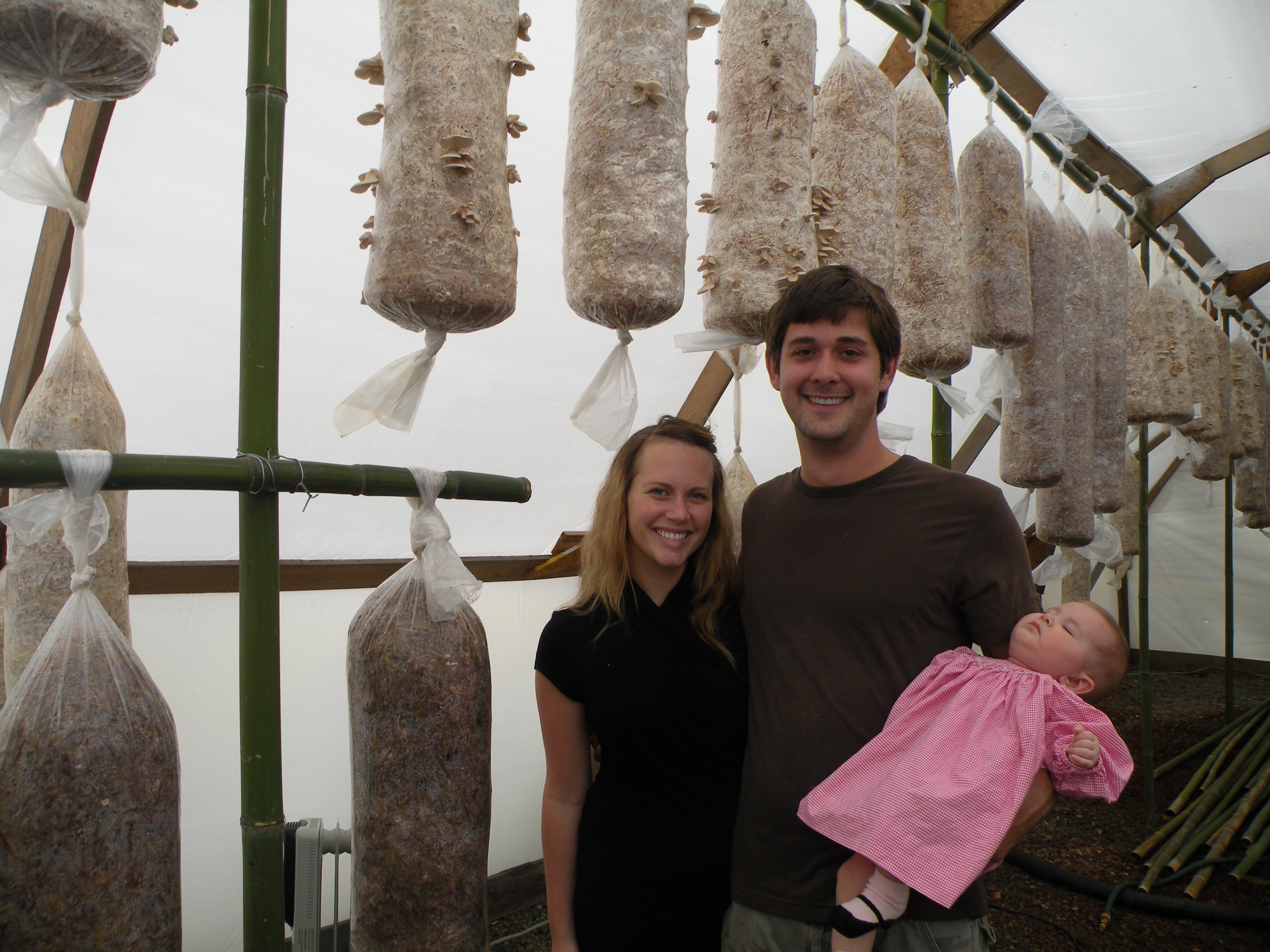 Waldens Peak Farm owners Brittany and Ryan Welch, with baby Eloise, show off their newly flushing Pearl Oyster mushrooms growing on artificial blocks, which are hung from bamboo they acquired from a friend in North Chattanooga.
The Welchs now live just inside the Hamilton County line a few houses down from his great-grandparents’ former home, where his parents now live.
He said they will be selling mainly Pearl Oyster mushrooms until the new year, when they will begin offering shiitakes, which need a more sterile environment to grow.
“Oyster mushrooms are really flexible and do fine if they don’t freeze,” said Welch. “You also don’t have to compete with the big companies because they’re really delicate and don’t ship well.”
He said he learned the process from reading books on mushroom cultivation and by learning from others doing the same thing.
Welch said he cultivates his own mycelium (live mushroom culture, or “spawn”) in a sterile lab using original cultures purchased at Knoxville lab Spore Works to inoculate half-gallon jars filled with local wheat grain from Sonrisa, which is sterilized in 55-gallon barrels using a steam generator to kill any competition for the mushroom cultures.
Each “first-generation” jar is used to inoculate 10 more jars, and the contents of the second-generation jars are spread out over wheat straw which he has chopped, soaked and steamed to achieve pasteurization.
The Pearl Oyster mushrooms are grown from an artificial column made by putting the wheat grain and straw into a bag, creating a sort of artificial log for the mushrooms to grow on, which occurs after holes are poked in the bags two weeks later.
The bags are put into a controlled environment kept at 75 to 100 percent humidity and begin to fruit within 10 days, with a second fruiting 32 days after inoculation, which occurs four times per bag.
He said a bag containing 10 pounds of straw yields around 10 pounds of mushrooms or more.
While Welch said he would like to grow the mushrooms naturally on hard wood, the artificial blocks he is using now allow him to harvest mushrooms year-round and are less bulky to move.
Almost everything used during the growing process has been re-purposed, such as the hospital sterilizer used to pasteurize the straw, the oak sawdust from a shovel factory nearby used as a fruiting substrate for shiitakes, and bamboo from North Chattanooga used to hang the artificial blocks.
Brittany Welch, a former Asheville, N.C., resident, said her main job at the moment is selling the mushrooms to restaurants and customers at the Chattanooga Market, as well as caring for 4-month-old baby Eloise.
Their next project is to grow fish, such as tilapia, along with vegetables in an 8,000-gallon water tank using an aquaponic system.